Blackouts at Dawn: How a Night of Drone Strikes Left Towns in the North Shivering and Silent
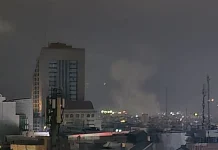
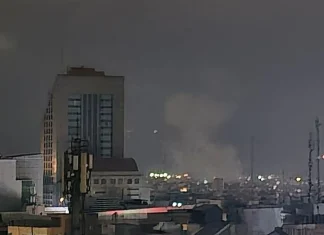
When the lights went out in Chernihiv in the pale hours before sunrise, the city did not simply lose illumination — it lost a thread of ordinary life. Stoves cooled, elevators stalled between floors, hospital corridors reverted to torchlight and the hum of freezers went quiet. For many, the silence was the loudest thing of all.
“We were woken by the boom and then everything went dark,” said Olena Ivanova, a nurse who lives near the city centre. “I packed my children’s chargers into a bag and sat with neighbors in the yard. You could see the stars again, but it didn’t feel like freedom.”
Numbers that Tell a Nighttime Story
Regional energy utility Chernihivoblenergo reported that two separate Russian strikes damaged energy facilities across the Chernihiv region, cutting power to roughly 212,000 consumers. Nearly 150,000 of those were in Chernihiv city and its immediate district; a further 62,000 were left in the dark after damage in the Nizhynskyi district, the company said.
This blackout followed an earlier strike that had already left large parts of the region without power on Saturday, compounding hardship for residents who had been patching together warmth and heat for weeks.
The scale of the attack
Ukraine’s air force put the night’s tally into stark relief: 147 drones were launched over the country, 121 of them intercepted or neutralised before they could find their targets.
“The number is not only large, but indicative of a tactical shift,” said Maksym Hrytsenko, a Kyiv-based security analyst. “Swarms of drones are cheaper and, when coordinated, harder to stop. Overnight figures like this show Russia’s ongoing focus on degrading energy and critical infrastructure.”
Beyond Chernihiv: Slavutych, Odesa and Belgorod
The ripple effects were not confined to one city. About 21,000 residents of Slavutych — the unusual, pastel-painted town built for Chernobyl workers and tucked into the neighbouring Kyiv region — briefly lost electricity after a morning attack, regional authorities reported. Critical infrastructure there was switched to backup power supplies to keep essential services running.
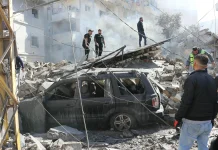
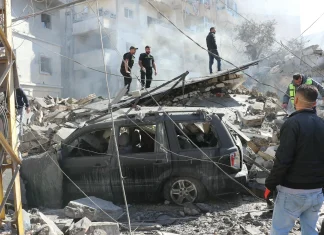
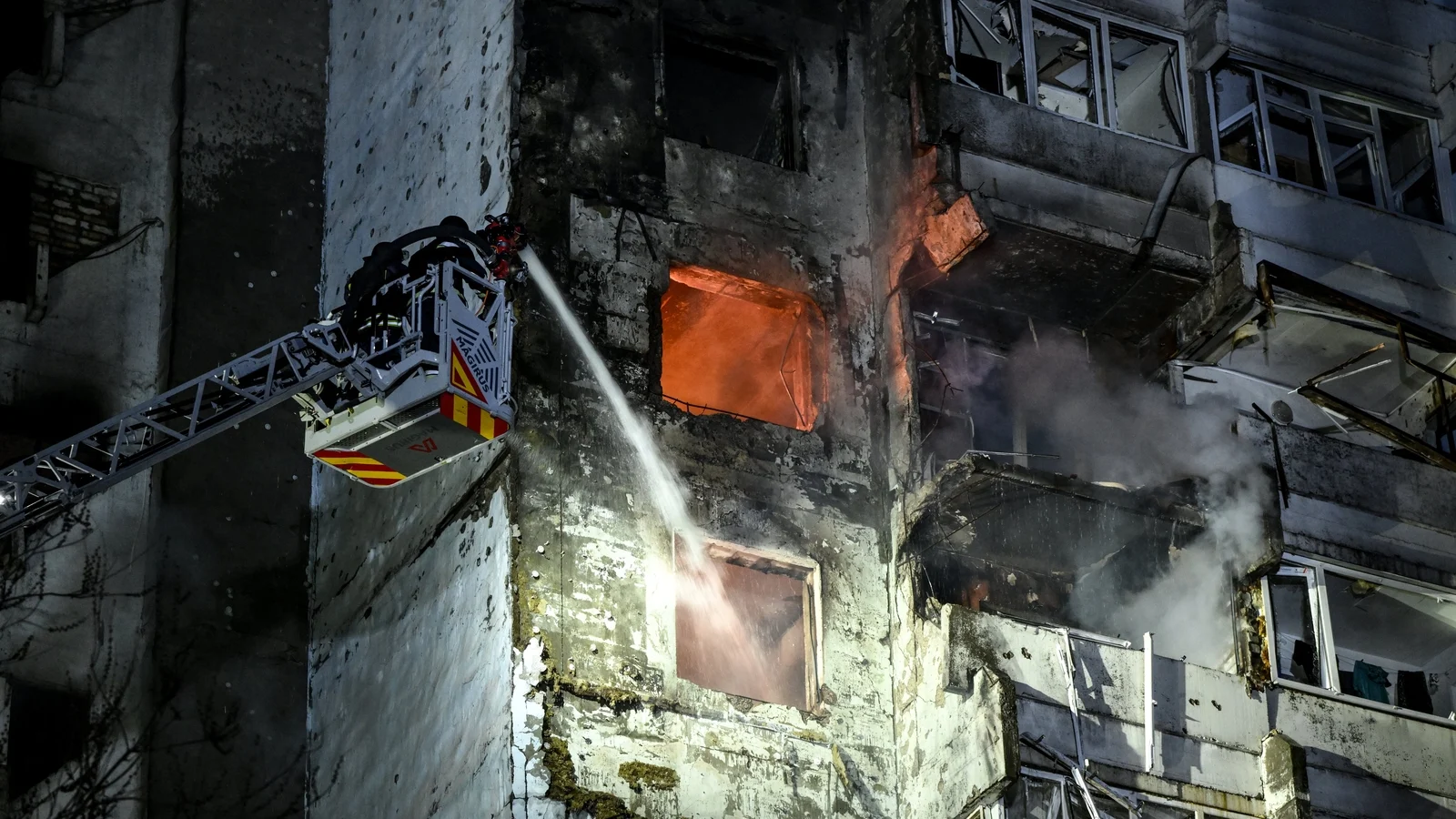
In the south, Odesa’s emergency services reported a Russian strike that killed one person and wounded another, damaging a private house, igniting a fire and scarring six nearby buildings. Firefighters posted images of charred facades and a partially destroyed building — the kind of intimate damage that becomes an indelible memory for those who live under it.
And across the border, in Russia’s Belgorod region, the head of the region, Governor Vyacheslav Gladkov, said Ukrainian strikes left almost half a million people without electricity — roughly 450,000 residents across multiple districts, including the regional capital. Heating and water supplies were also disrupted, and night-time temperatures were expected to hover around zero degrees Celsius, he added.
“Repair works have already started,” Gladkov said, “but it will take several days to complete.” Belgorod sits just 40 kilometres from the Ukrainian border and has repeatedly been on the receiving end of cross-border strikes and drone incursions.
Energy as a Target: The New Frontline
There is a grim logic to these attacks. Energy systems are the circulatory system of modern life: once they falter, so do hospitals, schools, factories and kitchens. Russia has methodically targeted Ukrainian energy facilities throughout the war, producing long, disruptive blackouts that shape people’s days and planning. Ukraine, too, has focused fire on Russia’s energy network, striking refineries, fuel depots and transport hubs — a tit-for-tat that turns power grids and pipelines into strategic weapons.
“This isn’t collateral damage, it’s deliberate disruption,” said Dr. Anna Lysenko, an energy security expert at a Kyiv institute. “When you attack electricity infrastructure, you attack the capacity of a society to carry on. That has immediate humanitarian consequences and long-term economic ones.”
On the ground: small acts, large endurance
In Chernihiv, residents improvised. Shopkeepers lit candles behind plastic shields and sold hot bread from gas-fired ovens. A schoolteacher brought extra blankets to neighbors who lived alone. A taxi driver ferried seniors to a municipal warming point.
“You learn to live in parts,” said Serhii Kovalenko, who runs a small bakery. “We keep batteries charged when power comes back for a few hours so that when the next blackout hits, we can run the tills. We heat water on a single gas burner and play cards at night.”
What this means for civilians — and for the world
These nightly episodes of warfare are not isolated incidents; they are part of a larger arc in which vulnerabilities in critical infrastructure are exploited to gain strategic leverage. The consequences are global: disruptions in Ukraine ripple through food supply chains, energy markets and geopolitical alliances. Europe watches closely because the tactics used here could be exported — and because winter temperatures and interdependence mean that outages can cross borders in price and policy.
Is the world prepared for the next scale-up? Are power grids hardened enough, and are communities supported with redundancy plans? These are questions not just for Ukraine or Russia, but for any state whose citizens rely on fragile, centralized systems.
Small lights in the dark
As crews work to repair transformers and patch damaged lines — a slow, dangerous business in a war zone — people in northern Ukraine keep tending to the small lights. Volunteers hand out soup at intersections. A barber opened his shop to charge phones. In Slavutych, a muralist painted a strip of sky on a blackout wall, an act of defiance that said: we will still mark the horizon.
“We don’t want pity,” said Olena. “We want to be seen. We want people to understand what living under these attacks feels like. It’s every night — you fall asleep listening for the drone hum and wake up hoping the heaters are still on.”
Key figures from the recent attacks
- 212,000 consumers in Chernihiv region left without power after strikes on two energy facilities
- 147 drones launched overnight; 121 intercepted or neutralised, according to Ukraine’s air force
- 21,000 residents of Slavutych experienced temporary outages
- 1 person killed and 1 wounded in an Odesa strike; six buildings damaged
- Approximately 450,000 people in Russia’s Belgorod region affected by power outages
In the end, this is a story about resilience and rupture. It is about the humbling reality that everyday comforts — light, heat, the ability to charge a phone — are both fragile and vital. And it asks us, as readers and citizens of an interconnected world: how will we respond when the targets of modern warfare are the systems that keep life running?
Tonight, somewhere in Chernihiv, a child will watch their breath fog in a living room as a parent tells a story by a single lamp. Small acts of care are being stacked against strategic blows. For now, they hold.