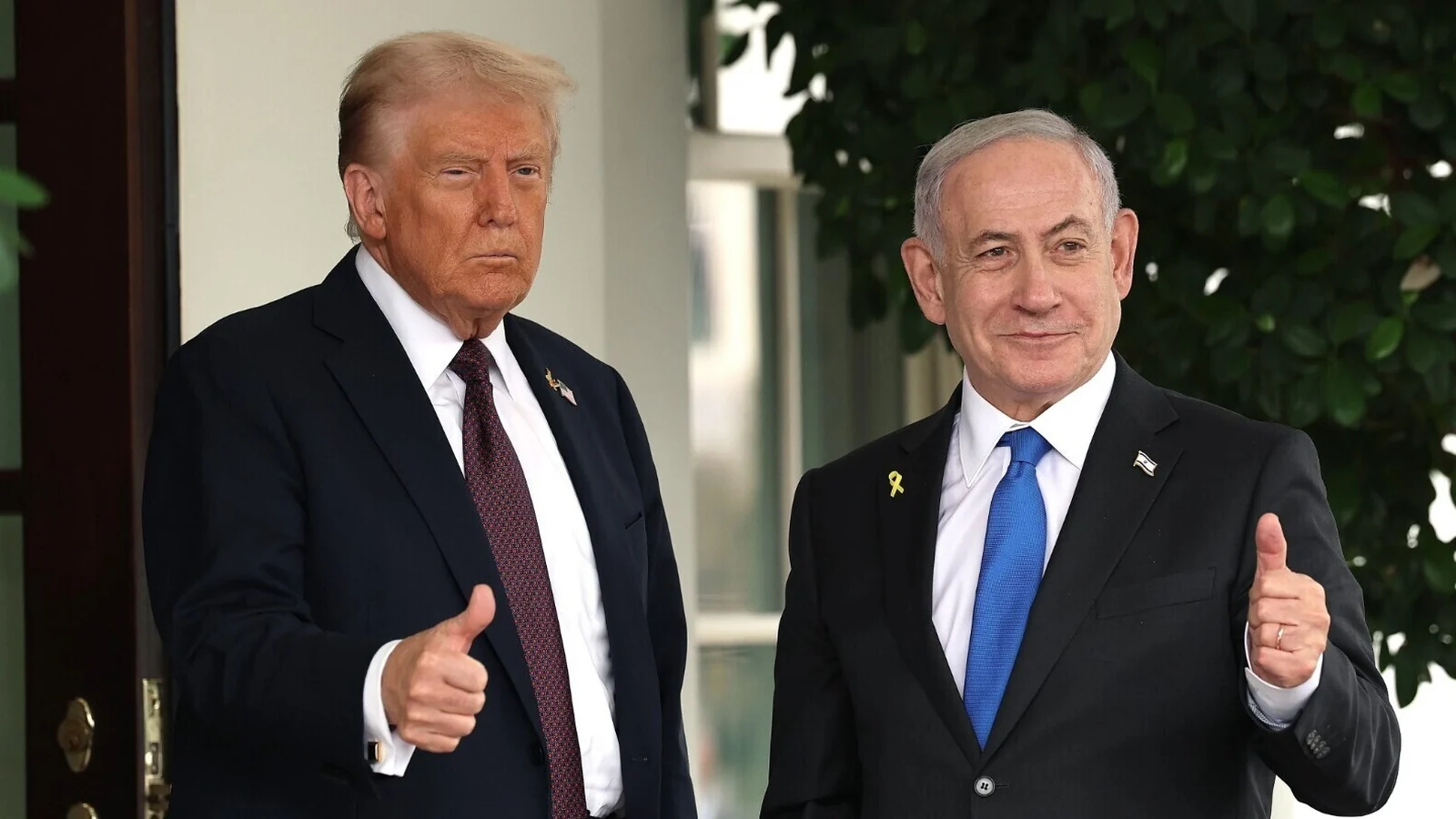
In a striking election-day declaration, US President Donald Trump said he had struck an agreement with Israeli Prime Minister Benjamin Netanyahu to end Washington’s annual funding to Israel after this year — while continuing to sell weapons to the longstanding US ally.
Trump unveiled the claim as Americans headed to the polls for midterm elections, framing the move as an attempt to strip Democrats of what he called a “bad talking point” that he said the left has used to attack Republicans over military support for Israel.
He offered no specifics on how such a cutoff would be carried out at year’s end, particularly because the existing memorandum of understanding governing US military assistance to Israel — which provides $3.8 billion each year — runs through September 2028.
Even so, Trump’s remarks underscored how assistance to Israel, once a cornerstone of bipartisan agreement in Washington, has increasingly become politically fraught. Analysts suggested the timing of his announcement — on election day — pointed to a tactical play aimed at domestic voters.
Talks have already been under way about what US support for Israel could look like beyond 2028, and Netanyahu has previously said he expects American aid to diminish gradually over time.
Israeli Prime Minister Benjamin Netanyahu addressing a joint meeting of Congress in 2024
But Trump’s comments indicated he viewed the decision as settled, a notable potential change in the US-Israel relationship even as the two countries remain locked in confrontation with Iran more than eight months after their joint attack.
Speaking to Fox News, Trump argued that Israel no longer requires the funding and said Democrats and left-wing politicians have used US financial support for Israel as a political weapon against Republicans.
Public opinion surveys show overall US support for Israel has dropped, largely in the wake of the war in Gaza.
“Now, as far as paying Israel, Bibi Netanyahu and I have made a deal that we give Israel $4 billion a year, and we made a deal months ago that we’re stopping,” Mr Trump said.
“We’ve already agreed that by the end of this year we won’t be paying Israel. Now we’ll help Israel if they need it,” he added.
Israel’s political outlook remains unsettled following a 27 October election in which Netanyahu — closely aligned with US Republicans — lost his governing majority while still preventing his opponents from quickly forcing him from office.
The outcome set the stage for what are expected to be lengthy negotiations to form a new government.
Reuters said neither the White House nor Netanyahu’s office responded to requests for comment.
Gadi Eisenkot, who leads a rival bloc seeking to remove Netanyahu, reacted on X by criticising how the news emerged. “The fact that the security establishment, along with Israeli citizens, is learning about a change in the strategic relationship framework through the media highlights just how much Benjamin Netanyahu’s conduct poses a genuine danger. We can no longer rely on him and must replace him,” he wrote.
Criticism of Israel
Support for Israel among Americans — especially Democrats — has fallen since Israel’s campaign in Gaza following a deadly Hamas-led cross-border attack in October 2023.
A Quinnipiac University poll in June found 48% of voters and 66% of Democrats believe the US is too supportive of Israel, up from 16% and 20%, respectively, when the question was first asked in 2017.
Polling and analysis also suggested Democrats were poised to take control of the House of Representatives from Trump’s Republicans, while the battle for the Senate remained unresolved.
Over the past year, several candidates critical of Israel prevailed in Democratic primaries, and even lawmakers considered moderate have shown greater readiness to challenge the traditional posture of strong US backing.
One high-profile contest is unfolding in a battleground state: Democratic candidate Abdul El-Sayed is running for a Michigan Senate seat.
If elected, El-Sayed would become the first Muslim to serve as a US senator, and he has argued against unconditional military aid to Israel.
Trump said the left had used the US funding as a “signal of unfairness” and that he wanted to remove what he described as an easy target.
Democratic candidate Abdul El-Sayed would become the first Muslim senator if he wins
He cited Mr El-Sayed by name when laying out his reasoning for ending the payments.
“Because they (Israel) don’t need it, and because why should we suffer the slings from lunatics like an El-Sayed when they don’t need it? It’s a bad talking point,” Mr Trump said.
Criticism has also intensified within parts of Trump’s own political coalition, with some supporters accusing Israel of misleading the president into thinking Iran could be defeated easily.
Surveys show most Americans oppose the war, and pollsters have linked it to higher US fuel prices and weaker approval ratings for Trump.
“The curious issue is timing,” said Jon Alterman of the Center for Strategic and International Studies think tank in Washington.
“Why did President Trump announce it on election day? And why did he announce it amidst speculation that a major joint US-Israeli military strike against Iran may be days away?”
While some US backers of Israel urged Trump to reconsider and instead reduce the funding gradually, US Representative Ro Khanna, a progressive Democrat from California, said on X that “Zero aid Israel” would be part of his party’s agenda if it wins congressional control.
Republican US Representative Don Bacon told CNN: “What I really had heartburn about is the Israelis didn’t know about it.”
Congress passed a law in 2020 authorising the funding for Israel, though annual appropriations bills in both the Senate and House are still required each year to distribute and release the money.
Netanyahu, speaking to an Israeli television channel in October, suggested Israelis should prepare for a future with less US support. “If you think we’re going to continue receiving what I secured twice, and that’s tens of billions of dollars in American aid for the defence budget, prepare yourselves and get used to the fact that it won’t happen because America has changed,” he said.
With the possibility of reduced US financial backing in mind, the US House passed a provision in a defence bill this summer aimed at expanding US-Israeli military technology cooperation.
The measure in the “2027 National Defence Authorization Act”, known as Section 219, would create far deeper defence cooperation between the two nations.
Dozens of NGOs have criticised the proposal as “exceptionally dangerous” and urged US politicians to drop it.