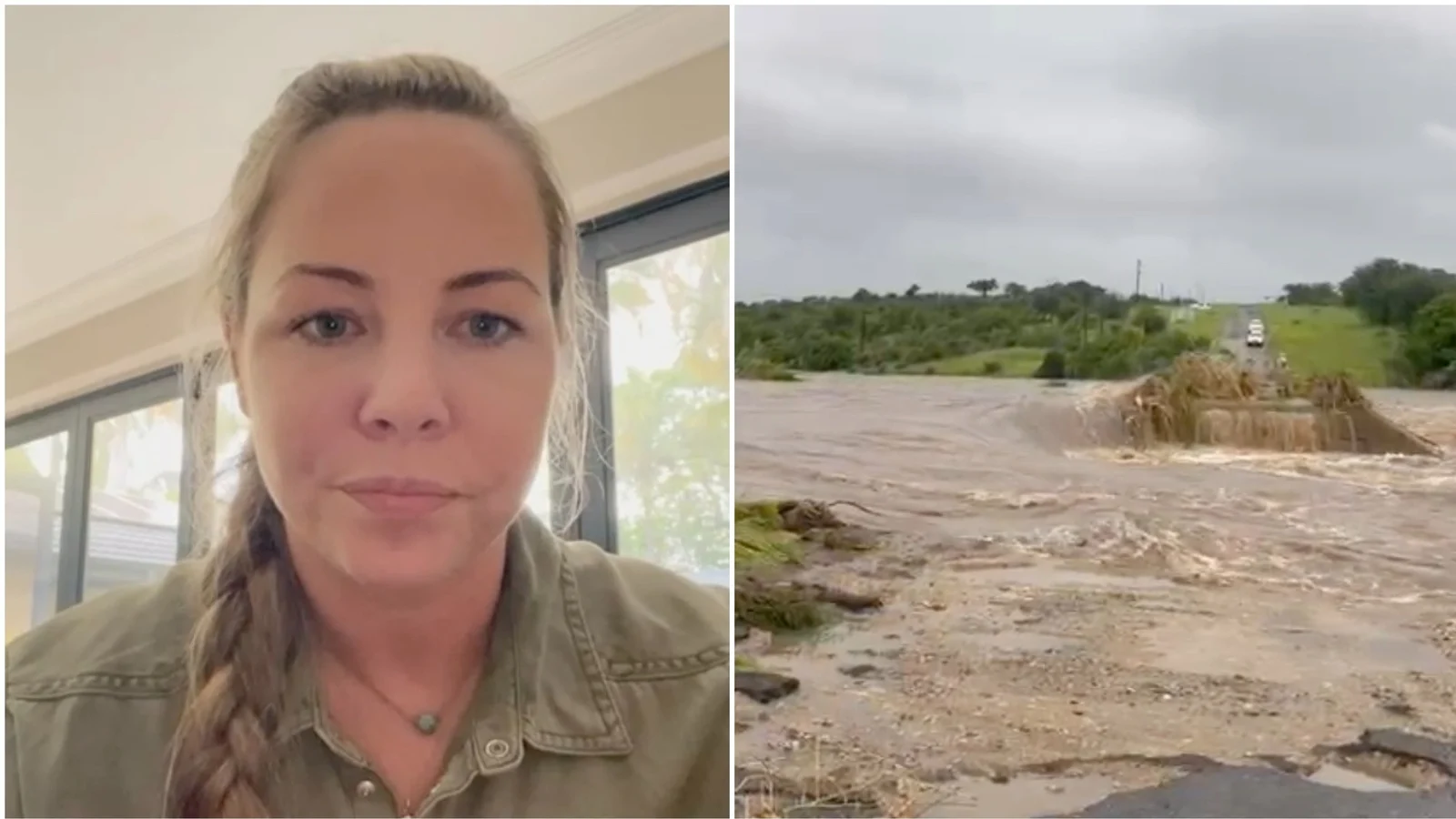
Night of the River: A Rescue from the Wilds of Kruger
The rain came like a story someone had been telling for years—one that finally decided to spill itself across the land. It was black and steady, the kind of downpour that makes the air heavy and the world shrink to the sound of water on tin.
Kim McNaughton had been learning the rhythms of the bush for months. She was a trainee field guide at a small safari lodge on the Olifants River, near Phalaborwa in South Africa’s Limpopo province—an edge-of-the-world place where hippos bellow at dusk, elephants wander across red dust tracks, and lions’ roars roll like distant thunder through the night.
“We thought it would be another storm,” Kim told me over the phone, her voice still carrying the rawness of someone who’d slept in the open and been hauled out by a helicopter. “By Wednesday night, the river was a wall. We could hear furniture banging inside the lodge. Someone knocked on my door and just said, ‘We have to go—now.’”
When Rivers Become Walls
Across Limpopo, several rivers that normally thread through savanna and mopane woodland swelled and broke their banks. The Olifants, a major tributary of the Limpopo River that traverses the Kruger National Park, rose with astonishing speed, turning roads into rivers and low-lying camps into islands.
Initial escape plans—walking out, driving a jeep—fell apart. A nearby bridge was gone in the night, torn away by the current. Vehicles bogged in mud that felt like concrete. The group of 18 at Kim’s lodge had only what they wore. Survival choices were raw and immediate: the only sensible option was uphill.
“Survival mode just kicked in,” Kim said. “We scrambled up a hill behind the lodge in the dark, rain in our faces. All we could think about was higher ground—and what might be up there. In Kruger, higher ground can mean lions or elephants. Tonight it just meant a place to wait.”
Between Wild and Rescue
Imagine climbing a hill with the rhythm of hippos echoing through waterlogged plains below, with the sky flashing every so often with distant lightning, the smell of wet earth heavy and metallic. The group huddled, three hours became two hours became a long, cold, anxious wait. Then a silhouette appeared—rotors humming in the black—and a South African Air Force helicopter began lifting people out, three at a time.
“They came like angels,” said one of the staff, a lodge manager who asked to remain unnamed. “You don’t know the feeling until you’re sitting on that slope with water five metres below and you see lights swinging. The pilot kept saying, ‘Keep calm, we’ll get you.’”
They were flown to safety, shaken but alive. Kim’s relief was immediate and complicated. “I’m so grateful we got out,” she said. “And then you look at the pictures, at the treetops sticking out of water, hippos swimming where land used to be, and you think—how many didn’t make it?”
Counting Losses and Looking Ahead
The floods’ toll in Limpopo has been severe. At least 19 people have been reported dead, and many more displaced as homes, roads and livelihoods were washed away. Across the region—Mozambique and Zimbabwe included—torrential rains have left thousands of homes damaged and tens of thousands of people facing evacuation.
Reuters’ video footage from the region showed entire river valleys submerged, only treetops visible above the brown, fast-flowing water. Hippos, bewildered and driven into odd places by the floodwaters, were seen bobbing between drowned trees.
“We’re watching a pattern repeat itself,” said Dr. Amina Khatri, a climate scientist who researches extreme precipitation in southern Africa. “Heavy rainfall events are becoming more frequent and intense as the planet warms. The physics are simple: warmer air holds more moisture—about 7% more per degree Celsius—and when that moisture falls, it falls in torrents.”
Climate models, including the IPCC’s assessments, predict that with ongoing warming many regions will see more extreme rainfall and flood events. For the communities living on river plains and for reserves like Kruger, the implications are immediate—ecosystems stressed, infrastructure vulnerable, tourism economies interrupted.
Lodges, Guides, and Local Economies
A safari lodge is more than a business; it’s a nexus where conservation, tourism, and local livelihoods meet. Guides-in-training like Kim are the next generation of custodians of the bush, relying on predictable seasons and safe access to trails. When infrastructure fails—roads, bridges, power lines—so do livelihoods.
“Most of our staff are local,” said the lodge manager. “When the lodge is closed or damaged, it’s not just about repair costs. Families go hungry. School fees get delayed. You feel the ripple.”
Tourism is a major economic engine in the region. Kruger National Park itself covers roughly 19,485 square kilometres, drawing millions of visitors over the years and supporting a complex web of hospitality, guiding, transport, and conservation jobs.
Stories from the Edge
I spoke briefly with an older villager in a small settlement outside Phalaborwa who had lost his maize field to the floods. He spoke in a mix of Xitsonga and English, pausing between words to find the right phrase.
“We wake up to the new rains,” he said. “We have prayed for rain for a good harvest. But this—this takes houses, it takes crops. It takes time.”
That tension—the blessing and the curse of water—runs through many lives here. The same rains that sustain the bush and fill the rivers also have the potential to overwhelm fragile infrastructure and erode decades of quiet preparation.
What Comes Next?
Rescue operations continue in affected areas. The South African Air Force and local emergency teams have been praised for swift action, but logistics are complex when roads are gone and communication networks shaky. Rebuilding will mean both immediate relief—shelter, food, medical care—and longer-term investment in resilient infrastructure.
Experts urge that adaptation measures be implemented alongside traditional humanitarian responses. That means better flood mapping, reinforced bridges, elevated camps, and disaster planning that includes the realities of a warming climate.
- Short-term needs: shelter, clean water, medical aid, psychosocial support.
- Medium-term: repair of roads and bridges, restoration of utilities, support for livelihoods.
- Long-term: climate-resilient infrastructure, better early-warning systems, community-based adaptation.
“This is not just about weather,” Dr. Khatri urged. “It’s about the way we build our communities and manage our landscapes. We have to move from reaction to resilience.”
What Do We Take Away?
There are images that will stay with Kim: the feel of cold rain on her face, the unexpected hush after the helicopter left, the sight of hippos in floodwater behaving like castaways. There are also numbers and maps and policy memos. But there is something else—as a global audience, we can’t ignore the human texture of events like this.
How do we balance the need for development with protecting people and places? How do we preserve wild landscapes that are also homes and livelihoods? And as a traveler, a policymaker, or a neighbor, what responsibility do we bear when storms once considered rare arrive more often?
“I’m grateful to be alive,” Kim said. “But I can’t help thinking about those who weren’t. I can’t help thinking about the animals, the people, the guides whose work is now uncertain. We need to learn—and fast.”
When the sun finally came out days later, the landscape looked fresh and stunned, as if blinked awake. It will take longer for the wounds to heal. For now, those who were rescued carry with them the memory of a night when the river rose and the hill saved them; and a wider region carries the knowledge that the age of sudden, devastating floods is no longer a forecast—it’s real, and it’s here.