Midnight at the Washington Hilton: A Selfie, a Shot, and a Country on Edge
The noise at the Washington Hilton on that late spring evening was the kind of polite hum you expect at a political gala — clinking glasses, the rustle of cocktail dresses, laughter threaded with small talk. A ballroom downstairs hosted a media dinner attended by former president Donald Trump and other senior figures. Upstairs, behind a closed door on one of the hotel’s quiet corridors, a man dressed in black took a photograph of himself in the mirror.
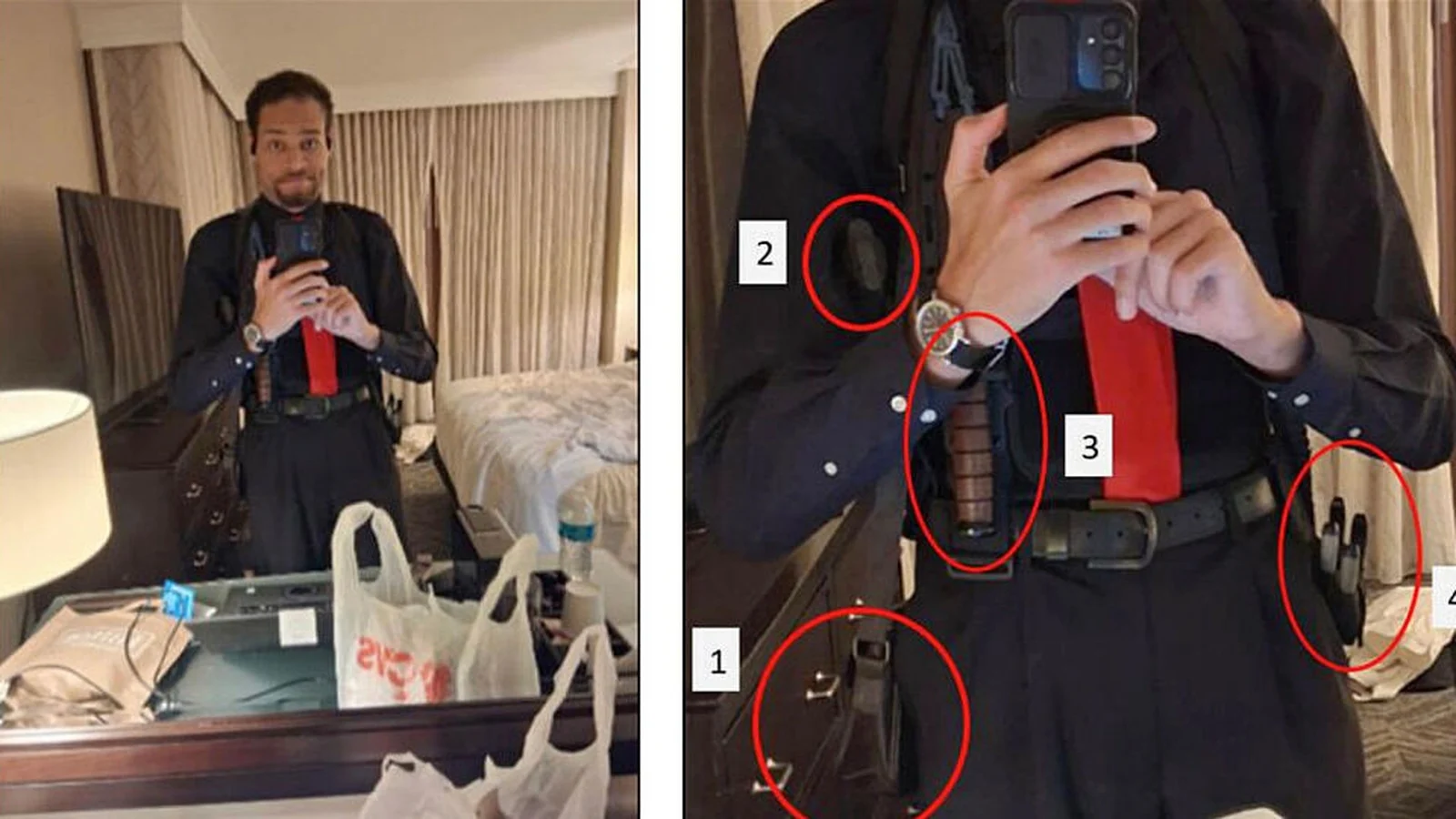
That image — a cellphone selfie of a 31-year-old identified by prosecutors as Cole Allen, in a dark shirt, red tie, with a shoulder holster and a knife visible at his side — would become one of the most chilling details in the federal court filings that followed. In the minutes after that photo, according to investigators, he descended from his room, burst through a line of hotel security and fired a pump-action shotgun toward the staircase leading down to the ballroom. Chaos erupted. Shots were exchanged. No one was killed.
A surreal sequence of events
The moment feels cinematic and yet utterly real. One hotel staffer who asked not to be named remembers the night differently: “I heard a boom and then people screaming. For a second I thought it was a kitchen accident or a dropped tray. Then we saw the security guards wrestling a man on the carpet.”
Prosecutors say Mr. Allen traveled to Washington by train — a scenic itinerary that took him through Chicago and the amber hills of Pennsylvania. On his phone, he is said to have paused to admire the landscape, writing that the woods looked like “vast fairy lands” with trickling creeks. That small line in a court filing complicates the caricature of a one-note villain; it is domestic, almost pastoral, and yet it sits alongside documentation of carefully planned violence.
“The courthouse papers show a person who was methodical about preparation,” said Dr. Lina Estrada, a criminologist who studies politically motivated violence. “He appears to have researched locations and security, assembled weapons, and even prepared explanations for why he was doing it. That combination — planning plus political grievance — is the dangerous mix.”
How it unfolded: a brief timeline
- Shortly before 8:30pm, Mr. Allen left his room at the Washington Hilton, carrying a shotgun, a handgun, knives and ammunition, according to prosecutors.
- He passed through a set of metal detectors and moved toward the ballroom entrance, where Mr. Trump and guests were gathered.
- Shots were fired in the stairwell area; Secret Service agents returned fire. Mr. Allen fell and was restrained after a chaotic scuffle with security guards.
- No guests, staff, or senior officials were killed. Mr. Allen sustained a minor knee injury and was taken into custody.
From manifestos to mirror selfies
According to the government’s detention filing, Mr. Allen scheduled emails to friends and family before he left his room, messages that included a manifesto listing members of the Trump administration as targets. The filing described his intent as an attack of “unfathomable malice” and urged the court to keep him detained pending trial.
“The political nature of the defendant’s crimes,” the prosecutors wrote, “counsels in favor of detention because the defendant’s motivation exists so long as he disagrees with the government.”
Mr. Allen’s story resists easy labels. Friends from his California town described him as highly educated and thoughtful — a community college teacher with an interest in literature and long-distance travel. Neighbors said he loved rail journeys and would often come home with folded maps and stories about the places he’d seen. “He would tell you about a sunrise over the plains like he was reading poetry,” said Maya Johnson, who grew up two streets away. “It makes all of this harder to understand.”
The broader pattern of political violence
Attempts on political leaders are not a new chapter in American history. Since the 19th century, the country has seen presidents assassinated, others critically wounded, and several plots foiled. What is shifting is an accelerating tempo of threats that move from online grievance to real-world action.
Experts point to a mix of factors: easy access to firearms, radicalized online communities, and a political climate in which personal animosity is often framed as moral duty. “We’re seeing the friction between grievance narratives and real-world violence become more combustible,” said Prof. Martin Kline, an expert in political radicalization. “When someone believes their actions are justified by a political cause, they effectively erase the boundary that keeps most people from committing violence.”
At a national level, gun deaths have hovered in the tens of thousands annually in recent years, with homicides and suicides comprising the bulk. Meanwhile, law enforcement agencies report a rise in ideologically driven threats; the calculus of risk has shifted for those responsible for protecting public figures.
Security at a crossroads
Hotel staff and guests now grapple with the unsettling realization that a bustling downtown hotel — a place meant for conferences and reunions — can become ground zero for national security concerns. “We’re trained to handle tricky guests and spilled drink situations, not a shooter on the stairs,” a long-time bellman said. “Everything changed that night.”
Secret Service protocols are under intense scrutiny. How did an armed man make it so far inside a hotel during a high-profile event? How do you balance hospitality with protection? The agency has yet to release a detailed after-action report, but officials noted quickly that the response prevented a bloodier outcome.
What do we do with this unease?
Take a moment to imagine being inside that ballroom — a roomful of people laughing hours earlier now thinking about life’s fragility. The spectacle of politics has real human consequences when rhetoric crosses a threshold into action.
What should we ask of our leaders, our tech platforms, our communities? How do we cultivate a public square that allows fierce disagreement without inviting violence? And how do we care for the individuals — the hotel workers, the guests, the first responders — who carry the aftermath of these moments?
“We can’t only respond after the fact,” Dr. Estrada said. “Prevention means addressing the social and psychological pathways that lead someone from grievance to attack. That’s community support, mental health resources, and, yes, better interventions at the crossroads where people radicalize.”
Closing the distance
The image of a man in a hotel mirror, adjusting his tie, is now part of a larger, troubling mosaic: a country that must reckon with the ways political fury travels, the fragility of public spaces, and the human stories tangled in headline fodder. For the staff at the Washington Hilton, for the diners who walked away stunned, for the teachers and farmers and commuters who followed the story on their phones — the episode is a reminder that safety is not an abstract policy debate but a fragile daily reality.
We will hear more details as prosecutions move forward. For now, the question that remains is less about the image of a man who aimed a gun and more about the social conditions that made it possible. How do we rebuild a civic culture in which the mirror reflects not plans for violence but the possibility of conversation?