Behind the Curtain: The White House, Artemis II, and a New Push to Unveil the Unknown
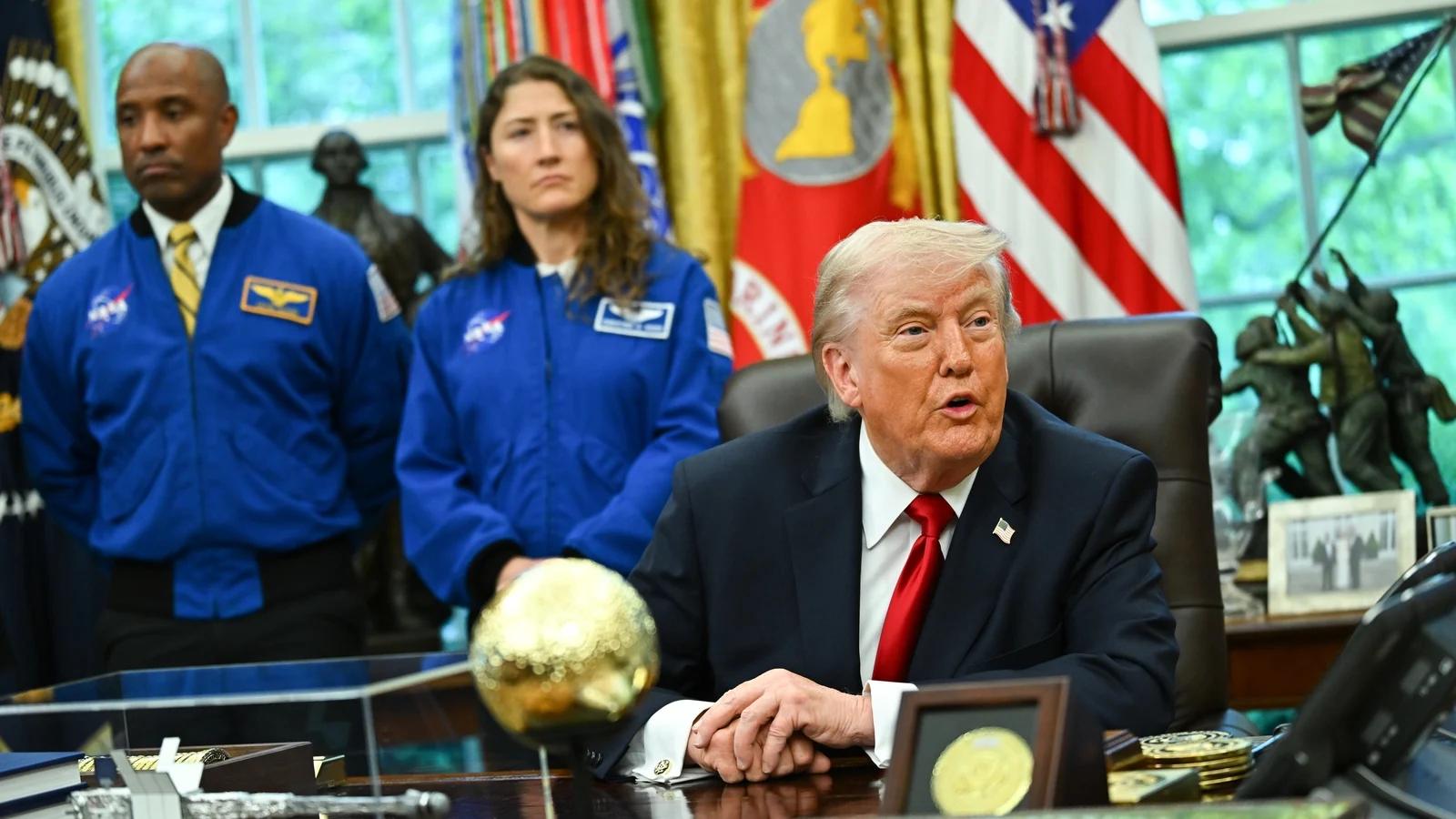
Under the cavernous portraits and chandeliers of the East Room, a scene unfolded that felt part ceremonial, part confession. Four astronauts—Victor Glover, Reid Wiseman, Christina Koch and Canada’s Jeremy Hansen—stood in their flight-blue suits, the tired, triumphant faces of people who had just shepherded humanity farther into the dark than any had before. Across from them, the President spoke in clipped, eager sentences about two things Americans have long watched with equal parts curiosity and skepticism: the Moon and what might be in the sky between here and there.
“We’re going to be releasing as much as we can in the near future,” he said, promising to open government files on unidentified aerial phenomena. “We’re going to be releasing a lot of things… that we haven’t,” he added, voice rising with the sort of theatrical certainty that makes headlines and late-night jokes in equal measure.
What was said—and why it matters
On its face, it was another installment in a larger drama. But the comments matter precisely because of context: they came after a presidential directive in February asking federal agencies to begin freeing up records related to UFOs—now commonly labeled UAPs (unidentified aerial phenomena)—and after an internal review that, the President said, had turned up “interesting” documents. In a country where secrecy and spectacle meet at the crossroads of national security and public curiosity, an administration signaling a move toward disclosure is news that ripples far beyond a single press room.
“Transparency here isn’t just theatrics,” said Dr. Elena Moreno, a former DoD analyst who now researches UAP policy at a Washington think tank. “It’s a test of institutional confidence. When governments choose to share, they’re asking citizens to trust the way they weigh risk and explanation.”
Artemis II: A human milestone with cosmic symbolism
The timing of the Oval Office conversation wasn’t accidental. The Artemis II crew had just completed a mission that read like the prologue to a new space age: a 1,117,515-kilometer journey—two orbits around Earth and a trajectory that carried their capsule around the Moon’s far side, coming within roughly 6,400 kilometers of the lunar surface. It was, officials stressed, a test flight. Yet to millions watching worldwide it felt like a promise—the opening chords of a program that aims to touch lunar regolith again by about 2028.
“We showed what humans can do when we blend audacity with engineering,” Reid Wiseman told reporters, still carrying the mild fatigue that follows long-duration missions. “But with the spotlight comes questions—about what’s up there that we thought we knew, and what we still don’t.”
The public hunger for answers
Ask almost anyone on the street corner—near the National Mall or along Florida’s Space Coast—and you’ll hear a similar sentiment: curiosity tempered by impatience. Tourists in Cape Canaveral, where families still flock for rocket launches like pilgrimages to a modern cathedral, speak of kids who demand to know whether we are alone. In a D.C. coffee shop, a barista with a sleeve of NASA patches told me she’d seen an uptick in customers wanting to discuss UAPs since the Artemis splashdown.
Polls back up the anecdotal evidence: across multiple surveys in recent years, roughly half of Americans say they are at least open to the idea that we have been visited by unexplained phenomena, and a majority want fuller government disclosure. Whether that means leaked alien artifacts or long-dormant aviation reports, the public’s appetite for clarity is clear.
Not just spectacle: the policy and security dimensions
UAPs aren’t merely fodder for conspiracy forums and late-night TV. For the Defense Department and intelligence community, unexplained aerial incidents have direct implications for sovereignty and safety. In 2021, the Office of the Director of National Intelligence reported 144 UAP incidents from 2004 to 2021 that defied conventional explanation—most of them observed in restricted flight spaces and by trained observers.
“Whether these are technological artifacts from other nations, sensor errors, or something else entirely, they could represent operational risks,” said Maj. Gen. Angela Bates, retired, who advises on airspace security. “For military planners, unknown equals threat—there is no such thing as a benign unknown when you’re responsible for an aircraft carrier strike group at sea.”
Since 2022 the Pentagon formed the All-domain Anomaly Resolution Office (AARO) to investigate UAPs across air, sea, space and cyber domains. The office has gathered thousands of reports—from pilots, sensors and satellites—though many remain unresolved. Officials say declassifying records is a process fraught with competing mandates: protecting sources and methods, safeguarding national security, and honoring transparency obligations to the public and Congress.
Culture, myth and the space-age imagination
Whether you grew up watching The X-Files or listening to late-night radio tales of Roswell, the stories we tell about the skies reveal as much about ourselves as about the cosmos. In an increasingly globalized, data-saturated world, UFOs function as a Rorschach test for trust. Do you believe your institutions? Do you want to believe in something beyond the banalities of daily life? Do you mistrust the slow creep of bureaucratic explanations?
“These narratives have always filled cultural voids,” said Mira Okafor, a cultural historian at Columbia University. “During times of rapid technological change—like now, as private companies routinize spaceflight—the urge to translate complex phenomena into story is only intensified.”
What might be released—and what to watch for
Officials have promised an initial tranche of records soon. What could that include? Flight logs, radar tracks, declassified video footage and test reports; perhaps even testimony from pilots and air-traffic controllers. Some documents will likely confirm mundane explanations—misidentified weather balloons, sensor artifacts, or foreign aircraft—while others could remain stubbornly ambiguous.
Here’s what to look for:
- Declassified incident reports with radar and sensor corroboration
- Contextual analysis from agencies like NASA, DoD, or intelligence partners
- Policy memos indicating how findings will influence air and space safety measures
We’re still asking the big questions
What does disclosure mean in a world where information is both weapon and balm? Does the slow trickle of declassified files satisfy a public primeval longing for certainty—or will it simply seed new stories? The questions are both scientific and civic.
“If the government opens the file cabinet, we will learn more about our sensors—and about our limits,” Dr. Moreno said. “But the outcome may not be neat. Transparency can lead to more questions than answers, and that’s a healthy place to be in science.”
As Artemis II’s crew head back into their lives—schools, family dinners, the small rituals that keep people human—the country watches. The Moon mission offered evidence: we can push farther. The promise of disclosure offers something else: a chance to test whether institutions can move from secrecy to dialogue. Which would you prefer—mystery kept in basements, or a slow, sometimes messy, unveiling in the light?
One thing seems certain: whether you’re looking up at the Moon or at a blurry dot on a radar screen, these are not just stories about craft and cosmic questions. They’re stories about who gets to know, who decides what the public can see, and what we imagine together as we reach into the dark.