On the Hill, a Testimony That Rekindled a Nation’s Unease
It was the kind of congressional hearing that felt less like a routine oversight session and more like a national mirror held up to a country still arguing about who gets to be here, who enforces the rules, and what happens when enforcement goes wrong.
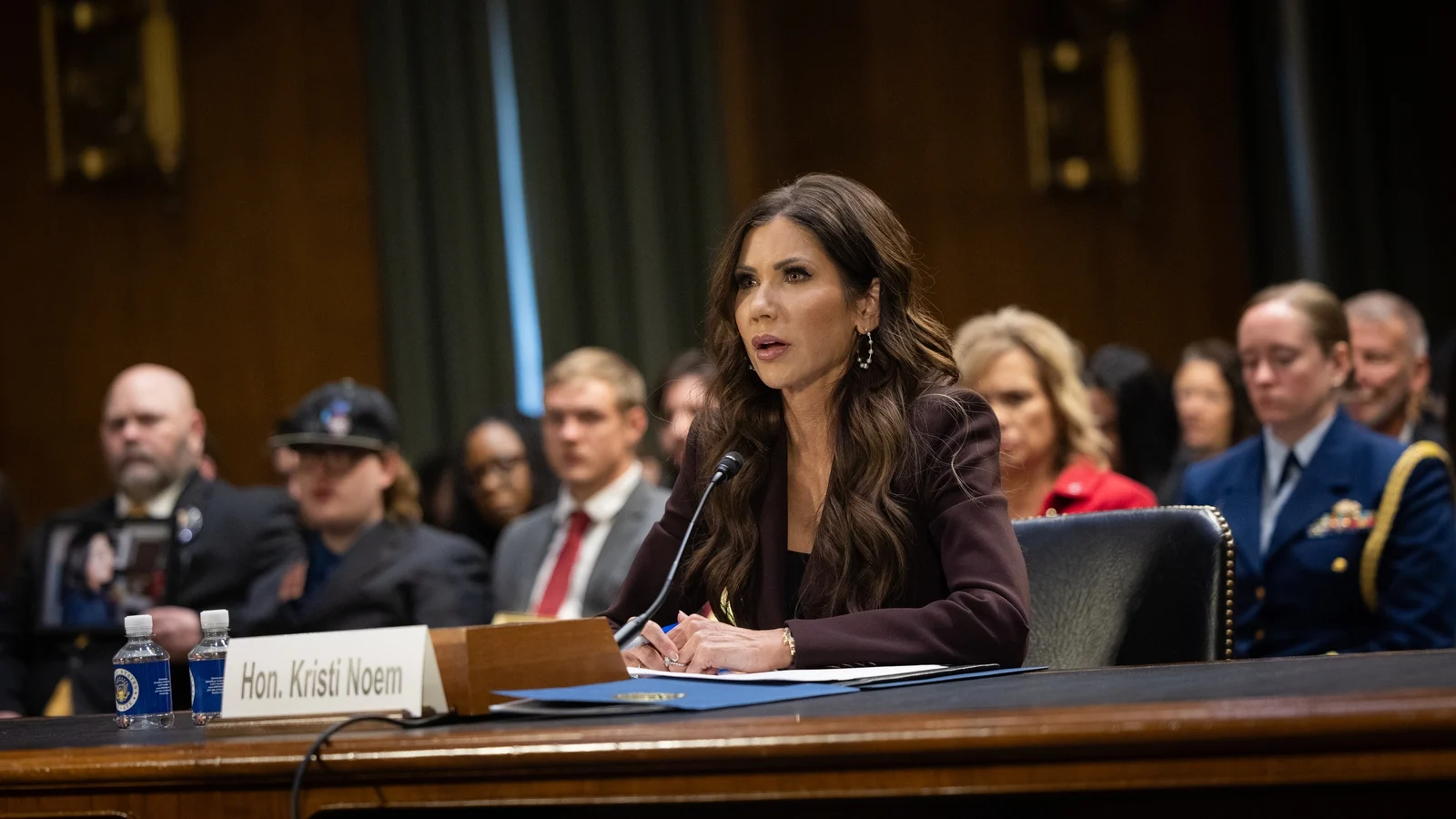
Kristi Noem, the secretary now overseeing a vast, controversial immigration apparatus, sat under the bright lights and relentless questions of the Senate Judiciary Committee. Behind her, the story she helped shape — of dramatic federal deployments into American cities, of fatal confrontations, and of a policy turned political lightning rod — pulsed with fresh urgency.
Images, Missteps, and the Weight of Words
In January, two U.S. citizens — Renee Good and Alex Pretti — were shot dead in separate encounters with federal immigration officers in Minneapolis. Within hours of those killings, Ms Noem used a phrase that would not let go: she suggested these deaths appeared tied to acts of “domestic terrorism.” The line landed like a headline and stayed there.
But as video from the scenes emerged and public scrutiny deepened, the neat narrative she had offered began to fray. Lawmakers from both parties pushed back in the hearing. Senator Dick Durbin, the committee’s top Democrat, demanded whether she would retract those comments — a request that cut at the core of accountability in moments of crisis.
“I was getting reports from the ground, from agents at the scene,” Ms Noem told senators, painting a picture of chaos and incomplete intelligence. “I absolutely strive to provide factual information,” she added, declining to withdraw or apologize.
The exchange underscored a growing tension in American civic life: how quickly a rumor or an initial official statement can harden into public judgment, how video and community eyewitnesses can challenge institutional narratives, and how fragile confidence in law enforcement becomes when questions linger about use of force and the speed of conclusions.
From Masked Federal Agents to Altered Tactics
Under Ms Noem’s watch, thousands of masked agents were dispatched to cities across the country, sweeping neighborhoods for people deemed to be immigration offenders. The images were stark — boots on pavement at dawn, vans idling beneath streetlights, agents moving in coordinated waves through stairwells and apartment corridors.
The administration’s playbook — once focused on broad, visible surges — has since shifted. In response to public outrage after the Minneapolis shootings, the strategy moved toward fewer, more targeted deployments. Numbers tell the change plainly: roughly 3,000 federal agents were in Minnesota at the start of the year; Ms Noem told the committee that figure has fallen to 650.
And yet the political aftershocks continue. Democrats in Congress have signaled they will withhold additional funding for the Department of Homeland Security without reform of enforcement practices. Funding for the 260,000-employee department lapsed last month, though most immigration and national security operations continue because they are deemed essential.
Quick facts from the hearing
- Department workforce: about 260,000 employees.
- Agents in Minnesota: reduced from ~3,000 to 650, per testimony.
- Controversial ad campaign: widely reported as costing roughly $220 million; a subcontractor was paid $226,000 for production.
- Public sentiment: a Reuters/Ipsos poll in February found most Americans back deportations of people without legal status, but around 60% felt immigration agents have gone too far in enforcement tactics.
Politics, Power, and a Shadow of Impeachment
The politics are raw. House Democrats introduced an impeachment effort in January, accusing Ms Noem and her department of civil rights violations, stonewalling oversight of detention centers, and awarding contracts to firms with political ties. That effort — unlikely to succeed with a Republican-controlled House — nonetheless keeps a spotlight on ethical and procedural questions.
“Mistakes have been made,” acknowledged Senator Chuck Grassley, the committee’s Republican chairman, in opening remarks. Yet he also defended the principle that officers enforcing the law “should never be threatened or harmed.”
Other Republicans were less protective. Senator Thom Tillis — who has not been shy about criticizing the execution of the enforcement campaign — warned that hasty condemnations and missteps erode public trust. “The way you’re going about deporting them is wrong,” he said, calling on Ms Noem to step down and threatening procedural roadblocks until answers arrive.
Money, contracts, and optics
The hearing touched on another sore point: an advertising campaign reportedly funded by DHS that featured Ms Noem and cost in the neighborhood of $220 million. Investigations revealed small subcontract payments to a company with ties to people close to the secretary, raising questions about cronyism and the appearance of using government dollars to boost political visibility.
“Even if there’s no wrongdoing, the optics are terrible,” said Mara Solano, a Washington-based ethics lawyer. “When public funds are used in ways that appear to enrich connected individuals, it damages confidence in the institution.”
Voices from the Ground: Minneapolis, Memory, and Mourning
Walk the blocks where federal boots once pounded and you’ll hear a different ledger of concerns. In a coffee shop near Lake Street, a mural of a family frozen mid-walk watches over customers who have their own tally of fear and fatigue. “We’ve been living beside this for years,” said Latisha Ahmed, a nurse who volunteered at community legal clinics during the raids. “It’s not just about the agents. It’s about the message — who belongs here and who’s treated like a threat.”
A neighbor whose windows faced the police action remembered the nights as loud and confusing. “I couldn’t sleep. There were helicopters, radios, shouting. My kids asked if soldiers had come to our street,” she said. “That’s how young you make people feel — unsafe in their own home.”
Yet not everyone sided with the critics. “We need borders, we need law,” said Mark Hensley, owner of a small auto shop, who supports tougher enforcement. “But we also need to do it right. Killing citizens raises profound questions.”
Why This Matters — Beyond Party Lines
Ask yourself: when does national security become domestic insecurity? When does enforcement to protect a border morph into a policy that frightens the very communities it is meant to serve? This hearing isn’t merely about one secretary’s words or a single department’s tactics. It’s the latest chapter in a global conversation about the balance between safety and rights, about transparency in government, and about the role of truth in a moment where visuals, viral clips, and official statements collide.
At stake is more than a job or a headline. It is trust — the fragile, essential trust that lets people believe the state is acting in their best interest and within the bounds of law. When that trust frays, so does the social fabric: institutions harden, communities withdraw, and politics intensifies.
“We’re not arguing about policy in the abstract,” said Professor Elena Márquez, a scholar who studies migration enforcement. “We’re arguing about whether a citizen can be shot on her own street and have the state’s first explanation carry the day. That has consequences for democracy itself.”
What Comes Next
Ms Noem is due before the House Judiciary Committee tomorrow. The questions will not abate. Funding fights loom. Local communities continue to demand transparency and justice. And the broader public — split, anxious, and watching — will decide in the months ahead whether it sees these incidents as isolated tragedies, as a pattern of misconduct, or as evidence that a different path is needed.
As you read this, consider what you want from institutions entrusted with such power. Do you want swifter action? More restraint? Better oversight? The answers will shape policy, elections, and the texture of daily life in American cities for years to come.