Smoke, Silence and the Price of Passage: A Trip to the Heart of a New Oil War
There is a gritty, metallic smell that clings to Kharg Island even on a good day: oil, salt, and the tang of hot metal. On a narrow strip of land where pipelines huddle together like lifelines, you can feel the world’s appetite for energy in the hum of pumps and the creak of loading arms. This is where Iran sends most of its oil to sea — an export hub that, if touched, could do more than rattle markets; it could change the map of global supply.
Last week, amid a crescendo of airstrikes and missile volleys that have spread across the Middle East, U.S. warnings turned into something closer to a threat: strikes would be ordered against petroleum infrastructure on Kharg if Iran continued to disrupt shipping in the Strait of Hormuz. The president’s near-invective on social media — declaring military targets on the island “totally obliterated” — was part threat, part theatre. It landed like a stone in an already roiling pond, sending echoes through ports, trading floors and living rooms from Dubai to Detroit.
The island at the eye of the storm
Kharg sits roughly 483 kilometres northwest of the narrow mouth of the Strait of Hormuz, a chokepoint through which nearly one-fifth of the world’s fossil fuels pass. The island handles roughly 90% of Iran’s exports; satellite images and independent trackers show very large crude carriers loading there even as warplanes circled the skies. According to tanker-monitoring group TankerTrackers.com, Iran exported between 1.1 and 1.5 million barrels per day from 28 February through this week — numbers that global markets watch like a pulse.
“We went to work the same as always,” said Ali, a 42-year-old pipeline operator who asked that his family name not be used. “But when the bangs started, everybody looked at each other differently. We are professional. We are proud. But we are also scared — because when oil stops, the work stops, and when the work stops, families go quiet.”
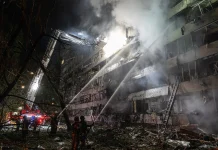
Iranian media cited more than 15 explosions on Kharg after the U.S. strikes, saying the targets were air-defence systems, a naval base and airport facilities. Officials insisted the island’s oil export infrastructure — the pipelines, terminals and tanks that make the place economically consequential — remained intact. Yet in a theater where perception can be as potent as reality, even the sound of blasts matters.
What happens when a bottleneck blinks?
Think about the Strait of Hormuz: a narrow artery that feeds about 20% of the planet’s traded oil. Disrupt that, and the consequences travel like ripples — shipping insurance spikes, tankers take longer, costs climb, and supermarkets and factories feel the pressure weeks or months later. Financial markets hate uncertainty, and they have gotten a steady diet of it: attacks on shipping, coordinated strikes by regional militias, and strategic warnings from world capitals.
“A single attack that damages export facilities can push markets into a higher volatility regime,” said Dr. Sara Mendes, an energy analyst who’s spent two decades watching oil markets. “Now imagine a sequence of attacks or the credible threat of strikes on terminals. Traders will price in a premium for disruption — not just for this week, but for the risk of spillover that could last months.”
- Strait of Hormuz: conduit for roughly 20% of traded oil
- Kharg Island: responsible for approximately 90% of Iran’s oil exports
- Iranian exports (late Feb–this week): 1.1–1.5 million barrels per day
- Reported casualties in the wider conflict: around 2,000 dead and millions displaced
From Tehran to Beirut: a war that refuses to stay in one place
What began as targeted bombardments has sprouted a dozen fronts. Tehran’s Revolutionary Guard says it has coordinated strikes alongside Hezbollah in Lebanon; Israel reports hitting more than 200 targets across western and central Iran in recent days. Beirut, once a city of narrow lanes and clattering cafés, has seen its suburbs hammered by air raids. Lebanon’s interior minister has been blunt: the capital’s shelter infrastructure is overwhelmed as hundreds of thousands seek refuge.
“You can’t imagine the worry,” said Layla, who runs a small grocery in the southern suburbs of Beirut. “We put food in sacks and hand it to people who arrive at night with nothing. People are not thinking about politics; they are thinking about boiling water, and where to sleep.”
Beyond human tragedy, the war has seeped into global logistics. The U.S. has signalled that its navy will begin escorting tankers through the strait. France has been in talks with partners to assemble a multinational escort plan for commercial vessels. When governments start sending warships to protect commerce, you know business-as-usual is over.
Escalation and the calculus of deterrence
On one hand, the United States has framed its actions as protecting freedom of navigation. On the other, Tehran warns that any strike on energy infrastructure will elicit strikes on facilities owned by oil companies that cooperate with the U.S. That is deterrence that does not stop at military targets; it reaches into the contractual networks of global commerce.
“This is not symmetric warfare,” said retired admiral Mark Hollis, now a maritime security consultant. “The calculus is about leverage: the ability to raise costs, to shift trade flows, to make certain routes untenable. You don’t need sustained occupation to win; you simply need the means to make the world pay a price for keeping the waterway open.”
And here lies the rub: making the world pay a price eventually hits ordinary people. Fuel surcharges, longer transit times, higher insurance premiums — these are the invisible taxes of a supply chain under siege.
Faces behind the numbers
There are faces in these figures. A refuelling crew in western Iraq lost six members after a plane crash that the U.S. military confirmed. Families in Lebanon sleep in hallways. In Tehran and cities beyond, ordinary merchants watch their customers thin out as weeks of conflict erode cash and confidence. Even in Kharg’s industrial sprawl, children learn to step lightly around pipelines while their parents pray for a ceasefire that feels increasingly remote.
“We are tired of counting shells,” an older man near a makeshift shelter in Beirut said, lighting a cigarette. “We count people now. We count who is left.”
What should we be watching next?
Will new international escort convoys keep tankers moving? Can diplomacy carve out a space for de-escalation before more oil infrastructure is damaged? How will markets respond if an export terminal — any terminal — is put out of commission for weeks rather than hours? These are not hypothetical questions for accountants and analysts alone; they are the kind that determine whether a shopkeeper can stock rice next month or whether a family can afford heating next winter.
In the end, the story of Kharg is not about a place so much as it is about the fragile lattices that bind the global economy — and how quickly those lattices fray when statecraft turns to strikes. When you next fill your car or switch on a light, consider that somewhere there is a technician checking a valve, a mother keeping her children calm in a shelter, and a trader on the phone recalculating risk. Their lives are the quiet accounting behind the headlines, and their futures now hinge on decisions being made in rooms far away from the salt-stung cranes of Kharg Island.
So what do we owe each other as distant consumers and neighbors in a precarious world? Attention, perhaps. And a willingness to ask tough questions: how do we protect commerce without feeding conflict? And how do we make sure the people who live at the crossroads of global energy are not the ones who pay the highest price?