A Night of Shattering Quiet: Missiles, Craters and the New Reality in Israel’s South
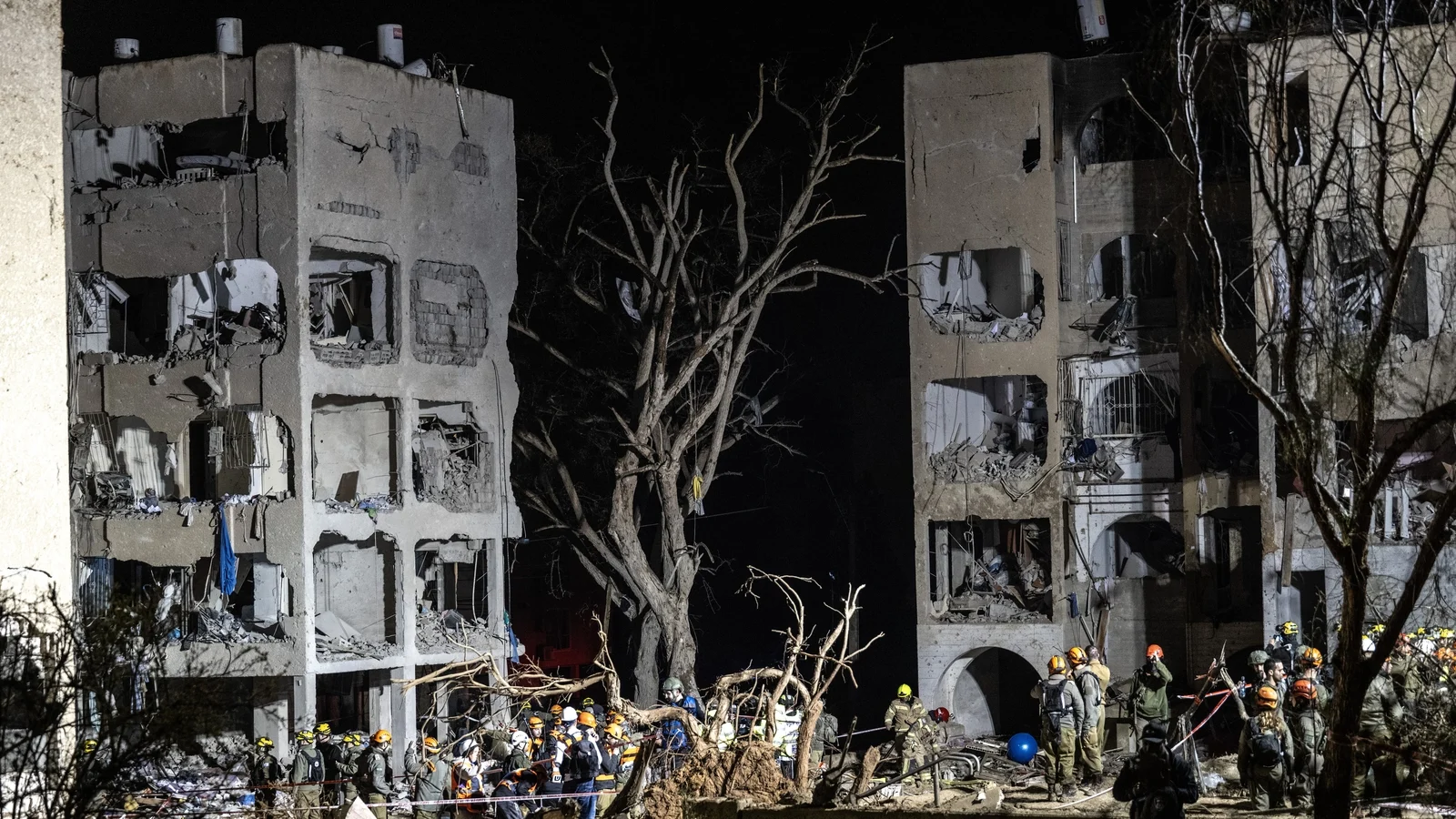
When dawn pulled back the desert night, it revealed a scene that felt ripped from a nightmare: two towns in Israel’s southern Negev woke to smoking craters, buildings with gaping wounds where facades had once been, and the slow, methodical work of medics and firefighters picking through rubble for life and story.
The casualty toll—more than 100 people hurt across Arad and Dimona—was a blunt measure of what had happened. Magen David Adom teams reported 84 wounded in Arad, ten of them in serious condition, and 33 people treated in Dimona, including a ten-year-old boy with shrapnel injuries who was awake but gravely hurt. For families, the numbers are not statistics; they are mothers calling frantically at makeshift triage centers, neighbors ferrying blankets and bottled water, and local schools told to move classes online as the town steadied itself.
The Strikes and the Morning After
First responders described “extensive destruction.” In Arad, three residential buildings were damaged and one caught fire. Firefighters said interceptors had been launched—but failed to stop the incoming projectiles. Two ballistic missiles, each carrying warheads weighing “hundreds of kilogrammes,” struck directly, carving deep holes into the earth and tearing open the fronts of homes.
“There was a lot of chaos at the scene,” said Riyad Abu Ajaj, a medic who spent the night sorting the wounded. “You could hear the calls, the sirens, mothers praying in different languages—it felt like the city had been thrown into a bad dream.”
In Dimona, the blast left twisted metal and a crater the size of a small house. Windows were blown out in several surrounding buildings. Footage from the scene showed emergency crews combing through debris while neighbors stood on sidewalks holding children and trying to make sense of a night that began like any other.
Quick Facts from the Ground
- More than 100 people treated for injuries across two towns.
- 84 wounded in Arad, including 10 in serious condition; 33 wounded in Dimona.
- Schools in the affected area moved to remote learning by order of the Home Front Command.
- Firefighters reported interceptor missiles had been fired but failed to neutralize the incoming threats.
Failures at the Heart of Defense
The most unnerving detail to emerge was not only that missiles had hit populated areas, but that Israel’s vaunted air-defence layers did not stop them. Brigadier General Effie Defrin, a military spokesman, told journalists the systems “operated but did not intercept the missile,” and promised an investigation. There will be technical post-mortems; there will be questions about doctrine and readiness. There will also be pressure to explain how a society built around a constant state of preparedness suddenly found itself vulnerably exposed.
For decades, Israel has invested heavily in a multi-tiered air-defence architecture: Iron Dome for short-range rockets, David’s Sling for medium-range threats, and the Arrow system for long-range ballistic missiles. These systems have a track record—Iron Dome’s operational success rates have often been reported above 80–90% in past conflicts—but they are not infallible. Analysts point to saturation tactics (overwhelming defenses with multiple simultaneous launches) and evolving missile technology as ways that can blunt even the best systems.
“No defense is perfect,” said Maya Rosen, a Tel Aviv-based security analyst. “The attack underscores a growing reality: missile arsenals are getting more sophisticated, and tactics are changing. It’s a reminder that technological edge can be eroded, and that civilian populations remain at grave risk.”
Dimona: Symbol and Target
Dimona is more than a dot on the map. Nestled in the Negev, it is the town that hosts a nuclear research facility long shrouded in ambiguity. Israel has maintained a policy of deliberate opacity about its nuclear capabilities, and the site is widely believed outside official circles to be linked to the country’s nuclear program. For residents, this has meant living in the shadow of a strategic symbol—visible in maps, whispered in international policy circles, and now, in a terrifying way, very much within reach of attackers.
“We never thought anything would hit here directly,” said Shlomo, a baker whose shop sits a few kilometers from one of the impact sites. “You hear the stories, you read the history, but to see a place you pass every day with a hole in the ground… it changes how you walk these streets.”
For a ten-year-old injured boy and his family, and for dozens of others treated for shrapnel and blast injuries, the strike is a personal rupture. Hospitals have expanded triage areas; family members pace corridors; volunteers bring sandwiches and tea. The local scene—once marked by bakery chimneys and tidy playgrounds—now carries the scent of dust and the metallic tang of broken glass.
Tehran’s Message and the Wider Context
Iranian state media quickly framed the strikes as a retaliatory act, citing earlier attacks on its Natanz nuclear site. For its part, Israel called the evening “very difficult,” with Prime Minister Benjamin Netanyahu vowing to continue operations against what he calls threats from Iran and its regional allies. The exchange is not isolated. Since February 28, according to officials and media reports, there have been repeated barrages exchanged across the region—a tit-for-tat pattern that raises the risk of uncontrolled escalation.
“This is a dangerous spiral,” said Nora al-Karim, a scholar of Middle Eastern geopolitics. “We’re seeing a blend of old-school state-to-state strikes and modern tactics—drones, proxy forces, cyberattacks—that make crises more unpredictable. When nuclear facilities, or sites tied to nuclear programs, become part of the kinetic battlefield, the stakes rise beyond the local to the global.”
People, Place, and the Question We’re Left With
Walk through Arad and Dimona today and you’ll see the habits of daily life reasserting themselves: an elderly woman sweeping the steps of her building, coffee shops reopening, prayer candles lit on stoops. But there is also an unmistakable tremor—people talking in low voices about what used to be ordinary and will not be the same again.
What does it mean to live under a sky where interceptors can miss, where a war can reach towns that felt safely tucked away? Is this an acceleration of a tension that has been quietly simmering for years—or a new chapter, harsher and more proximate, in a long-running conflict?
Policy answers are being drafted in command centers and parliamentary offices even as the first sorrows are buried. But the human answers—the ones that shape how communities heal, how families rebuild, how towns that once simply baked bread and sold produce become, overnight, symbols of vulnerability—are written in quieter moments: cups of tea shared under a sky still bearing faint smoke, parents checking backpacks for shattered glass, kids learning again that safety can be fragile.
There will be investigations, there will be official statements, and there will be strategic moves. There will also be the small acts that make the difference: emergency funds opened by municipalities, volunteer networks delivering supplies, neighbors insisting on staying for each other through nights that no one asked for.
As the region watches and as nations weigh responses, one question lingers for anyone reading this far from the desert: when the tools of war reach deeper into places once assumed safe, how do we choose to respond—with escalation, with restraint, or with a renewed push toward diplomacy that puts civilian lives at the center? The answer will shape lives here—and echo far beyond these craters in the sand.