On the Edge of Ice and Influence: Greenland’s Future, Negotiated on a Global Stage
There is a kind of light in Nuuk that catches you by surprise: as the sun hangs low in spring, it turns the fjord into molten silver and sets the weathered wooden houses ablaze in colour. Down by the harbour, a woman in a bright red anorak hauls a net from a small trawler, her hands sure and quick despite the cold. She is one of about 56,000 people who live on an island the size of Western Europe — a place whose very vastness has lately placed it at the centre of geopolitics.
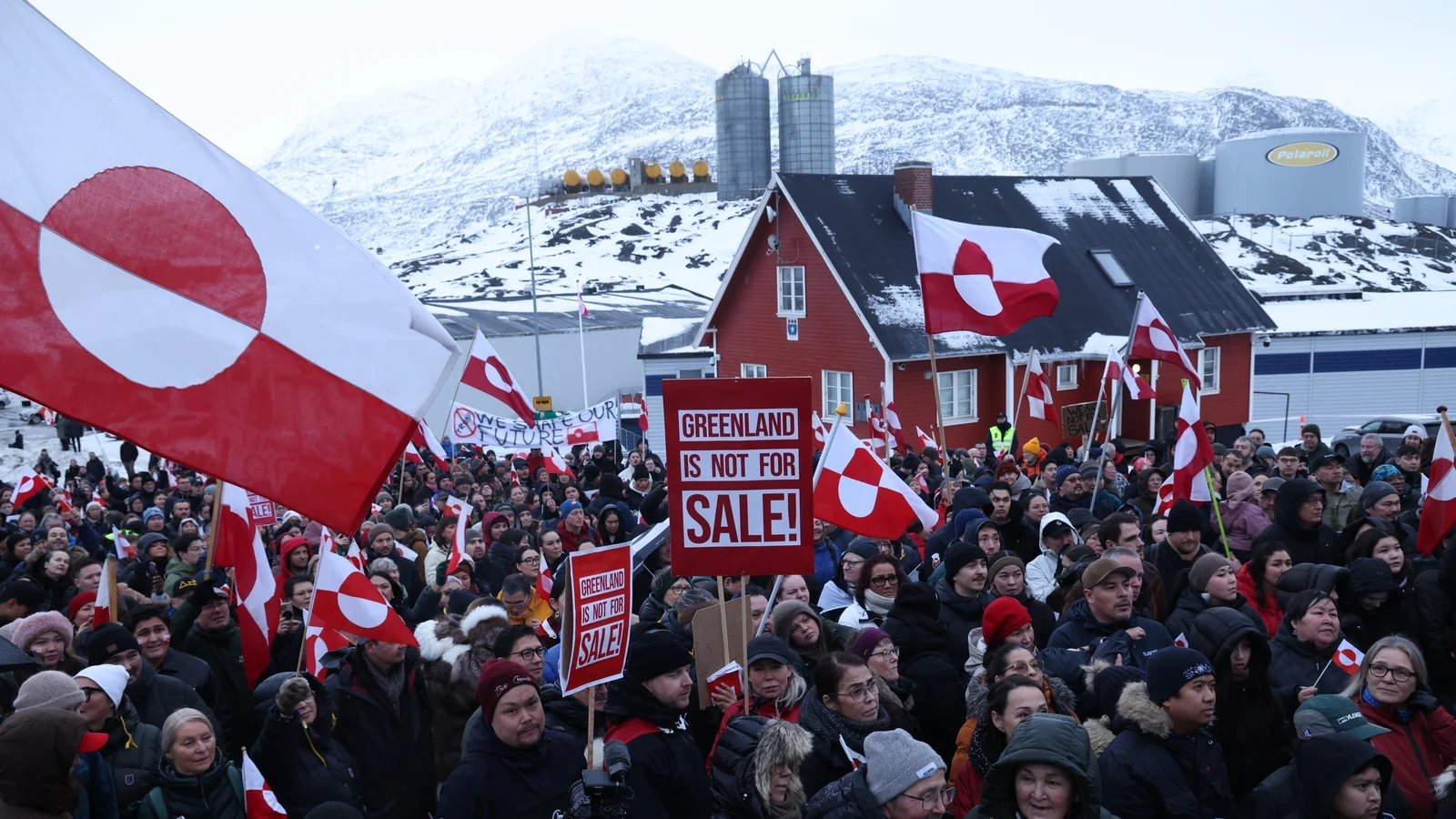
Talk of bases and bargaining chips has become ordinary here in a way it never used to be. For months, Greenland’s government has been in discussions with Copenhagen and Washington over what role the island might play in a rapidly changing Arctic — whether that will mean deeper defence cooperation, expanded military presence, or a new configuration of autonomy and responsibility. Officials say progress has been made. But as one Greenlandic politician put it at a recent press event, “We are negotiating, but there is no deal yet.”
Why Greenland matters
To the naked eye, Greenland is an icon of raw nature: 2.16 million square kilometres of ice and rock, a coastline carved into a maze of fjords, and a people whose lives are attuned to the seasons. Beneath that ice, geologists long suspected — and recent surveys increasingly confirm — a trove of mineral wealth, from zinc and rare earth elements to uranium and other resources that the world will prize as demand for clean technologies surges.
But the calculus isn’t only economic. Strategists from Washington to Beijing now watch Arctic sea lanes open as the climate warms, while satellites and early-warning systems have made the High North a zone of significant military interest. The United States already operates Pituffik — better known internationally as Thule Air Base — in northern Greenland, established in the early 1950s as the Cold War settled into place.
“Greenland is not a relic of the Cold War; it is the front line of a new strategic era,” said Dr. Emilie Sørensen, an Arctic security analyst at the Copenhagen Institute for Polar Research. “Shorter sea routes, untapped resources, and the increasing competition among major powers mean that what happens here has global consequences.”
Negotiations under the northern sky
The 1951 defence agreement between Denmark and the United States — refreshed in subsequent decades — allows the U.S. scope to expand military infrastructure on the island, provided Copenhagen and Greenland are informed. That legal framework underpins current talks. Washington, seeking to consolidate its position in the north, has discussed the possibility of additional bases in southern Greenland to supplement Pituffik in the north.
Greenland’s leaders are walking a careful line. “We have always been willing to shoulder more responsibility for security,” said a Greenlandic official at a press conference. “But our only demand is respect — respect for our rights, for our environment, and for our people.”
Out on a bench near Nuuk’s cultural centre, 68-year-old Aqqaluk Johansen — a retired hunter who still reads the weather like scripture — pinned the negotiations into the same ledger where he keeps track of icefall and tide. “They come to talk about bases and minerals, but we live here,” he said. “If there is to be more foreign boots and big machines, it should be on our terms.”
On the ground: Voices from Greenland
Conversations in Greenland are rarely abstract. In Sisimiut, a young geology student named Nivi explained why the potential for mine development is double-edged. “Jobs and money could mean hospitals, schools and less dependence on Denmark,” she said. “But my grandfather remembers when a military road divided a hunting ground. We must not trade our land for promises we cannot keep.”
In the capital, fishermen debate the same questions in dingy cafés over strong coffee and flatbread. “We’re not against cooperation,” said Kûsâq Petersen, owner of a small fishing company. “But fishing is our life. If foreign bases scare the fish away or pollute the water, no amount of money will bring it back.”
What the numbers tell us
These human stories sit beside stark statistics. Greenland’s population — roughly 56,000 — is sparse across a huge territory. Climate change has already reshaped the region: the Greenland ice sheet lost hundreds of billions of tonnes of ice annually over the last decade, contributing significantly to global sea level rise. The Arctic is warming at up to four times the global average in some measures, unlocking new shipping routes and potential extraction sites — but raising the stakes for local communities and ecosystems.
At the same time, the global appetite for rare earths and metals needed for electric vehicles and wind turbines is rising. Experts estimate that Greenland could host commercially viable deposits of these materials, drawing interest from mining companies and the governments that see them as assets in a transition away from fossil fuels.
Balance, sovereignty and climate justice
There is no single thread that will determine Greenland’s future. Instead, it will be woven from a complex fabric of sovereignty, economics, indigenous rights, environmental protection, and global strategy. For Denmark, Greenland is an autonomous part of the realm — but Nuuk is increasingly insistent on shaping its own destiny. For the United States, Greenland presents both a strategic advantage and a diplomatic puzzle. For Greenlanders, the question is existential: can they gain the benefits of cooperation without surrendering control?
“We must be careful not to replay colonial patterns,” cautioned Lena Asii, a lawyer who works on indigenous land rights. “Fair agreements mean real participation — not decisions done to us, but decisions done with us.”
And the clock is not just political. As the climate warms, the window for safe, responsible development narrows. Disturbance of permafrost or the release of greenhouse gases trapped in Arctic soils could accelerate changes even further. “This is climate justice as much as it is geopolitics,” Dr. Sørensen said. “Who benefits matters. Who bears the risks matters.”
Questions for the reader
What should a small, remote community be entitled to when major powers come knocking? How much sovereignty do people trade for security guarantees and economic promises, and who decides when those trade-offs are acceptable?
As you read from your own corner of the globe, consider this: Greenland’s future will not be determined in Washington or Copenhagen alone. It will be shaped by people who go out on the ice at dawn, by students studying geology in the capital, by elders whose knowledge of the land predates maps. The world may watch satellite images and sign memoranda, but the decisions here will be lived every day.
Negotiations continue. Envoys may visit, agreements may be proposed, and incremental steps will be taken. But the most important voices — those of the island’s people — are asking for something that resonates far beyond the Arctic: respect, participation, and a say in the destiny of their homeland.
- Greenland: ~2.16 million km²; population ~56,000
- Pituffik/Thule Air Base: U.S. facility in northern Greenland since the early 1950s
- Key issues: defence cooperation, mineral development, indigenous rights, climate impacts
Where do you stand on the balance between strategic necessity and local rights? If the Arctic is the world’s new frontier, what kind of frontier do we want it to be?