Under the Same Sky: Shells, Sovereignty, and the Quiet Lives of Sweida
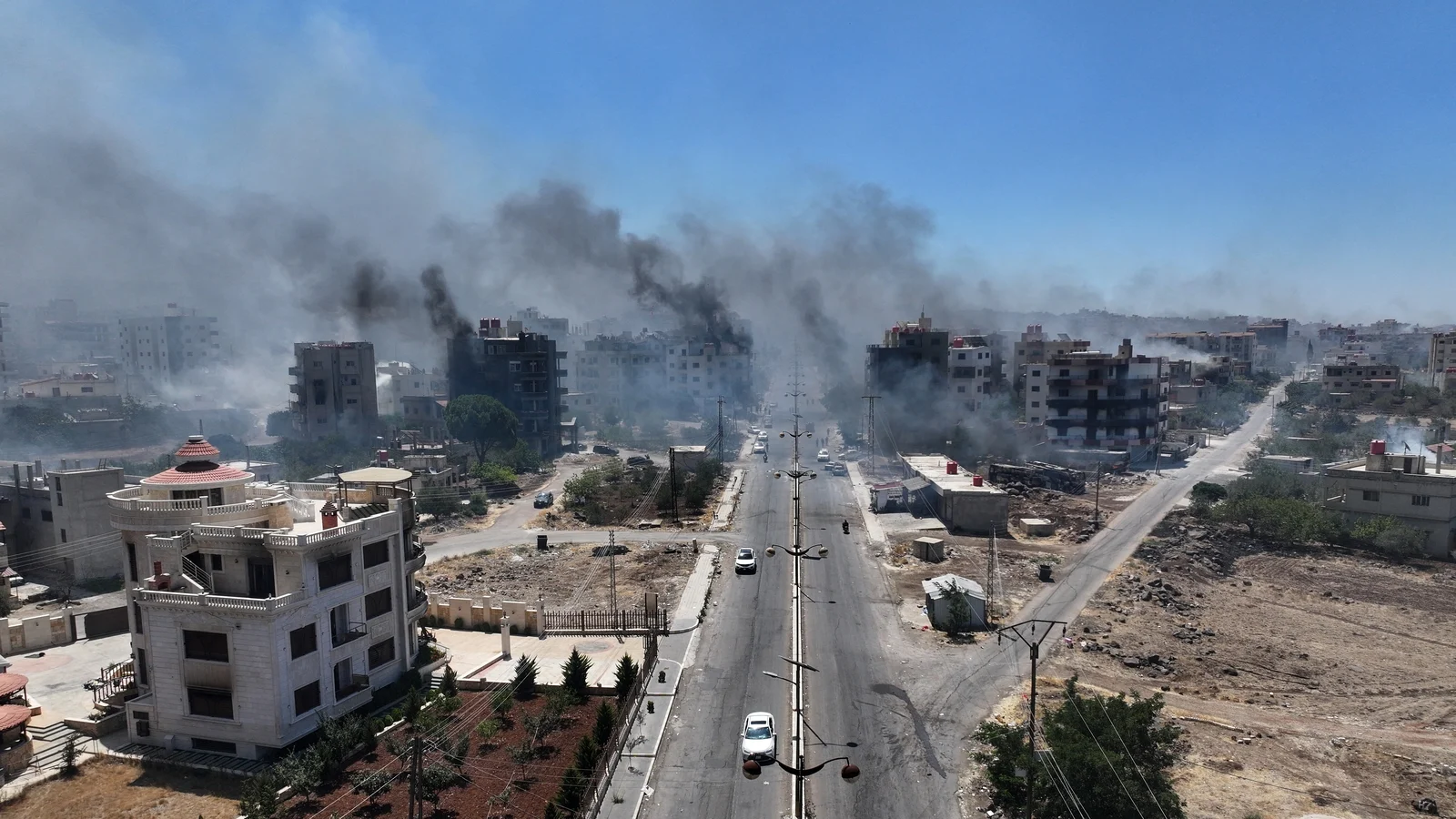
When the first booms split the pre-dawn silence over Sweida, residents thought a pipe had burst, or a truck had overturned on a narrow mountain road. By mid-morning, they were counting broken windows and friends who hadn’t answered their phones. By late afternoon, the sound of fighter jets had threaded through the town’s olive trees and vineyards — and a reluctant region once again found itself on edge.
The strikes, which Israel says were aimed at military positions in southern Syria, quickly ballooned into a wider diplomatic row. Riyadh called the attacks “a blatant violation” of Syrian sovereignty. Ankara warned of a dangerous escalation. Damascus called the strikes an “outrageous assault.” And beyond the official statements, there were those who live here — Druze elders, farmers, shopkeepers — trying to make sense of why their lives keep intersecting with the geopolitics of others.
What happened — the short version
According to Israeli military briefings, the operation targeted sites in southern Syria in apparent retaliation for attacks against the Druze community in Sweida province. The Syrian Observatory for Human Rights (SOHR) later reported clashes with government forces that left at least four Druze fighters dead, and said that Israeli shelling hit residential neighborhoods in Sweida city.
For context, this flare-up comes amid a broader, more dangerous chapter in the region. After US and Israeli strikes on Iran on 28 February — an escalation that has rippled across borders — much of the Middle East has felt the tremors. Syria, which has so far largely avoided direct entanglement in that confrontation, was nonetheless not immune to the violence and the politics that follow.
Voices from the ground
“You learn the rhythm here,” said Nadir, a 46-year-old olive farmer whose family has tended terraces on the slopes outside Sweida for three generations. “Sundown is prayer and soup. Now it is the sound of planes. How do you teach your children that the sky belongs to them when it keeps being taken away?”
Inside Sweida’s narrow market lanes, a seamstress named Laila sat amid bolts of fabric and made a small, bitter joke: “The new fashion is to wear your heart like armor.” Her hands trembled as she measured cloth; her mother, a veteran of old conflicts, kept recalculating the number of chronic illnesses they could afford to treat should access be cut.
An unnamed Syrian foreign ministry official, responding to reports of the strikes, called the Israeli pretexts “flimsy” and said Damascus would not accept attacks that violated its territorial integrity. A Saudi foreign ministry statement condemned the strikes as aggression and urged the international community to intervene. Turkey’s foreign ministry called the operation “a dangerous escalation.”
“We are caught between airstrikes and diplomacy,” said Dr. Miriam Haddad, a Beirut-based analyst who studies minority communities in the Levant. “The Druze have long navigated precarious relationships with the states that surround them. But being a minority does not grant immunity from state and non-state violence — it often increases your vulnerability.”
Local color: Sweida’s heartbeat
Sweida province — part of the lava-scoured hills known locally as Jabal al-Druze — is a place of sharp basalt ridges, verdant terraces, and a community that prizes secrecy and solidarity. Weddings are loud and joyous; funerals are long and communal. The local souk sells roasted chickpeas, sumac, embroidered sashes and, tucked between stalls, whispers about which cousin is leaving for Europe.
The Druze community, with its distinct religious traditions and a strong sense of local autonomy, has historically been both a protector and a pariah in Syrian politics. That complex identity makes the signals from outside more fraught: protections announced by foreign militaries, however well-intended, can be read as invitations for further intervention.
Why regional reactions matter
Reactions from Saudi Arabia and Turkey are more than statements for the record. Riyadh’s condemnation frames the strikes within the language of international law — sovereignty, territorial integrity — and signals concern about precedent. Ankara’s warning about escalation is a reminder that neighboring states are watching for any sparks that could set the entire region alight.
“When states invoke international law selectively, it erodes norms rather than reinforcing them,” said Professor Elias Matar, an international relations scholar in Beirut. “If the international community is serious about upholding sovereign boundaries, then such incidents need coordinated responses — not only words.”
And somewhere between declarations and diplomacy, there are practical consequences. In 2019–2023, international monitoring showed a steady rise in cross-border strikes and air incursions into Syria by multiple parties — a pattern that has hollowed out any clean distinctions between battlefronts and civilian life. The post-2024 landscape, after the ousting of President Bashar al-Assad, has seen Israeli forces occupy areas of the demilitarized zone along the Golan Heights and carry out repeated operations inside Syria, according to regional reporting.
What this means for the bigger picture
At its core, this is about three connected dynamics: the protection of minorities, the limits of power projection, and the erosion of legal norms that once kept interstate conflict partially in check. Who protects a minority group when the protector is also a regional power with strategic interests? When does “defense” become domination? And when do interventions intended to deter violence end up amplifying it?
Consider the numbers: while precise counts shift with the fog of conflict, the Syrian civil war displaced millions and created humanitarian needs across the Levant. The Golan Heights — seized by Israel in 1967 and internationally regarded as occupied Syrian territory after its annexation by Israel in 1981 — remains a flashpoint. Every strike that crosses that line is another test of the international order that emerged in the aftermath of World War II.
It’s easy to read the headlines and assume this is just another military skirmish. But for people like Nadir and Laila, for children who swap schoolbags for gas masks, it is the daily calculus of survival. For diplomats, each exchange raises the question of proportionality and legality. For analysts, it is another data point in a pattern of regional realignment — one in which local communities become proxies, bargaining chips, and collateral.
What comes next?
Will the international community move beyond statements? Will humanitarian corridors be established, or will political posturing take precedence? The answers are not written in the sky over Sweida, but in the backrooms of capitals and in the courage of local leaders who can still keep people fed and medicine arriving.
“We ask for nothing but to be left in peace,” Laila said, folding a length of blue cloth. “Is that too much?”
As you read this, consider the fragility of peace in a world where borders can be punctured by a single decision and where the lives of ordinary people hinge on the choices of faraway capitals. What responsibility do distant nations have when their actions ripple into the lives of strangers? And what responsibility do we — readers, citizens, watchers — have to hold power to account?