Smoke over the river: a small town, a giant plane, a nation in mourning
It was the kind of morning that presses on your skin—humidity thick as wool, river mist clinging to the trees, far-off parrots breaking the quiet with shrill calls. Puerto Leguízamo sits like a hinge between jungle and river, a place where the runway is more of a lifeline than a spectacle: a strip of compacted earth and asphalt that brings troops, medicine, mail and the occasional dream of moving on. On the day the Hercules tried to lift into that morning, the lifeline turned deadly.
By the time the smoke had cleared and the helicopters hummed over the treetops, official tallies put the dead at 66. The figure, which rose nearly overnight as rescuers combed through wreckage and ash, has reshaped grief in households across Colombia. Dozens more were wounded; a database of lives and names that will be stitched back together by families and officials for weeks to come.
How it happened — the scene, the machine, the mystery
The aircraft was a Lockheed C-130 Hercules, a workhorse invented in the 1950s and used the world over for hauling cargo, troops and hope into remote corners. In Colombia these machines are as familiar as machetes and riverboats—lifelines in an internal conflict that has scarred the country for generations.
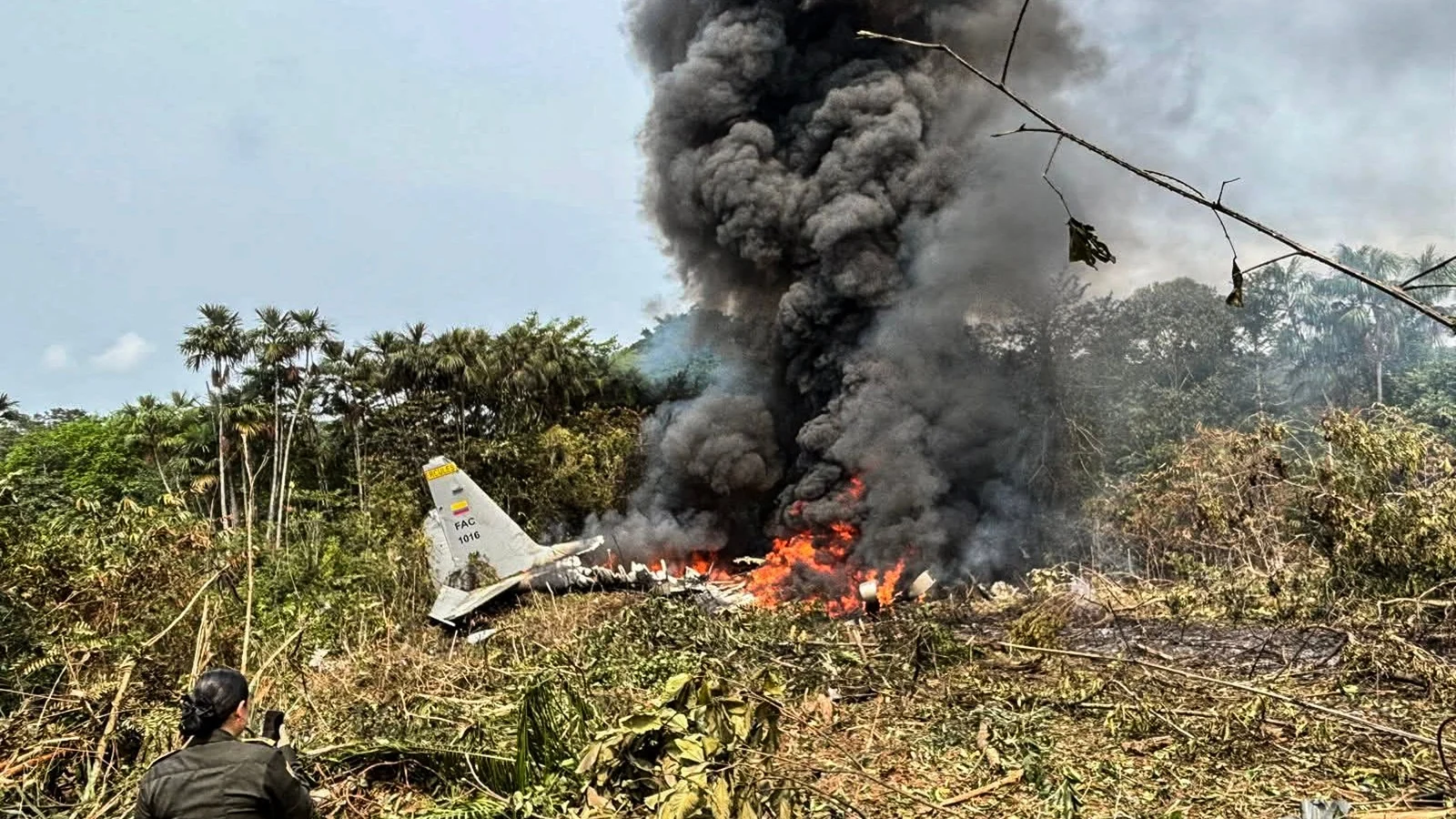
Defence Minister Pedro Sánchez reported the aircraft had been taking off from Puerto Leguízamo, near the Peruvian border, when something went grievously wrong. Firefighters at the scene said the plane appeared to strike an object near the end of the runway, then clip a tree as it tumbled away, bursting into flames. A local brigade member told a reporter that an explosion followed—“something on board detonated”—but investigators have been careful to say that a definitive cause has not yet been established.
The first rescuers were not uniformed professionals. They were neighbors—fishermen, motorbike couriers, a teacher who had just closed her shop—who raced down muddy tracks to pull people from mangled metal. Videos shared on social media showed wounded soldiers strapped to the backs of motorcycles, a crude ambulance system answering where roads and resources are thin.
Quick facts
- Confirmed deaths: 66 (figures rose as bodies were recovered)
- Initial manifest reported: 121 passengers (110 soldiers and 11 crew, per early military reports)
- Aircraft type: Lockheed Martin C-130 Hercules — first introduced in the 1950s; Colombia acquired its first in the late 1960s
- Region: Puerto Leguízamo, Putumayo department — a remote, riverine area on the border with Peru
- Context: C-130s frequently transport troops as part of Colombia’s long-running internal conflict, which has resulted in over 450,000 deaths by some estimates
Voices from the riverbank
“We heard a boom and then the whole sky was smoke,” said Juan Carlos, 28, who ferries people across the Putumayo River. “We ran. There were men with uniforms who were still moving. I grabbed a blanket—then another—and we carried them to the clinic. There were too many to count at first.”
At the small municipal hospital, nurses worked past exhaustion. “They were carrying men and boys. Blood on their shirts, on their hands,” recalled Ana María, a nurse. “We try to be steady, but you can see the fear. We don’t have everything they need.”
President Gustavo Petro, in the twilight weeks of his administration, turned the tragedy into a political spotlight. “I will grant no further delays; it is the lives of our young people that are at stake,” he wrote on X, chastising bureaucratic hurdles that he says have stalled military modernization. “If civilian or military administrative officials are not up to this challenge, they must be removed.”
Lockheed Martin, the manufacturer of the Hercules, issued a statement saying it stood ready to assist Colombian authorities in the investigation. Military spokespeople emphasized that the fleet includes both older C-130s and aircraft modernized through transfers and upgrades, a patchwork solution that reflects decades of shifting priorities and budgets.
Age, maintenance, politics: larger questions loom
There is a practical question that will follow every crash of an old aircraft: was this failure of metal, maintenance, or something else entirely? Aviation safety expert Dr. Carolina Vega, who has studied Latin American military fleets for 15 years, says the truth is rarely simple.
“You must look at three lines of inquiry,” she told me. “Mechanical integrity; human factors—was there an error in judgment or procedure; and the possibility of an external impact or deliberate act. In many countries, including Colombia, the fleet can be a mix of newly overhauled planes and aircraft that have been flying for decades. That creates complexity in maintenance pipelines.”
Vega notes that C-130s—first produced in the 1950s—are robust, and countless variants remain in service worldwide precisely because they are adaptable and durable. But age amplifies the need for coherent modernization programs, sustained budgets, and transparent training and oversight. In a nation where the military has a prominent role in internal security operations, she said, “there is no room for administrative inertia.”
Local color, national grief
Putumayo’s landscape is itself a character in this story. Boats tied to bamboo docks, women selling grilled fish and cassava, the scent of earth and smoke after rain—everyday life here exists at the intersection of remoteness and resilience. That resilience was on display the day the Hercules fell: strangers became stretcher-bearers, motorbikes the ambulances that patched a gap the state could not immediately fill.
Across Colombia, the crash has reopened old wounds. The country carries the memory of more than half a century of violence—more than 450,000 dead by some estimates—so a military tragedy hits with layered meaning. For some it is a grim reminder of the human cost of deployment; for others it is a flashpoint in debates about where the government’s priorities should lie.
What comes next?
Investigators will sift metal and data, question survivors, comb through maintenance logs and cockpit voice recorders if they can be recovered. Lawmakers and presidential hopefuls have called for an inquiry. Families will wait for names. The town’s clinic will count supplies. The river will keep flowing.
So what do we ask as outsiders looking in? Do we accept mechanical failure as an isolated tragedy, or do we see the crash as part of a pattern—aging fleets, underfunded logistics, and a country still sorting through the long tail of conflict? Can a nation reconcile its need for security with the imperative to protect the lives of those who serve?
One thing is clear: the men and women pulled from that wreckage were not anonymous statistics. They were brothers, mothers, first lieutenants with futures, cooks who loved to sing, young soldiers clutching letters from home. In Puerto Leguízamo, the river keeps moving, and life will go on. But for a long while, every takeoff will be marked by the memory of that morning—the roar of engines turning to silence, and a small town answering the call in a way that only communities who know how to survive can.