Night Smoke Over the Diamond Quarter: What a Burned Car Reveals About a Tense Europe
Shortly after 11:30 p.m. in Antwerp’s diamond quarter — a maze of narrow streets, Hebrew signage and storefronts shuttered against the night — a parked car went up in flames. The glow licked the windows of nearby kosher bakeries and bounced off the polished stones of diamond merchants’ displays. Within 15 minutes, police had detained two minors from the city; within hours, prosecutors described an investigation that may now reach into the murkier territory of “terrorist” activity.
For anyone who walks those streets on an ordinary day, the scene felt unreal. Men in black coats and fedoras cycle past, children with tzitzit dashing after each other, and in the small squares outside synagogues, elders negotiate the price of rough diamonds with practiced, conspiratorial gestures. The diamond district is intimate, familiar — a place where ritual and commerce interlace. To see smoke and the acrid smell of burned upholstery there is jarring in a way that makes you take stock of what has changed.
Quick arrests, complicated motives
The public prosecutor in Antwerp said two minors were arrested on suspicion of arson and “participation in the activities of a terrorist group,” and that a video circulating online had been added to the case file. Investigators were careful to note that motives were still being probed, and they did not confirm whether the Jewish community was the deliberate target.
“We seized the moment,” a prosecutor — speaking to reporters with the cautious cadence of someone threading a legal needle — said. “The facts are being established. We have material that suggests coordination; whether that points to a terror motive or something else is for the investigation to determine.”
At the scene, the car’s owner, who gave her first name as Fatia, told Flemish media that valuables had been removed from the vehicle before it was set alight. “I woke up to the sirens,” she said. “My heart is still pounding. They didn’t just burn my car; they burned my sense of safety.”
Not an isolated spark: a pattern across Europe
The Antwerp incident did not occur in a vacuum. In recent weeks Europe’s Jewish communities have reported a wave of incidents — from an explosive device outside a synagogue in Liège on March 9, to the mysterious nighttime arsons that destroyed four Jewish community ambulances in London’s Golders Green. Authorities in multiple countries are now cross-referencing videos, social media accounts and message boards for common threads.
Security monitors such as SITE Intelligence Group reported that a recently formed group calling itself Harakat Ashab al-Yamin al-Islamiya (HAYI) — translated as The Islamic Movement of the People of the Right Hand — has claimed responsibility for several of these attacks in online videos. The International Centre for Counter-Terrorism in The Hague noted that at least some of the online activity surrounding the London claims circulated on accounts linked to pro-Iranian Shia militias.
“We are seeing something increasingly familiar: proxy conflicts and ideological battles overseas spilling into European streets,” said Dr. Laila Hassan, a security analyst at a Brussels think-tank. “Whether it’s an organized militia or opportunistic actors inspired by online propaganda, the end result is the same — minority communities feeling their everyday lives have become politicized battlegrounds.”
What’s at stake in Antwerp’s diamond quarter
Antwerp’s Jewish population — one of the largest in Europe — is concentrated around diamond trading, religion and education. Estimates put the community at roughly 20,000 people, a substantial portion of whom are Orthodox and maintain tightly knit social networks. That density makes the area both resilient and vulnerable: resilience through community support; vulnerability because concentrated targets can feel easier to single out.
“This neighborhood has always been loud with life — the chatter of the bakers, the call for morning prayers,” said Miriam Cohen, who runs a small kosher deli near the site of the fire. “Now you look at the street and wonder if someone is watching. It’s not just about a burned car. It’s about whether we can go about our lives without being watched for the wrong reasons.”
Security stepped up — but at what cost?
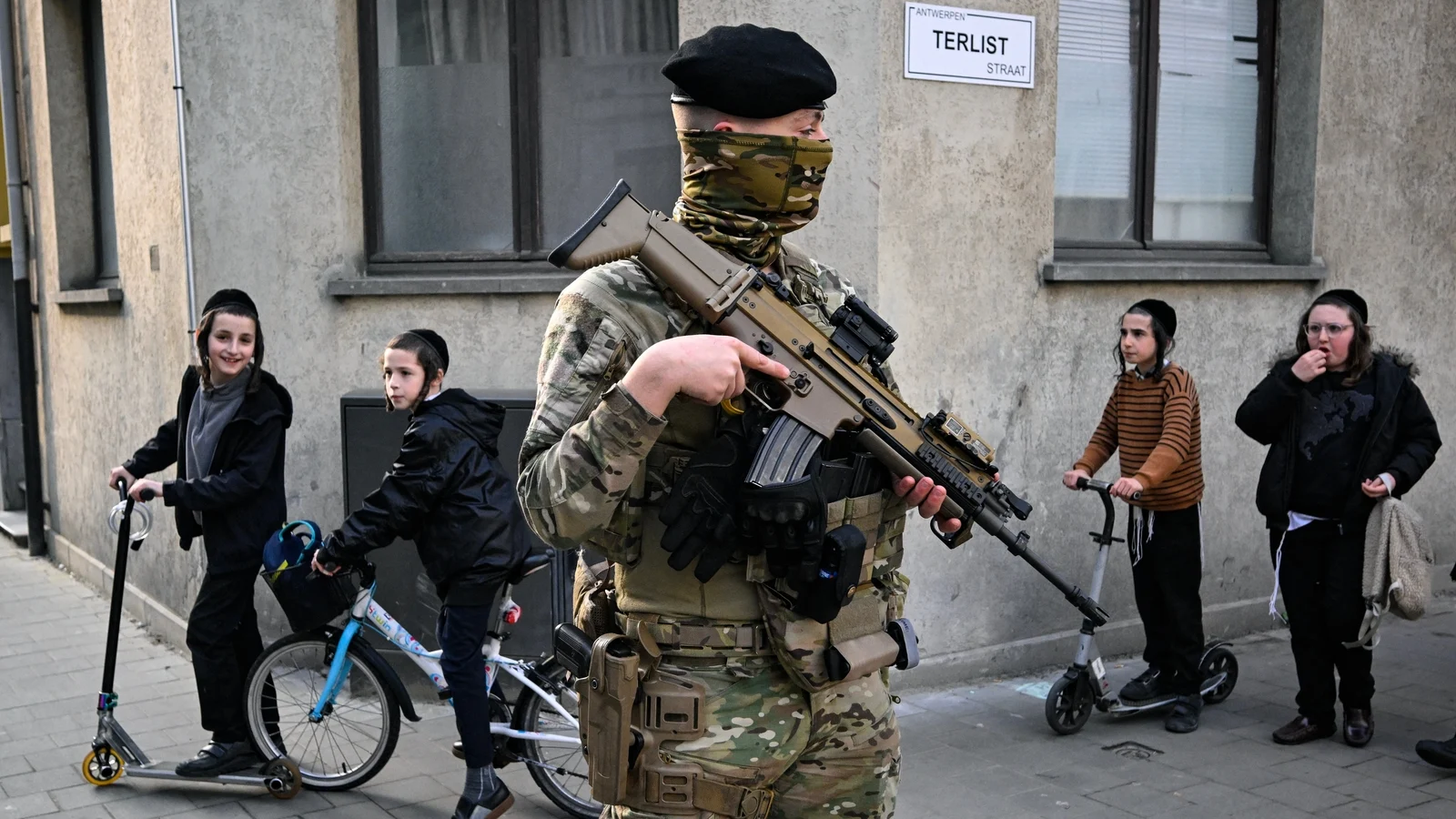
Belgian authorities have already reacted: soldiers were deployed to reinforce police around synagogues, schools and daycare centres in Antwerp and Brussels, adding a visible layer of protection. Measures like these are familiar across European capitals whenever threats spike — a rapid response intended to deter and reassure.
- Increased patrols around Jewish institutions
- Surveillance of online claim videos and social accounts
- Coordination between national security services and local police
“Soldiers on the street make some people feel safer,” said Pieter Van den Broeck, a local councilor, “but they also remind you that fear has entered daily life. That’s damaging too.”
Digital echoes and the spread of fear
One complicating factor is the way extremist groups use the internet. Claim videos, posted and reposted across platforms, can magnify an incident’s psychological reach far beyond the immediate damage. SITE’s detailing of HAYI’s online claims has been crucial to investigators trying to determine links between attacks in different countries.
“Digital bravado can fuel copycat acts,” said Dr. Anna Petrov, who studies online radicalization. “An incendiary post can inspire someone with no prior record to act. That’s what makes online monitoring as important as boots on the ground.”
Questions for the reader — and for society
When a car burns in a neighborhood, it is easy to write it off as vandalism, theft or juvenile delinquency. When arrest reports mention terror laws and social media claim videos, the story grows knotty and urgent. Where does one draw the line between criminality and politically motivated violence? How much surveillance and security is acceptable before normal life feels militarized?
These are not just policing questions. They are civic ones. They ask how democracies protect vulnerable communities while preserving the freedoms that define them.
“We must respond with clarity and imagination,” Dr. Hassan said. “Protect the people, investigate expediently, and do not let fear hollow out community life. Otherwise, the attackers — whoever they are — have already won.”
Closing scene: a neighborhood on edge, and the long view
In the days after the fire, the diamond quarter returned to its rhythms — shop shutters rolling up, the drone of prayer services, the chatter in Yiddish and Flemish. But there is a thinness now to the laughter, a slight caution in the way people close their doors. The immediate danger may recede as arrests are processed and cameras analysed. The deeper work is slower: examining what allowed such violence to spread, confronting the online ecosystems that amplify it, and rebuilding a sense of normalcy without surrendering to suspicion.
As you read this from wherever you are, consider the ordinary routines that sustain your community. Would a burned car — or a shouted slur, or a viral video — change them? And if so, what would you want your leaders to do about it?