The Night Before the Moon: A Small Florida Town Holds Its Breath
There is a peculiar hour in Cape Canaveral when the orange of dusk softens the towering silhouette of a rocket and the Atlantic smells like metal and salt. Families drift toward the fence lines, teenagers post footage to their phones, and the old-timers who watched the shuttle launches in the 1980s stand a little straighter. This time, the silhouette is NASA’s Space Launch System — SLS — and the congregation is here to watch humans prepare to travel farther from Earth than anyone in living memory.
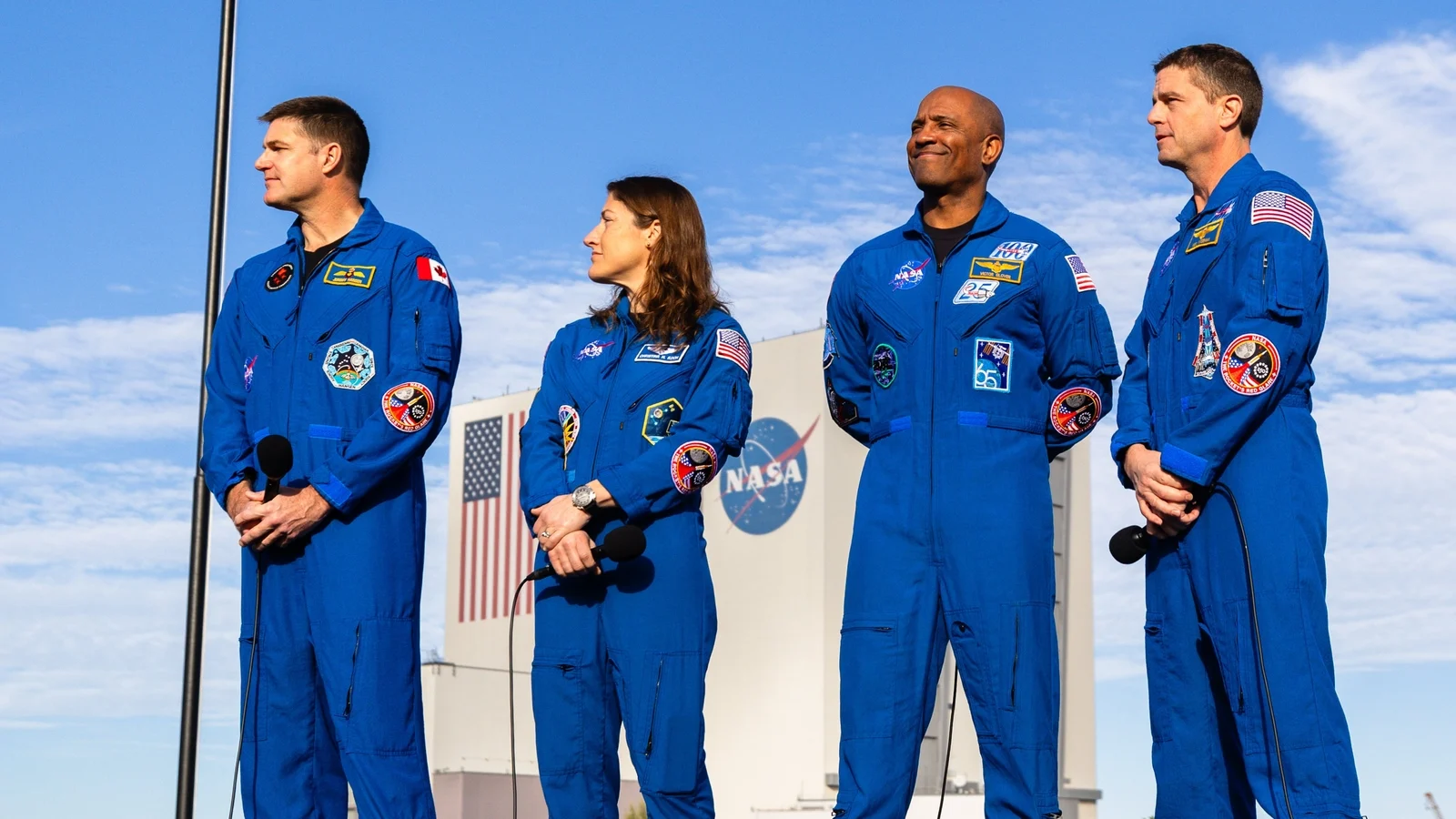
Four astronauts — Commander Reid Wiseman, Mission Pilot Victor Glover, Mission Specialist Christina Koch, and Canada’s Colonel Jeremy Hansen — have arrived in Florida, closing a long chapter of training and quarantine that began months ago in Houston. Their destination is not a lunar landing; it is, for now, proof that humans can go there and back safely again. Their ship is Orion. Their booster is SLS. Their mission name is Artemis II, and its heartbeat is a dozen years of engineering, budgets, triumphs and setbacks.
Faces on the Capsule: Who These Four Are
The constellation of this crew feels carefully curated — a mix of experience, firsts and international partnership.
- Commander Reid Wiseman: A former Navy test pilot with 165 days aboard the International Space Station and a tenure as NASA’s chief astronaut. Calm, steady, meticulous.
- Mission Pilot Victor Glover: A decorated former Navy pilot and veteran of long-duration stay on the ISS; he will make history as the first Black astronaut to travel to the Moon’s vicinity.
- Mission Specialist Christina Koch: An engineer and physicist who once spent 328 continuous days in space; poised to become the first woman to reach the Moon’s neighborhood.
- Colonel Jeremy Hansen (Canada): The first non-American in this flight to go beyond low Earth orbit — a testament to long-standing U.S.–Canadian collaboration on space robotics and human spaceflight.
“When we get off the planet,” Wiseman told reporters last year, “we might come right back home, we might spend three or four days around Earth, we might go to the Moon — that’s where we want to go. But it is a test mission, and we’re ready for every scenario.”
Why Those Firsts Matter
These are symbolic milestones, yes, but they are also practical ones. Representation matters when a nation — or a planet — is planning a sustained human presence beyond Earth. A Black astronaut in lunar vicinity, a woman doing the same, and an international crewmember together send a message about inclusion and shared stakes.
“It’s not just about who sits in the capsule; it’s about who sees themselves reflected in that seat,” said Dr. Leila Martinez, a space policy analyst in Washington, D.C. “It changes the narrative of exploration from heroic individualism to a collective human project.”
Ten Days, One Giant Loop: The Mission in Plain Numbers
The flight is planned as roughly a ten-day high-speed loop around the Moon and back. During that time, the crew will travel roughly 384,000 to 400,000 kilometers from Earth — distances that matter because they put astronauts outside the protective cocoon of low-Earth orbit and test systems that would have to work on a future lunar base or a Mars transit.
Artemis II will validate Orion’s life-support systems, the vehicle’s navigation and communications, and the heat shield that will have to survive a high-speed return through Earth’s atmosphere. If Artemis I — the uncrewed test mission that launched in November 2022 and lasted about 25 days — was the dress rehearsal, Artemis II is opening night.
The Hardware: A Coalition of Contractors
For readers who love the machine as much as the myth: Boeing built the SLS core stage, Northrop Grumman supplied the solid rocket boosters, and Lockheed Martin produced the Orion capsule. The SLS stands at nearly 98 meters (about 322 feet) and roars to life with a combination of RS-25 engines clustered in the core and twin massive boosters feeding additional thrust.
“The SLS and Orion are a marriage of old and new technologies,” said Anna Cheng, an aerospace engineer who previously worked on payload integration for the ISS. “They reuse proven engines, incorporate modern avionics, and are built for deep-space endurance.”
On the Ground: Quarantine, Rituals, and a Town That Knows How to Wait
The crew has spent the last several days in standard pre-flight quarantine at Johnson Space Center in Houston, the necessary seclusion to protect a mission that will depend on perfect human health. In Florida they will move into the Astronaut Crew Quarters at Kennedy Space Center — a small cluster of rooms where quiet rituals precede a vehicle’s rumble.
At a café two miles from the Kennedy fence line, Maria Lopez serves omelettes to engineers, retired technicians and anxious visitors. She’s been watching launches for decades. “It feels like a church morning,” she said, stirring a pot of coffee. “Everyone is polite. People actually talk to each other.” She laughed. “We always fry an extra batch of bacon for the astronauts. It’s tradition.”
Down by the visitor complex, a high school teacher who drove three hours with a bus of students said, “These kids carry calculators, but tonight they’ll learn about distance in a new way. Ten days. That’s a long time to be gone and come back. It’s real. It’s tangible.”
Risk and Hope: What Could Happen — and Why We Keep Trying
This is a test mission in the most literal sense. Any one of the following could happen: an abort shortly after launch, a shortened mission if systems behave conservatively, or a full-completion loop that validates every test objective. The crew has trained for all of it — simulation after simulation, failure scenarios folded into daily routine.
“We train like we fail, so that in space we succeed,” Glover said at a public event in Houston last year. “We don’t expect surprises, but we prepare for them.”
Beyond the mission’s immediate goals, Artemis II sits at the junction of larger debates: public spending on space, the role of private companies in exploration, the value of scientific return versus geopolitical status, and the long-term aim of sustainable lunar habitats that could serve as staging grounds for Mars.
Consider the scale. NASA’s Artemis program has mobilized tens of billions of dollars and an industrial web that spans hundreds of firms and thousands of engineers. Those resources create jobs, spur technological advances in materials, robotics, and telecommunications, and inspire a new generation to study STEM fields. They also prompt tough questions about priorities and public return on investment.
Looking Upward and Inward
On launch day, the rocket will be a vertical city: tanks, engines, wires, and human hopes stacked skywards. But beyond spectacle, Artemis II asks something quieter. Who gets to explore? Who benefits from exploration? And how can we build an approach to space that’s less about flags and more about frameworks — shared science, shared costs, shared knowledge?
As the countdown creeps, the town exhales and holds its breath. Children check their watches. The smell of frying bacon and coffee circulates. A retired engineer wipes his eyes and says, “They say we never go to the Moon alone; we take a thousand people with us in their work. Tonight, you’ll see a hundred thousand hands up in the air.”
Will Artemis II be flawless? Maybe. Will it be perfect? History suggests otherwise. But whether the mission returns with a textbook success or a valuable lesson in resilience, it will push the boundaries of human travel and imagination. It will remind us, on a humid Florida evening, that the Moon is not just a postcard in the sky — it’s a new neighborhood we are tentatively, gloriously, learning to visit.
So: are you watching? What do you hope this mission proves about humanity — our ingenuity, our partnerships, our willingness to take risks together? The launchpad is ready. The crew is ready. The rest of us, for now, can only look up and wonder.