A Quiet Line, a Loud War: What It Feels Like When Fronts Stop Moving
There is a peculiar kind of silence along parts of Ukraine’s front line this spring. Not the gentle hush of peace—but the taut, anticipatory quiet that follows a month of fierce activity and precedes the next push. Soldiers tighten boots, drones hum in the distance like persistent insects, and conversations turn, again, to maps and weather reports rather than to homecomings.
In an unexpected twist for a conflict that has ground on for years, Russia’s forces registered no territorial gains in March — the first month without forward progress in roughly two-and-a-half years, according to an analysis by the Institute for the Study of War (ISW) in partnership with the Critical Threats Project at the American Enterprise Institute.
It is a statistic that reads like a punctuation mark in a long sentence of war: zero. Meanwhile, Ukrainian troops clawed back roughly nine square kilometres of ground. These are not sweeping victories that change the course of a campaign; they are small, stubborn recoveries that matter immensely to the men and women who live and fight there.
The numbers and the landscape
The ISW’s tally, corroborated by the AEI team, shows a sharp deceleration in Russia’s advance. Where January saw reported gains of 319 square kilometres and February just 123 — among the smallest monthly advances since April 2024 — March brought none. For context, in 2025 Russian forces made more territorial progress than in the two prior years combined; the first quarter of 2026, however, saw gains roughly half those of the same period in 2025.
Across the country, Moscow still holds just over 19 percent of Ukrainian territory, a figure that largely reflects the shock of the invasion’s opening weeks. About 7 percent of Ukraine, including Crimea and parts of Donbas, had been under Russian control or the sway of pro-Russian separatists even before the 2022 escalation.
- Russian advances in Jan 2026: ~319 sq km
- Russian advances in Feb 2026: ~123 sq km
- Ukrainian recaptured ground in March: ~9 sq km
- Reported long-range drones fired by Russia in March: 6,462 (AFP analysis)
- Territory under Russian control: just over 19% of Ukraine
Why the pause?
“You can feel a change in how operations are conducted,” said a senior analyst familiar with the ISW assessment. “The tempo has slowed because Ukrainian counter-offensives have been effective in critical sectors — chips off the Russian advance. At the same time, Moscow’s efforts to strangle communications and deny access to commercial satellite terminals have had an impact on coordination.”
Two specific measures have been flagged by analysts: Russia’s ban on Starlink terminals operating in Ukrainian territory and the Kremlin’s ongoing restrictions on Telegram, a messaging platform widely used by soldiers, medics, and humanitarian networks. While these moves were intended to disrupt Ukrainian lines of communication, analysts say they also have knock-on effects on Russian units accustomed to the same digital channels for command, logistics, and morale-boosting chatter.
“When you cut off a network, everyone feels it — it’s not a one-sided operation,” explained a Ukrainian communications specialist working near the front. “Because both sides adapt rapidly and use the same tools, restrictions ripple across the battlefield in unpredictable ways.”
At the sharp end: civilians, strikes, and drones
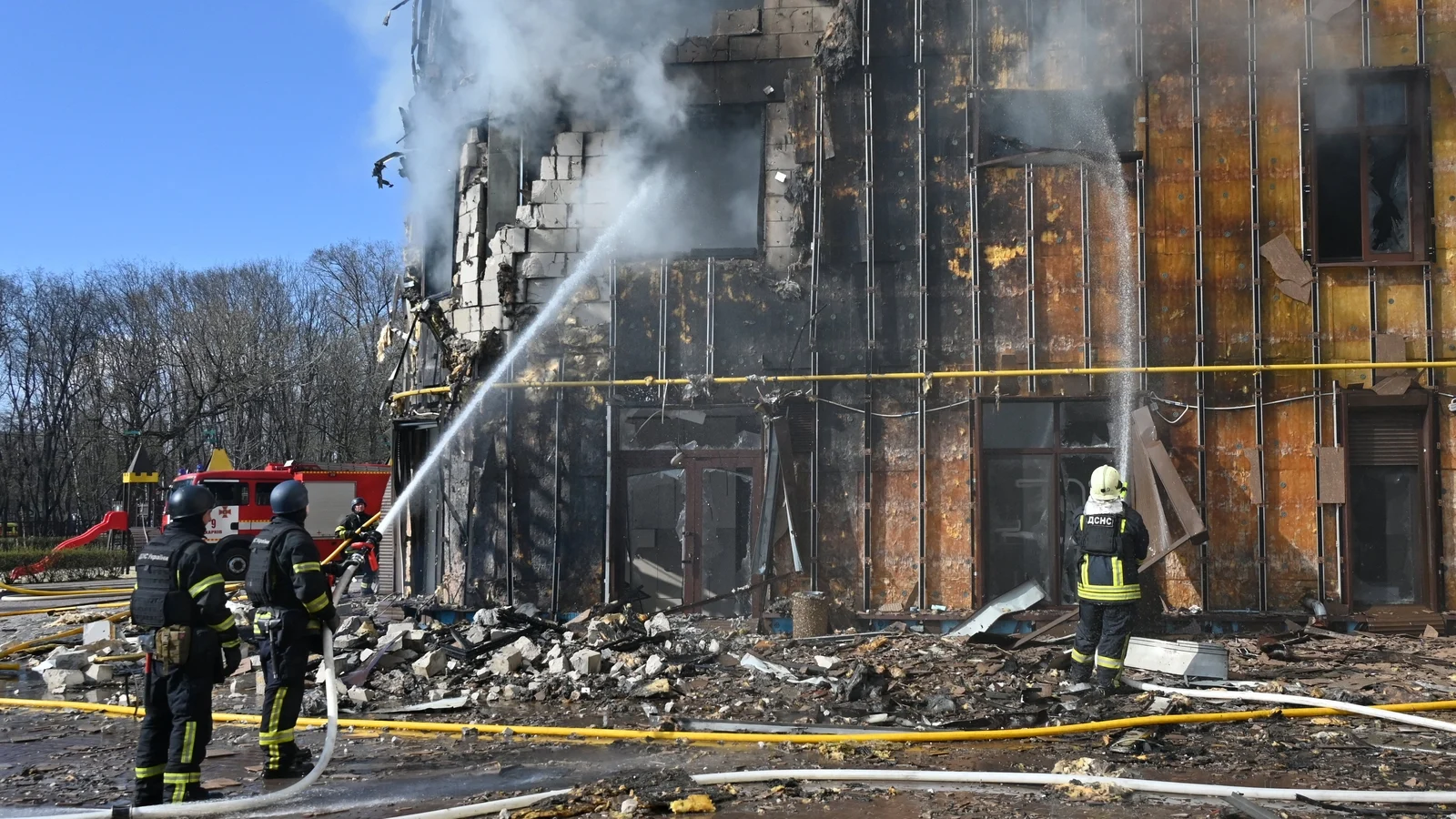
Behind the statistics are people waking to the same electric fear every morning. In Kherson, a 42-year-old man died when a drone struck a civilian car; sixteen others — including a teenage boy and three police officers — were wounded in a mix of artillery and aerial attacks. In Chernihiv, a ballistic missile strike damaged an enterprise’s premises and killed one person, according to local officials. And in the embattled Donetsk region, the city of Druzhkivka bore aerial bomb damage that wounded at least nine and struck administrative buildings and private homes.
“We count broken windows and count people,” said Maria, a volunteer physician in Kherson whose surname she asked to withhold. “You get used to the forms, the lists, the paperwork of grief, but you never get used to the sound of a drone overhead.”
March also saw a dramatic spike in Russia’s use of long-range drones. An AFP analysis of Ukrainian air force daily reports found at least 6,462 such drones were fired into Ukraine last month — nearly 28 percent more than in February and the highest monthly total since the full-scale invasion began in 2022.
The proliferation of drones changes the daily rhythms of life in cities and on the steppe. Air raid alerts are no longer a night-time phenomenon only; they intrude on grocery runs, school dismissals, and funerals. For the front-line soldier, the sky is now as dangerous as trenches and minefields.
Voices from the front and the farm
“We lost a neighbour’s house last week,” said Petro, a farmer from a village near Donetsk. “The shelling doesn’t care about potatoes or hens. In spring, we should be thinking about planting — instead we measure the crater for ruble-sized compensation forms.”
A local official in Druzhkivka, speaking on condition of anonymity, described the city’s endurance: “Administrative buildings are shot, but the registry is still working. We cook, we treat wounds, we teach children in basements. The state becomes the sum of small acts of defiance.”
Beyond the battlefield: digital warfare and the world watching
These developments are not confined to geography. The conflict is increasingly about access to information, resilient supply chains, and the global architecture of private technology companies operating in wartime environments. When a private satellite service becomes a contested asset, policymakers, armies, and courts are all pulled into a new kind of engagement where bytes and bandwidth matter as much as bullets.
What does it mean when a tech blackout is called a military tactic? It raises uncomfortable questions about the modern battlefield: the degree to which civilian platforms are weaponized, the responsibilities of companies that operate satellites and messaging services, and the hunger of states to control narrative and logistics alike.
“If you ask me what will determine the next phase of this war,” said a security policy expert, “it won’t just be tanks or missiles. It will be who can sustain logistics, maintain connectivity, and keep the population resilient. That’s a geopolitical contest as much as a military one.”
Stalemate, strategy, and the human ledger
For now, the map is a patchwork of gains and losses, punctuated by the human ledger: lives lost, towns scarred, families displaced. The pause in Russian territorial gains does not equal peace. It is, instead, a reminder that wars breathe — they inhale and exhale — and that each breath carries consequences.
Internationally, the pause is watched closely. European capitals, diplomatic missions, and aid organisations are recalibrating their assumptions about a war that has already redrawn security calculations across the continent. The surge in drones, the information controls, the month-to-month swings in territory — all of it feeds into a wider debate about how democracies can adapt to long wars fought with technologies that outpace the laws designed to govern them.
So what should we take from a month of no gains? Perhaps this: progress in war is not only measured by lines on a map. It is measured in quiet recoveries, in the battered courage of volunteers, in a teacher who still holds class in a cellar, in a farmer who measures the earth and decides to plant anyway. It is measured by the small, stubborn insistence that tomorrow matters.
When you look at the figures — territories, drones, wounded, killed — remember the people beneath them. Ask yourself: how does the world respond to a conflict whose shape changes with each new app, each new drone? And finally, how do we keep our compassion in step with our politics?
In the mud and thawing fields of Ukraine, spring arrives as it always does: impatient, messy, and full of work. The front may have paused this March, but life — stubborn as a sunflower pushing through frost — carries on.