Two Fathers, One Impossible Friendship: A Quiet Counterpoint to Endless War
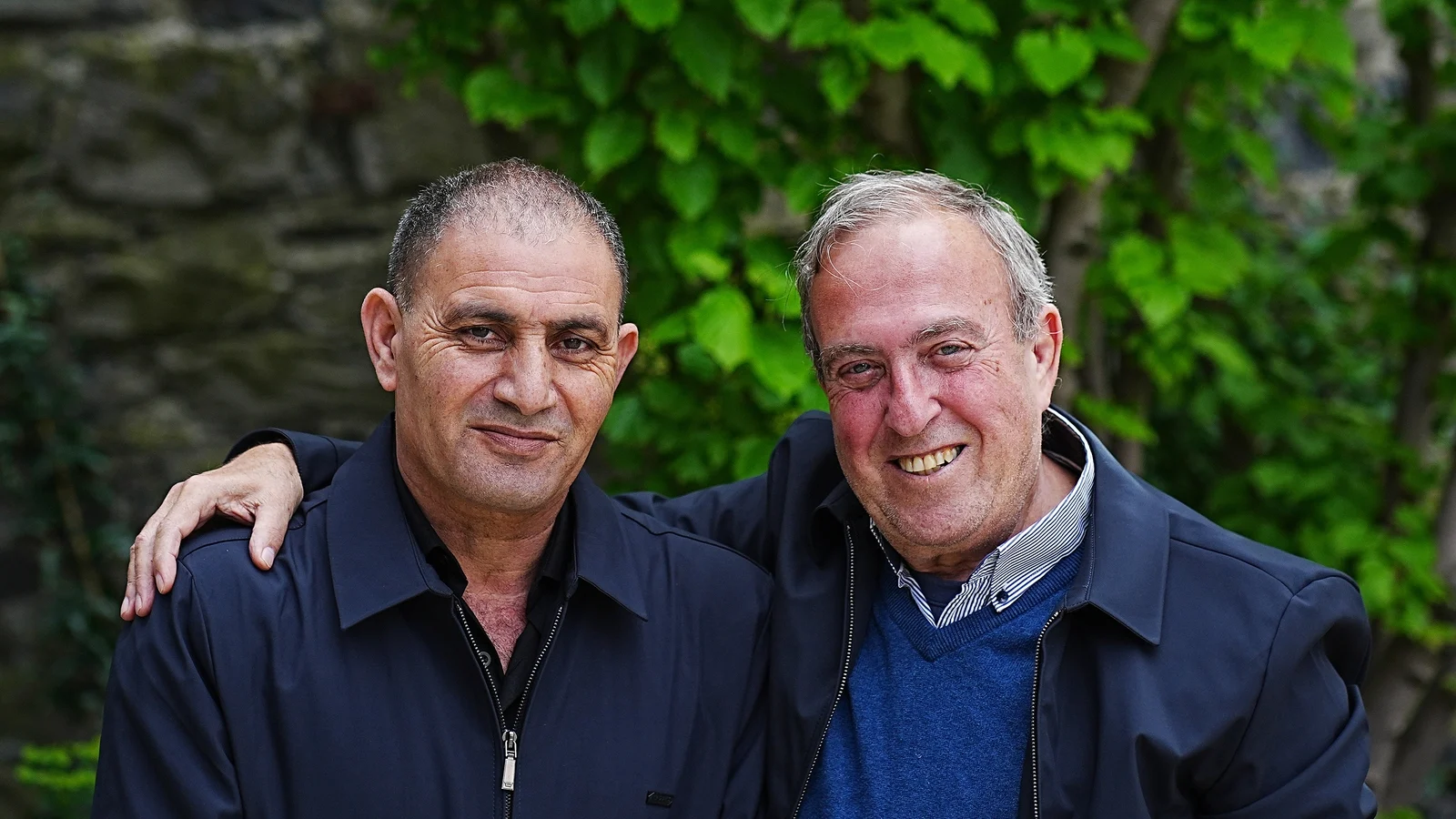
On a damp Dublin evening, beneath the warm glare of stage lights and the hush of a crowd that had come to listen rather than cheer, two men took the same small podium and made an old wound feel like fresh weather: raw, aching, but somehow also a promise.
They did not speak of strategies or slogans. They spoke of daughters.
Rami Elhanan, an Israeli who once fought in the Yom Kippur War, and Bassam Aramin, a Palestinian whose youth was marked by clashes with Israeli forces, have both been carved by personal loss. Where most of us would harden, they have, against expectation, chosen to open.
A meeting that changed everything
Elhanan’s eldest daughter, Smadar, was killed while buying schoolbooks in Jerusalem; Aramin’s daughter, Abir, was shot while playing in East Jerusalem. The kinds of deaths that usually calcify a lifetime of mistrust instead became, for these two fathers, the raw material for unexpected solidarity.
“When I first sat in that room,” Elhanan told the Dublin audience, his voice low and steady, “I expected to find enemies. Instead I found people who knew how to cry like I do.”
He is not alone in that discovery. Their paths crossed through well-worn networks of grief and activism: The Parents Circle – Families Forum, a joint Israeli-Palestinian organisation that brings together hundreds of bereaved families, and Combatants for Peace, a grassroots group of former fighters turned activists. In rooms like these, the language of accusation is often traded for the language of memory.
From suspicion to kinship
“I was suspicious, cynical,” Elhanan admits of his first encounter with Palestinians in a structured dialogue. “I’d only ever seen them as workers, or weapons of war. I had never met them as people.”
Aramin, who spent part of his youth building and hurling at jeeps, remembers meeting Elhanan as the first time he felt seen by someone who had lived on the other side of the headlines. “He told me once that he fell in love with me the minute he met me,” Bassam said, half laughing, half incredulous—a phrase that drew a ripple of warmth from the room. “Not love in the romantic way, but a kind of love that is born when someone else becomes family.”
Family is a loaded word here. For Elhanan, who grew up the son of an Auschwitz survivor, for Aramin, who learned the meaning of the Holocaust only after listening to that survivor’s testimony, family also means carrying the weight of history and trauma together.
Grief as a bridge
They both use grief not as an accusation but as testimony. “You learn the humanity of the person you thought was your enemy when you sit and listen to them tell the story of their child,” Aramin said. “When Rami’s father described the camps, it became real for me—this was not an abstract sadness; it was a person who survived horror.”
Those testimonies have ripple effects. According to The Parents Circle, hundreds of joint events, testimonies and educational programmes have reached tens of thousands of Israelis and Palestinians, carrying personal narratives into schools, churches and community centers. It is the slow, steady work of building empathy in a landscape scarred by decades of conflict.
Why their friendship matters
There is a reason journalists and novelists alike have turned to this pair. Colum McCann’s novel Apeirogon draws from their lives to imagine how intimacy can be a form of resistance. In Ireland, where they have often been welcomed, the comparison to the peace process is natural: people here know what it is to negotiate a bitter history and imagine an uneasy peace.
“We come to Ireland like a football team playing a home match,” Aramin said. “People here understand us. They remember how they stopped killing each other and started talking.”
That reference is deliberate. The Good Friday Agreement of 1998 is a beacon for many who work in conflict resolution; its lessons—dialogue, inclusion, power-sharing—are not a one-size-fits-all solution, but they are a reminder that entrenched cycles of violence can be interrupted.
Respect as the first step
“One word is essential,” Elhanan says. “Respect. Without it, nothing will change.”
It is an elegantly simple prescription for a complex problem. Respect, he argues, is not the same as agreement; it is the willingness to see the other as equal in dignity. “Once you can look into the eyes of the person beside you,” he told the audience, “everything else becomes technical.”
The wider context: hope and hard numbers
This is not a story of abstract hope. In the last decades, the Israeli-Palestinian conflict has flared repeatedly—wars in Gaza, intifadas, and recurring cycles of violence that have claimed thousands of lives and displaced many more. Each flare reinforces polarization and makes moments of reconciliation harder to sustain.
Yet the grassroots peace movement remains alive. Hundreds of joint initiatives—educational programmes, memorial projects, and peacebuilding groups—operate across the region. They are small in scale compared to the machinery of war, but they offer a different measure of power: the ability to change minds.
For some critics, these gestures are naïve at best and performative at worst. For others, they are the bones of any future peace. “You cannot build a political solution without a social one,” says Dr. Eileen Murphy, a peace studies lecturer in Dublin. “When individuals from both sides form sustained relationships, they create constituencies for peace that politicians cannot ignore forever.”
What does it take to trust your former enemy?
Ask yourself: Would you sit across from the person who took your child’s life and listen? Would you invite them to your home? These are not rhetorical questions; they are the daily reality for Elhanan and Aramin.
“It’s the most difficult thing,” Bassam admits. “To trust your killer, your occupier, the one you believe stole your land. Yet here we are.”
They do not promise immediate miracles. They do not guarantee a political breakthrough. What they offer is testimony, and the conviction that testimony can change a heart, and that heart changes a community.
Small acts, big echoes
They meet parents, students, religious leaders. They speak in schools, where young people listen without the armor of decades. They share coffee, tears, sometimes anger. “I lost many friends,” Elhanan says. “But I gained a larger family.”
And with that gain comes a sharpened moral focus. “I know exactly where I’m going,” he added. “I want children in this land to stop dying—Muslim, Christian, Jewish. No children at all.”
A quiet invitation
This is not a neat narrative with a tidy ending. The region is still fractured, and politics remains volatile. But there is a deeper, quieter current here: two bereaved fathers walking into rooms where people are expected to hate, and instead asking them to mourn together.
What would happen if more people in conflict zones—politicians, soldiers, parents, young people—sat across from their supposed enemies and truly listened? What if grief could become a bridge rather than a battlement?
Rami and Bassam cannot end the conflict. But they show us something essential: that human connection, stubborn and ordinary, can be a form of resistance. In a world quick to simplify and to rage, their friendship insists on complexity—and on the hard work of being human together.
- Groups like The Parents Circle – Families Forum bring together hundreds of bereaved Palestinians and Israelis through joint remembrance and education.
- Colum McCann’s Apeirogon, inspired by this friendship, helped bring the story to a wider international audience in 2020.
- Comparisons to the Northern Ireland peace process remind us that entrenched conflicts can, in time and through negotiation and social repair, be transformed.
They left Dublin with new friends, a handful of invitations, and the same stubborn belief: that respect can travel farther than fear. If you are reading this, perhaps the question you should carry away is this—what small, brave act of listening might you undertake in your own community?