Inside a Trial Like No Other: El Salvador’s Mass Prosecution and the Price of Order
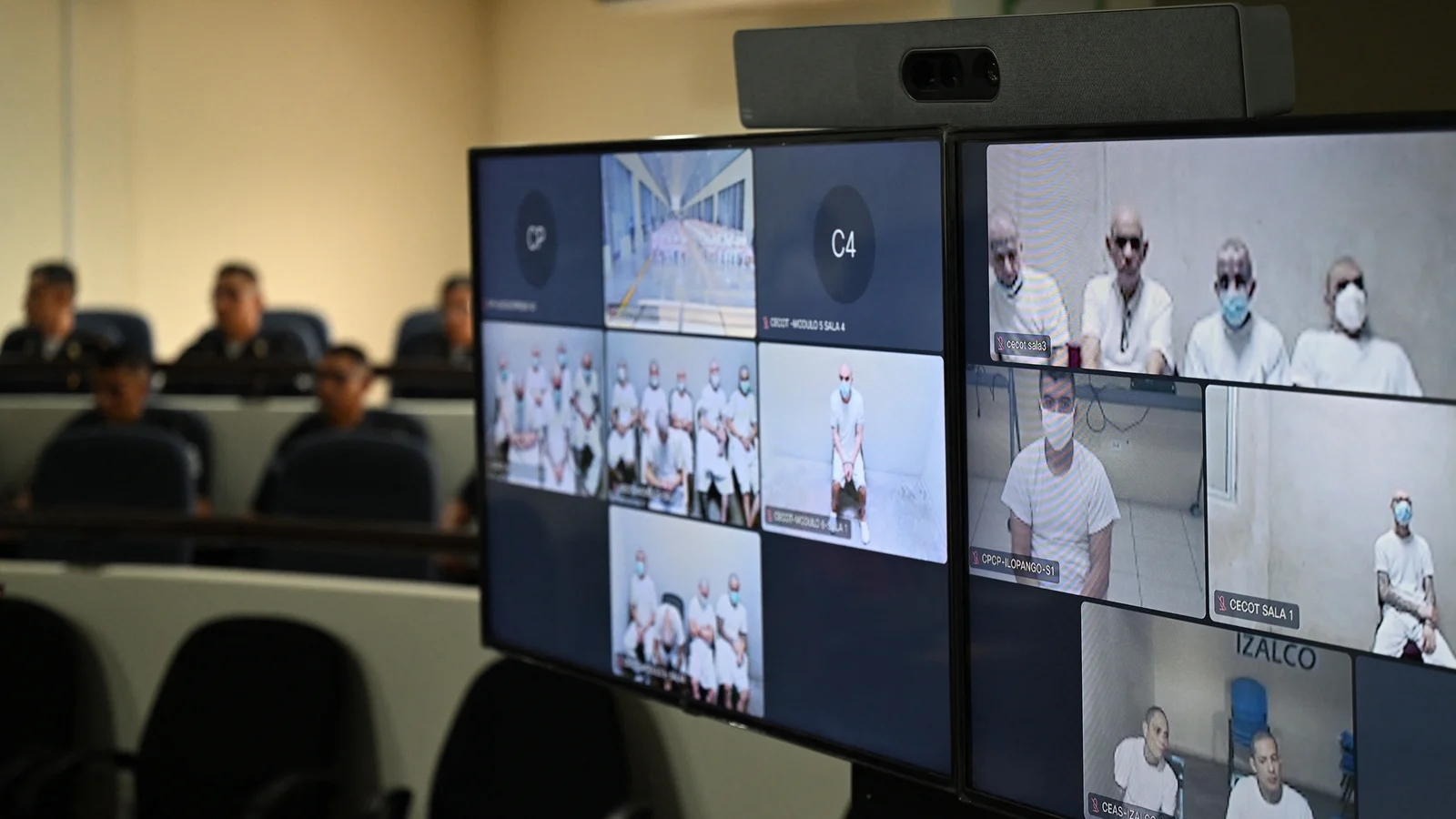
The courtroom was humid, fluorescent lights humming above rows of faces behind steel mesh. Four hundred eighty-six accused sat in grouped benches — a single column in a nightmarish roll call. They were not names on a docket. They were bodies, gestures, murmurs, and stories folded into one collective trial that could reshape how a nation balances safety and liberty.
When prosecutors opened the day, they laid out a dossier that read like a catalogue of violence: some 47,000 alleged crimes spanning a decade, from 2012 to 2022. The charges range from homicide and femicide to extortion and arms trafficking. For many Salvadorans, the list resurrected the long tail of gang conflict; for human rights defenders, it was a warning sign that the legal system was being compressed into an emergency straitjacket.
Numbers that Stun — and Divide
Under a state of emergency imposed in 2022 and repeatedly extended since, security forces have detained more than 91,500 people. The current mass trial — one of the largest under President Nayib Bukele’s zero-tolerance campaign — groups 486 defendants for allegedly belonging to Mara Salvatrucha (MS‑13), the transnational gang that has long terrorized neighborhoods across the country.
“We are trying to put a price on a decade of terror,” said a prosecutor, speaking briskly in the courthouse corridors. “This is about delivering justice to families who lived in fear.”
The government points to a dramatic drop in homicides as proof the strategy works. Bukele’s officials tout a fall in the homicide rate to 1.3 per 100,000 people last year, down from 7.8 in 2022 — figures they say are the payoff for severe measures. “People finally sleep again,” a midwife in San Salvador told me when I asked how life had changed in her barrio. “The streets are quieter, the extortions stopped. But I worry about what happens in the dark.”
Order at What Cost?
Those quiet streets are threaded with another reality: lawyers and human rights organizations argue that the sweeping powers used to achieve this calm have gutted basic liberties. The Inter‑American Commission on Human Rights and local advocates have repeatedly warned that collective prosecutions, prolonged administrative detentions, restrictions on communications, and limits on access to counsel raise serious due‑process problems.
“You cannot hold hundreds of people in one proceeding and meaningfully guarantee each the right to a defense,” said a human rights lawyer who asked not to be named because of security concerns. “Collective trials are a legal oxymoron — efficient, perhaps, but incompatible with justice.”
On one hallway wall of the courthouse, a black-and-white photograph of a weekend in 2012 — a weekend that prosecutors now describe as the bloodiest since the civil war — reminded everyone why the state took such drastic steps. Families on weekdays still light candles at sidewalks for victims whose names never fit neatly in investigative files.
Prisons, Power, and the Face of Punishment
Many of the accused have been moved to high-security facilities, including a fortress-like complex opened by the administration in 2023 called CECOT. The prison, remote and heavily guarded, has become a physical symbol of the government’s approach: containment, isolation, and severity.
“They packed them in like a cargo ship,” whispered a former guard in a nearby plaza, his words soft as coffee steam. “We used to see people in the neighborhood. Now you see only vans and armed men.”
The prosecutor’s office has presented autopsies, ballistic reports, and witness statements to buttress its case, asking judges to impose the maximum sentence for each count. A single defendant could face up to 245 years behind bars if convicted on multiple charges — a sentence that reads like an attempt to account for every grievance at once.
Faces Behind the Numbers
Walk the marketplaces of Soyapango or the narrow streets of Mejicanos and the conversation shifts. A shop owner will tell you the extortionist’s call has stopped; a grandmother will say her grandchildren can play outside again. Yet next to those small reliefs sits a gnawing unease about fairness.
“I’m happy my son is alive,” said a mother whose brother was murdered in 2014 and who supports tough action on gangs. “But I also want to know these people had a real trial. I do not want our democracy to be built on fear of being wrong.”
Security analysts point out that dramatic drops in homicide rates are not unique to El Salvador — other governments have achieved short-term declines through mass arrests or curfews. But whether those gains stick depends on the rule of law and economic opportunities that offer alternatives to gang life.
History Bending Beneath Our Feet
Some of those on trial are alleged to have been leaders during an earlier truce between gangs and the state during Mauricio Funes’s presidency (2012–2014), a controversial episode that divided Salvadoran society. That truce, then and now, reveals a grim calculus: deals struck in back rooms, peace bought in pauses, and a cycle of negotiation and repression that never fully resolved deeper social fractures.
“We keep treating the symptom,” said a sociologist based in San Salvador. “What we haven’t repaired are the wounds of inequality, youth unemployment, and weak local institutions. You can incarcerate hundreds of thousands and still not solve the root causes.”
Questions for a Wider World
As readers, as global citizens, what should we make of this experiment in security? Does a country’s right to protect its people justify sweeping curbs on due process? Or does the erosion of legal safeguards portend a different danger: normalized emergency powers that outlast the emergency?
These are not hypothetical queries. Around the world, democracies wrestling with violence face the same balancing act. El Salvador’s courtroom — packed, rattling, and charged — is a mirror for nations debating whether safety and justice can truly coexist if one is constructed by suspending the other.
Back in the plaza, an elderly woman selling pupusas leaned on her cart and asked me, eyes steady. “If they did these things, let them pay. But if they did not, who will pay us when the law becomes the weapon of those in power?”
What Comes Next
The trial will unfold over weeks, perhaps months. Its outcome will reverberate: for victims seeking closure, for defendants fighting for legal counsel, and for a country watching whether emergency policies end with restored normalcy or calcify into a new order.
Beyond El Salvador’s borders, the case is a cautionary tale and a conversation partner for democracies everywhere — a call to weigh immediate security gains against the slow erosion of rights that, once lost, are difficult to reclaim.
So I leave you with a question: in a world where fear can be as contagious as violence, how much of our liberty are we willing to trade for the illusion of safety? The answers we choose will shape not just law books, but the soundscape of our streets and the stories in our neighborhoods for generations to come.