When the Map Shifts: What a Possible US Drawdown from Germany Means — and Who’s Watching
On a rain-soft morning in a Berlin neighborhood where the scent of fresh bread mixes with the metallic tang of tram lines, conversation turns quickly to one topic: the American military footprint. At a small table in a café near the Tiergarten, a retired technician from a nearby NATO logistics depot stirs his coffee and says, “We woke up to a message, not a telegram.”
It’s an apt way to describe the way policy now travels: quick, loud, and sometimes only a few lines long. President Donald Trump posted on Truth Social that “The United States is studying and reviewing the possible reduction of Troops in Germany, with a determination to be made over the next short period of time.” That sentence — terse, public, immediate — rippled through diplomatic corridors from Washington to Berlin to Brussels.
Numbers that Tell a Story
Numbers have a way of grounding political theater. According to the US Defense Manpower Data Center, the United States had just over 68,000 active-duty troops permanently stationed across Europe in December 2025. Of those, roughly 36,400 were based in Germany — a figure that echoes a different era, but in a quieter key.
Where those figures sit against history is stark: in 1985, at the height of the Cold War, the US had about 250,000 troops in West Germany. The scale of America’s presence then was monumental, almost a physical line in the sand against the Soviet Union. Today’s presence is smaller, but no less symbolic.
What’s at stake in plain terms
- US troops in Europe (Dec 2025): ~68,000
- US troops in Germany (Dec 2025): ~36,400
- US troops in Germany (1985): ~250,000
Pulling those forces, even partly, would not be an abstract budgetary decision. It would reverberate from family bases in Kaiserslautern, to military logistics hubs like Ramstein Air Base, to alliance politics in Brussels. It would tilt the map of American reach.
Diplomacy, Disagreement, and a New German Posture
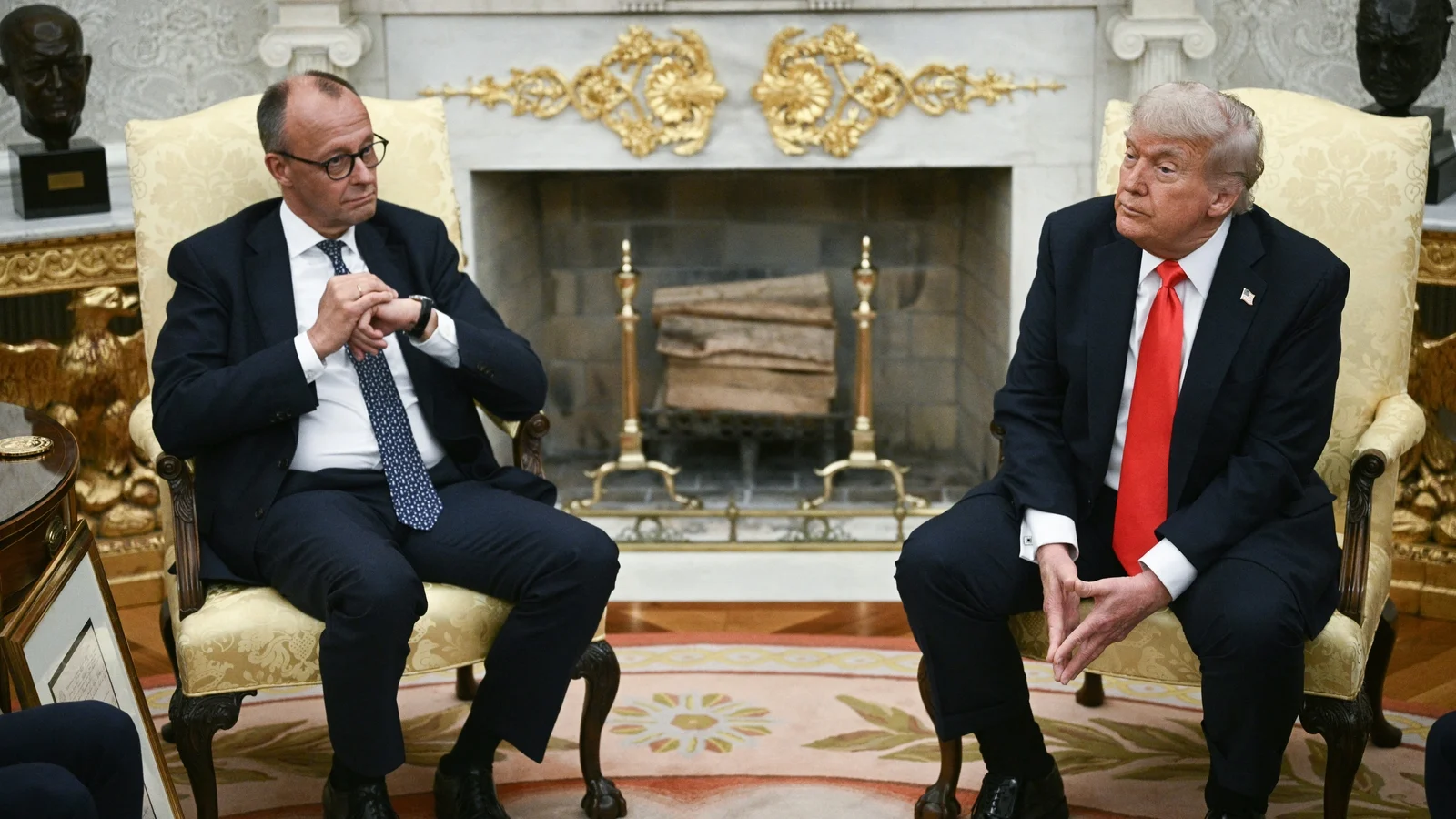
The announcement didn’t arrive in isolation. Over the past weeks, a public spat has surfaced between Mr. Trump and German Chancellor Friedrich Merz over the hostilities in Iran — a reminder that alliances are not immune to personal and policy frictions. Mr. Trump dismissed Mr. Merz’s comments about Iran, saying the chancellor “didn’t know what he was talking about,” while Mr. Merz later insisted relations were fine despite the row.
Against that background, Germany has been quietly, deliberately rewriting its military script. Last week Berlin published a defense document signaling its intent to become Europe’s leading conventional force — the most significant German strategic pivot outside NATO since World War Two. General Carsten Breuer, Germany’s top general, traveled to Washington to brief US officials on those plans. He told reporters that Defence Undersecretary Elbridge Colby showed “great appreciation” for the document and Germany’s financial commitments.
Mr. Colby, posting on X, framed it bluntly: “President Trump has rightly laid out that Europe must step up, and NATO must no longer be a paper tiger. Germany is now taking the leading role in this. After years of disarmament, Berlin is stepping up.”
Voices at Ground Level
Not all reactions have been measured or strategic; many are human and immediate. “My grandson sleeps under a poster of a C-130,” says Anna Müller, whose family rents out rooms near a US base. “If the Americans leave, it’s not just shops that will close — it’s a network of friendships.”
At a mess hall on a base in southern Germany, a sergeant — speaking on condition of anonymity — shrugged and said, “We’re service members first. Politics comes and goes. But you can’t separate the mission from the people who do the mission.”
Observers in Washington offer another layer. Jeff Rathke, a former US diplomat and now president of the American-German Institute at Johns Hopkins University, put the matter bluntly: “US forces in Europe are not a charitable contribution to ungrateful Europeans – they are an instrument of America’s global military reach.”
Why this matters beyond flags and parades
Think about logistics and rapid response. Bases in Germany are key nodes for American operations in Africa, the Middle East, and eastern Europe. A reduction would alter timelines for reinforcements, complicate NATO exercises, and force allies to fill gaps not only with money but with doctrine and readiness.
And there’s the optics: when a superpower scales back a permanent presence, it gives rise to narratives — about retreat, realignment, or retrenchment. Those narratives then shape policy choices in capitals hundreds or thousands of miles away.
Who Gains, Who Decides?
If Washington decides to pull back, the immediate question is whether Europe — and Germany in particular — can absorb the strategic and economic cost. Berlin’s new defense strategy signals willingness. Yet rearmament is expensive and politically fraught in a country that has, for decades, viewed military power with caution.
“We want to be a pillar, not a shadow,” said a senior German defense official in Brussels, declining to be named because talks were ongoing. “But pillars must be built, and that takes time.”
Economically, communities around bases would face job losses and shrinking local economies. Strategically, NATO would be forced to reckon with a more distributed and less American-centric defense posture. For allies in Eastern Europe, worried about Russia’s ambitions, a smaller US footprint in Germany could mean heightened anxiety.
Big Questions for a Small World
What does sovereignty mean in an era when security is both local and global? Can Europe sustain a credible conventional force without decades of US basing? How do human stories — families, workers, enlisted personnel — factor into decisions often framed as geopolitical chess?
These aren’t hypothetical. They are real choices with real consequences for people who live and work around bases, for families whose breadwinners deploy, and for allied capitals balancing defense budgets and public sentiment.
Three quick realities to keep in mind
- Any withdrawal would require logistical planning measured in months or years, not days.
- Germany’s defense ambitions are growing, but they are being built against a backdrop of domestic debate and fiscal constraints.
- US forward presence in Europe serves both defensive and expeditionary purposes — removing it shifts those strategic calculations.
Closing: The Human Geometry of Strategy
Back at the café, the retired depot technician scans the news and laughs softly. “We have coffee from the same place since 1989,” he says. “Things change. Friends leave and new friends come. But we learn to find the constants — good bread, good conversation.”
Policy is often written in capitals and posted online in blunt sentences. But at its core, it ripples through lived lives: through kids going to school on base, through shopkeepers whose livelihoods depend on steady paychecks, through soldiers and diplomats who build the scaffolding of alliances. When a map shifts — even a little — we should ask not only where the lines move, but who the movement leaves in its wake.
So here’s the question for you, the reader: if a great power redraws its military footprint, how should communities, allies, and leaders respond — with caution, courage, or something in between? The answer will be shaped as much by budgets and battalions as by the quiet decisions people make over coffee in city squares and living rooms across the Atlantic.