David Attenborough at 100: The Voice That Made the Earth Feel Like Home
On a bright May morning in 2026, the world celebrated a man who has spent a century listening—to tides, to trumpeting elephants, to the subtle mechanical click of a beetle’s wing—and to us, the people who needed him to tell the story.
Sir David Attenborough turned 100 on 8 May, and for those who grew up with his voice as the soundtrack to childhood curiosity, his birthday feels less like a single day on the calendar and more like a milestone in a long conversation about who we are and the home we’ve inherited.
A lifetime narrating our planet
Seventy years of filmmaking is more than a career; it’s an archive of wonder and a slow-motion witness to change. From his early days on Zoo Quest—when he returned from the field with animals destined for London Zoo—to the sweeping, elegiac canvases of Life on Earth in 1979, Attenborough turned natural history into storytelling that felt intimate and urgent at once.
“When I was a child, I thought the world ended at the garden gate,” said Asha Patel, a teacher in Leicester who brought her class to a centenary screening. “He taught us there are worlds inside a puddle and dramas unfolding on distant ice floes. He made us care.”
Those dramas were often unforgettable. There was the 1979 moment when two young mountain gorillas clambered onto him while the cameras rolled, and the gut-punch of Lonesome George—the last of his species—whose filmed decline and death put extinction in human terms. In more recent decades, sequences like the orcas creating waves to wash seals from ice floes or the heartbreaking images of albatross chicks fed plastic from the sea left viewers changed.
Blue Planet II in 2017 did more than win awards; it altered behavior. That series sparked an outcry over plastic pollution that rippled beyond living rooms into government policy and supermarket aisles. “We saw petitions, ban proposals and corporate pledges within weeks,” says Dr. Lena Müller, an environmental policy analyst. “A TV series didn’t just inform—it mobilised.”
How one voice moved the world
It is easy to quantify some of Attenborough’s impact—decades on the BBC, programmes watched across dozens of countries, thousands of hours of footage—but harder to measure the quieter ways he shifted a culture’s sympathy. He has been a bridge between science and storytelling, translating complex ecological trends into page-turning narratives.
“He made the invisible visible,” says Mike Salisbury, a long-time collaborator, who remembers Attenborough’s meticulous curiosity on set. “David didn’t just describe animals; he listened to them. He treated every sequence as if it were the first time anyone had ever seen that moment.”
That listening is more important than ever. Scientists now say biodiversity is declining at an unprecedented rate—an estimated one million species are at risk of extinction, the Intergovernmental Science-Policy Platform on Biodiversity and Ecosystem Services warned in 2019—and the planet has warmed more than 1°C since the late 19th century. Those cold facts are humanised when a voice like Attenborough’s anchors them to memory and feeling.
Centenary celebrations: global, local, musical
Across Britain and around the world, the centenary became a week’s worth of rituals: special broadcasts on the BBC, concerts at London’s Royal Albert Hall, immersive shows at the Natural History Museum, and community-led nature walks that connected a familiar narrative to local soil.
- In London, the Royal Albert Hall hosted a night of music and film, a program that mixed the orchestral scores of Planet Earth with songs that had become part of the series’ DNA—Hoppípolla played by an Icelandic ensemble, the pounding rhythms of film-score classics, and new performances inspired by scenes people watch over and over again.
- Outernet Tottenham Court Road transformed part of the city into a five-minute immersive piece called Our Story With David Attenborough, condensing a lifetime into a short, luminous, free experience for passersby.
- In Morecambe Bay, artists drew Attenborough’s likeness in the sand—an ephemeral portrait that the tide would reclaim, fitting for a life dedicated to showing us the impermanence and the preciousness of the world.
“I came for the music and stayed because I remembered where I’d been on the first time I saw Planet Earth,” said Hassan Ali, a postal worker who queued for hours outside the Royal Albert Hall. “You don’t expect a TV voice to hold you like a grandfather. But his does.”
At home in Richmond, still curious
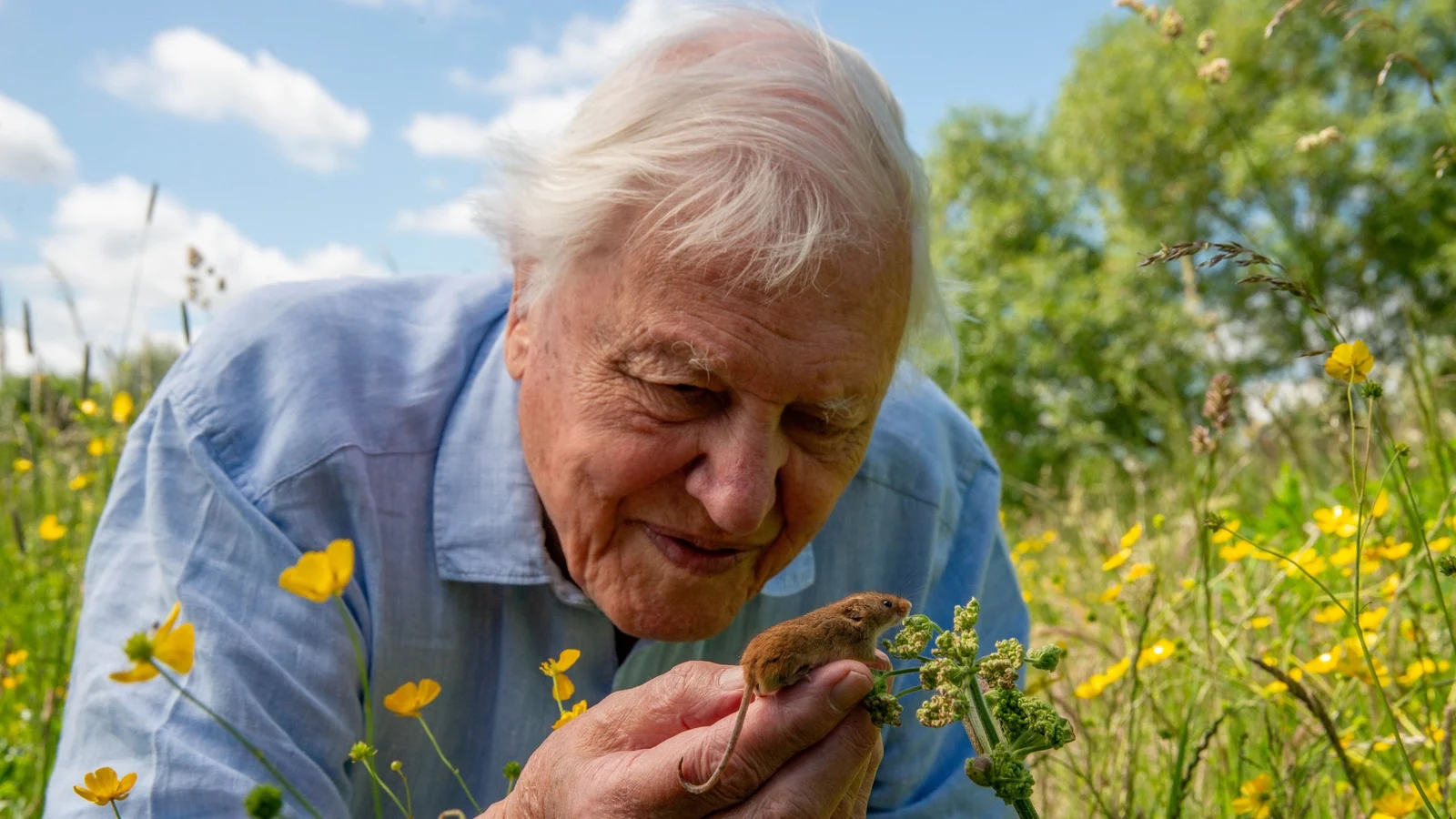
At 100, Attenborough no longer treks through jungles or stands for hours in the polar wind. He has traded some of the globe-trotting for the small triumphs of the near-at-hand—Wild London, a 2026 series, revels in urban foxes, beavers returning to rivers, hedgehogs, and the surprising wildlife of a metropolis.
“After all that travel, he told me once, he loves Richmond best,” recalls Eleanor Marks, a neighbour. “There’s a quietness there. He loves the river and the chestnuts in spring. He knows the birds by their calls.”
The personal touches around his centenary were affectionate and playful: charities named rescued animals in his honour, orchestras arranged suites of familiar themes, and grassroots groups organised tree plantings and guided walks—small public actions that echo the larger conservation message he has championed.
Legacy, responsibility, and the question for readers
Celebrating a life as luminous as Sir David’s can be more than nostalgia. It can be a moment of reckoning. What does it mean to inherit a planet he has spent his life explaining? How do we answer his long-standing challenge: if we know what is happening, what will we do about it?
“David asked us to feel, and then to act,” says Dr. Jorge Alvarez, an ecologist. “He never told us what to do with our lives, but he made us feel the weight of our choices. That is a remarkable gift.”
So on his 100th birthday—whether you watched him as a child bent over a bedroom bookshelf, listened to him in a lecture hall, or caught his voice on a late-night documentary—ask yourself: what will my small part be? Will it be planting a tree, pressing a petition, cutting single-use plastics, or simply teaching a child to look for life’s quiet miracles?
Sir David has been clear that story and stewardship go together. If his century of broadcasting has taught us anything, it is that knowing is the first step; caring must come next, and action must follow.
As the celebrations wind down and the sand portraits vanish with the tide, the challenge remains: can the rest of us live up to the urgency, the curiosity, and the tenderness that one man coaxed out of millions? If ever there were a moment to answer that question, his hundredth year feels like it.