Under the Shrapnel of Night: A Dormitory, a Town and the Quiet Geometry of War
It was a small town that most foreign maps ignore until violence knocks on its door: Starobilsk, a modest settlement in Lugansk, now for months and years a place of occupation and quiet dread. In the early hours, when most of its young residents should have been sleeping, an attack tore through the night. Windows blew out. A five-storey dormitory groaned and collapsed inward. By morning, officials in Moscow were counting names, and families were counting seconds that had stretched into aching uncertainty.
Russian officials say six people were killed, 39 wounded and 15 unaccounted for after what they described as a drone strike on a college dormitory. President Vladimir Putin—speaking on television—called the assault a “terrorist” act and ordered the defence ministry to prepare a response. Leonid Pasechnik, the region’s Moscow-installed governor, posted that 86 children aged 14 to 18 had been inside the building at the time.
The scene: flames, broken glass and a city of waiting
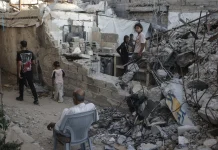
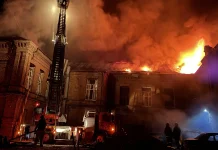
Images shared by local authorities show a college with gaping windows and a blaze licking at an upper floor—photographs that look like a déjà vu of so many other nights during this war. The town lies about 65km from the active frontline, captured by Russian forces in the early months of the 2022 invasion. In a landscape littered with competing narratives, these images became the immediate story: a civilian facility struck, students in their beds, a community jolted awake.
There was, notably, no immediate comment from Kyiv. Ukraine has repeatedly denied deliberately targeting civilians; it says its drone strikes are aimed at military positions or infrastructure used for war. Moscow, by contrast, accused Ukrainian forces of launching multiple drones at the academic building. Russia’s Investigative Committee described the five-storey structure as having collapsed down to the second floor.
Voices from Starobilsk
“I heard an explosion like the sky had fallen,” said a teacher who rushed to the site, her voice tight with exhaustion. “We pulled out people who were still breathing. The dust smelled like plaster and smoke; the kids were coughing and shaking.”
A mother, clutching a small pink scarf, stood near the cordon and said between sobs, “My daughter slept in a different dorm tonight. If she’d been there—” Her sentence broke. Nearby, an elderly man lit a cigarette—brief, solitary defiance—and said, “We are used to fearing the front, but not the school. Not the children.”
Not everyone speaks freely in occupied towns. A local volunteer who asked for anonymity described frantic searches through the rubble: “We scraped and called. You don’t stop until you either find someone or the rescuers tell you to leave. You cannot explain the feeling—every sound is a small monstrous hope.”
Why a college dormitory matters
Beyond the human toll, the attack highlights the fragile reality of occupied territories where civilian life and military logic collide. Dormitories and schools are not merely targets on a map; they are where teenagers rehearse adulthood, where teachers try to keep study alive in a climate of fear and where parents pin their hopes for normalcy.
The wider truth is stark: the conflict’s geometric grinding does not respect the boundaries between combatants and civilians. The United Nations Human Rights Monitoring Mission in Ukraine has recorded more than 60,000 civilian casualties since 2022—an arresting number that underlines how entire societies have paid a daily price. Nearly 90% of those casualties were documented in areas controlled by Ukraine, reflecting both the intensity of fighting there and the challenges of documenting events in occupied zones.
Drone warfare and the new frontlines
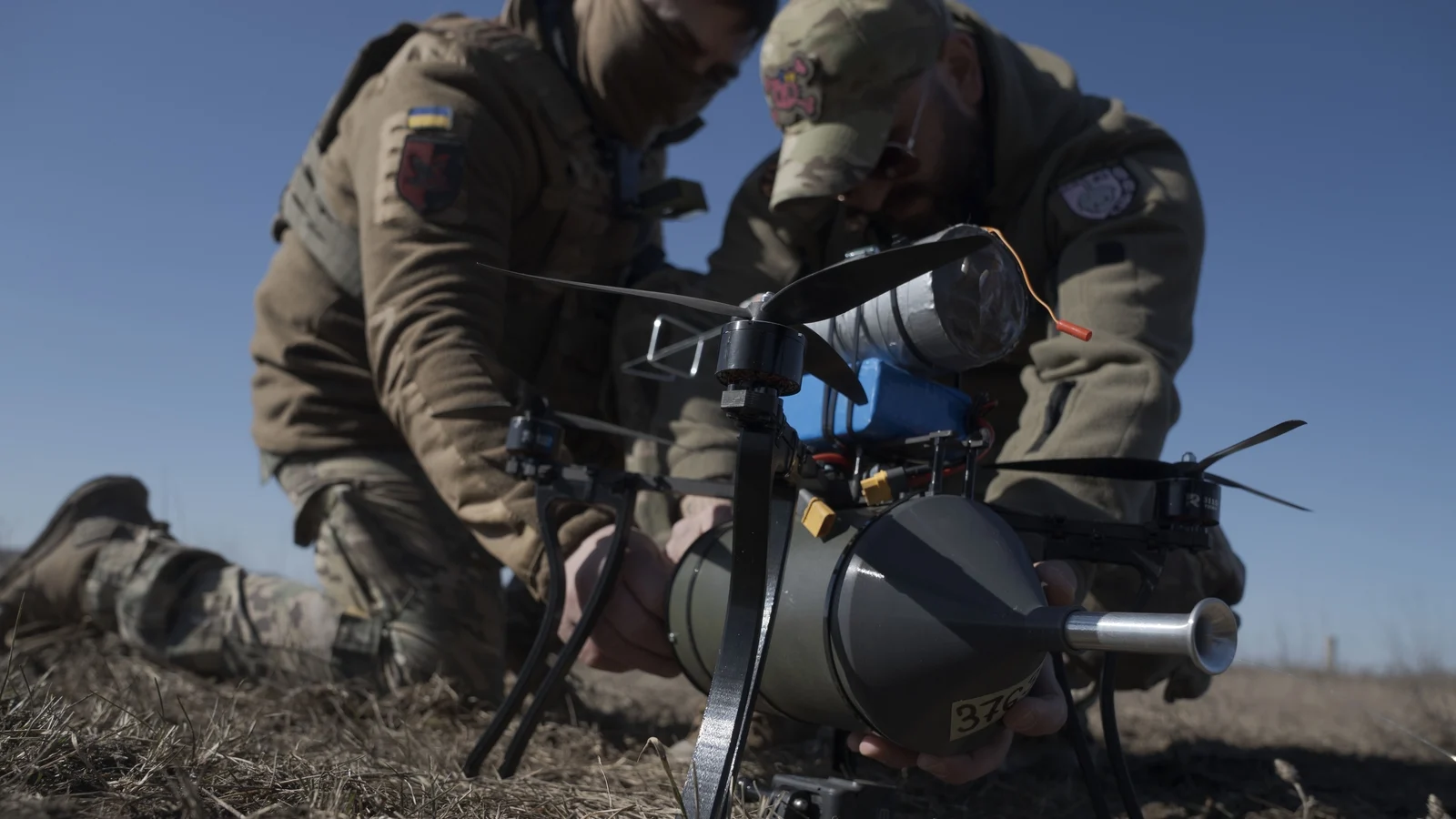
We are living through a proliferation of drones—cheap, adaptable, and increasingly lethal. Both sides have used unmanned aerial vehicles for strikes, surveillance and psychological warfare. Ukraine, unable to match Russia’s air and missile capacities conventionally, has leaned heavily on drones to harass logistics, bases and rear areas. Russia, meanwhile, launches waves of drones and missiles that have struck cities, energy infrastructure and neighborhoods deep inside Ukraine.
“Drones compress the battlefield,” said a military analyst in Kyiv. “They make the rear camp a frontline. That’s why a dormitory in an occupied town ends up within the calculus of attack.”
The Ukrainian air force reported that Russia had fired more than 100 drones in a recent salvo between late yesterday and this morning—an accusation framed by Kyiv as part of relentless strategic pressure. For civilians, these numbers become the rhythm of sleepless nights and evacuated classrooms.
Law, blame, and the slow architecture of proof
Every such incident is swiftly politicized. Moscow’s foreign ministry promised “inevitable and severe punishment,” and Putin vowed there would be “no leniency.” Kyiv, tightly focused on its own survival and defence strategy, has said nothing publicly about the Starobilsk strike at the time of reporting. In the middle lies a tangle of forensic difficulty: who fired the drones, from where, and with what intent?
“We need an impartial, independent investigation,” urged a human rights lawyer who has tracked violations in eastern Ukraine. “Evidence can be destroyed or staged. Witnesses can be intimidated. International bodies must be able to get access, and that is not easy in occupied territory.”
What the story of a single night tells us
Think of Starobilsk not as an isolated tragedy but as a prism reflecting broader patterns: the weaponization of the ordinary, the displacement of education and childhood, and the global spread of relatively inexpensive technologies that make distant strikes possible and accountability harder to secure.
What do we ask of the international community? How do we protect schools and dormitories in contested landscapes—especially when traditional doctrines of warfare are being rewritten by small, autonomous systems? How do grieving families—those who lost a teenager, or those who still wait by the rubble—get justice beyond a press release and a televised condemnation?
As you read this from whatever time zone you occupy, remember that Starobilsk is not alone. Across Ukraine, towns and suburbs keep tally of losses the way some families keep holiday calendars: dates marked by memory, by silence, by visits to memorials. This is an era when civilians live in the shadow of devices once thought toys; the consequences are measurements of humanity’s collective failure to keep war contained.
So we circle back to the faces: the teacher, the exhausted volunteer, the parent with the pink scarf. Their grief is immediate. Their questions are universal: will anyone be held to account? Will children again be able to sleep without fear? And what does it say about our world when a college dorm is as vulnerable as any frontline bunker?
We will keep watching, asking, and reporting. What do you think should change—on the battlefield, in halls of power, and in the rules that try to shape human conduct in war? Your answer is part of the conversation the world can no longer afford to ignore.