With Gulf leaders uneasy about Washington’s tentative framework with Tehran, US Secretary of State Marco Rubio used the final stop of his Middle East tour to promise that any deal with Iran will reflect the security interests of America’s regional partners.
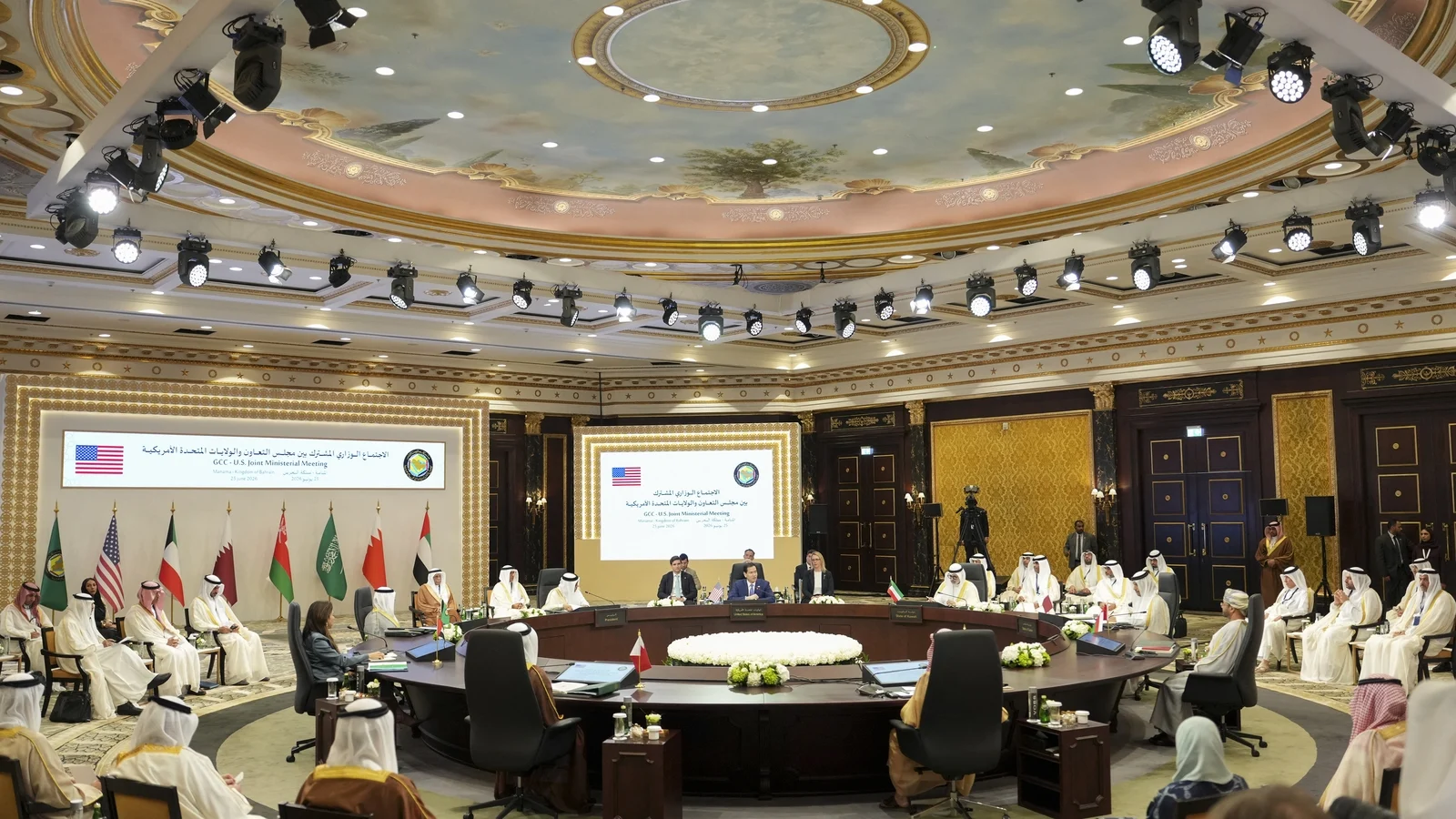
Addressing Gulf Arab foreign ministers in Bahrain — home to the US Navy’s Fifth Fleet — Mr Rubio said the United States was pursuing a lasting peace with long-time foe Iran, but not one that leaves allies in the oil-rich region exposed. Several Gulf states came under Iranian attack during the conflict and have warned privately that the preliminary accord appears too lenient.
On his first regional trip since the US and Iran signed a memorandum of understanding to end the Middle East war, Mr Rubio underscored that Washington wanted a peace deal, but not “at any price”.
Iran fought two of the world’s most powerful armies — the US and Israel — during the conflict and took effective control of the vital Strait of Hormuz, heavily disrupting oil flows and rattling global energy markets and the wider economy.
Mr Rubio told reporters that Gulf allies had raised “very serious” concerns and wanted visibility on each stage of the peace accord, which includes provisions on Hormuz.
If Iran threatens or blocks ships in the Strait of Hormuz, “then we’re going to have a problem”, Mr Rubio said. Earlier, he told a Gulf Cooperation Council (GCC) meeting that “no country on Earth has the right to charge for the use of international waterways” and that shipping fees would never be part of any deal.
“International waterways do not belong to any nation state. This is a foundational principle in the world today, without which the world would be in total chaos,” Mr Rubio told ministers.
“If in fact we accepted that you can charge money to use an international waterway because it happens to be near your territorial space, well then this will spread throughout the world like a contagion.”
Mr Rubio said he did not discuss a $300 billion reconstruction fund for Iran that is part of the peace proposal. Gulf states fear Iran would use that money to revive its military capacity.
Bahrain’s Foreign Minister Abdullatif bin Rashid Al Zayani, who chaired the gathering, welcomed Oman’s announcement of a corridor for the safe passage of vessels through the strait.
Oman told the meeting that future arrangements for the Strait of Hormuz would not involve transit tolls.
Reassuring way regional allies
Mr Rubio’s three-day tour of the Gulf was the first high-level diplomatic mission since the US-Iran framework agreement last week to end the conflict, which started on 28 February with US-Israeli strikes on Iran.
At earlier stops in the UAE and Kuwait, Mr Rubio worked to convince officials that the proposal was not tilted toward Tehran, which struck several Gulf states during the war.
“We’re not going to do anything that undermines the security of our allies, our longstanding allies in the region,” he told reporters in Kuwait.
US President Donald Trump said on Tuesday that Iran had agreed to nuclear inspections into “infinity,” while Tehran said it had made no such concession in negotiations.
The two countries, which ended a first round of negotiations in Switzerland on Monday, have also offered conflicting accounts about financial incentives for Iran, control of the Strait of Hormuz, and Israel’s parallel war in Lebanon.
Mr Rubio told allies that “International waterways do not belong to any nation state”
All six GCC nations Saudi Arabia, Qatar, Oman, the United Arab Emirates, Bahrain and Kuwait are strategic US allies that offered some degree of logistical support to Washington during the war, and all were buffeted by Iranian airstrikes as a result.
Together, they form the backbone of America’s security architecture in the Middle East. Any shift by these countries in how they view their security ties with the US could carry major consequences for US military strategy across the region.
The draft US-Iran agreement includes no limits on Iran’s ballistic missiles, a proposed $300bn reconstruction fund and provisions that could expand Tehran’s regional influence and control over critical oil shipping lanes.
Some US Gulf allies are privately concerned that the interim deal could become a pathway to US normalization with Iran, a predominantly Shi’ite country that most Sunni-led GCC states consider their main adversary.
Occupied southern Lebanon
Meanwhile, senior Israeli and Lebanese officials have denied that there had been any Israeli withdrawal from occupied southern Lebanon, after a US official said Israel had pulled some troops back as a good faith gesture toward Lebanon’s government.
Israel and Lebanon have been discussing a US-backed proposal for Israeli forces to hand some of the territory they occupied in their war with Hezbollah to Lebanon’s military — a possible step toward restoring Lebanese control in the south.
The “pilot zone” proposal has featured in the latest round of Israeli-Lebanese talks in Washington, mediated by the US. Those talks have resumed even as they appeared to be eclipsed by Iran’s move to make Lebanon central to its own talks with Washington.
A US State Department official said that “Israel has already taken a concrete step by pulling back from a part of its buffer zone”. The so-called buffer zone is a vast area of southern Lebanon that Israeli forces are occupying north of the Israeli border.
The official described the move as “a significant demonstration of good faith toward Lebanon’s legitimate government.”
“The (Lebanese Armed Forces) should now move in and verifiably clear out terrorist weapons and infrastructure. This model will be repeated across South Lebanon, enabling the safe return of displaced families, reconstruction of the south, and the restoration of full Lebanese sovereignty,” the official added.
Smoke rises after an Israeli Army airstrike in southern Lebanon on 6 June
A senior Israeli defence official rejected the account, saying there had been no pullback or withdrawal and that Israel would not be leaving its buffer zone.
A senior Lebanese military official said developments on the ground in recent days “show the opposite of a pullback”.
Israel has been enforcing its buffer zone against anyone approaching, including the Lebanese army, the official said. Israel’s military said in a statement there had been no change in the location of its soldiers in the zone.
Israel has established what it describes as a buffer zone about 10 km into Lebanon from the Israeli border. Its military has forced the local Lebanese population from their homes and carried out raids on villages, destroying buildings.
Israeli officials say the area is intended to protect communities in Israel’s north from Hezbollah attacks. It says it has found Hezbollah weapons. Israeli Prime Minister Benjamin Netanyahu has repeatedly said that the military would not be withdrawing from the area.
The discussions about handing over Lebanese territory to the Lebanese army concerned a few areas outside the buffer zone — not inside it the senior Israeli official said.
The State Department official said the pilot zone process was aimed at ensuring the complete and verifiable destruction of Hezbollah’s weapons and infrastructure and the dismantling of non-state armed groups.
A second Lebanese military official said the Washington talks had focused on a mechanism through which the pilot zone plan would be implemented, but that disputes had emerged.
Lebanon’s government wants the pilot plan to be implemented within Israel’s buffer zone, while Israel wants to start by withdrawing from areas north of that area, the official said.
Israel has insisted on separately negotiating each area it could hand over without setting a timeline, while Lebanon wants to see a roadmap for full Israeli withdrawal, the official added.
Another Israeli military official said yesterday that the military had not received orders to hand over any position to the Lebanese army and that, for now, it would not permit the Lebanese army or civilians to cross into the buffer zone.
“We will not allow the Lebanese army to go south from the security line,” the official said.