Fresh Ukrainian strikes on Crimea knocked out electricity in Sevastopol, the peninsula’s largest city, Russian and Ukrainian accounts said, underscoring Kyiv’s push to disrupt the Russian-held region annexed by Moscow in 2014.
Crimea has been forced to suspend fuel sales to the public as Ukraine’s military targets Russian supply lines to the peninsula and has struck a string of oil refineries and depots across southern Russia that help keep them running.
Sevastopol’s Moscow-installed governor, Mikhail Razvozhayev, appealed to residents to check on vulnerable neighbours and to limit phone use to emergencies, urging people to conserve battery power and avoid overloading communications networks.
“The enemy is once again striking treacherously, attempting to deprive us of normal living conditions and sow panic,” he said.
Razvozhayev said parts of the city — where temperatures are nearing 30C — would remain without power until at least this evening.
“It is important that as many Russians as possible come to understand that it is the Russian leadership’s rejection of diplomacy that is prolonging the war,” Ukrainian President Volodymyr Zelensky said on X.
Ukraine’s SBU security service said it had hit two military airfields and air defence systems in Crimea.
In Ukraine’s south, a Russian strike on the Kherson region killed two mine disposal experts from Oslo-based charity Norwegian People’s Aid, the region’s governor said.
The strike hit the village of Novopetrivka, governor Oleksandr Prokudin wrote on Telegram.
“Two staff members of Norwegian People’s Aid sustained fatal injuries in the attack. Four other specialists were wounded,” he added in a later post.
The deputy head of the Kherson region’s military administration said those affected were Ukrainian citizens.
The region’s prosecution service said it was a missile strike.
Dozens of aid workers have been killed and injured since Russia launched its full-scale invasion of Ukraine in February 2022, according to the Aid Worker Security Database.
Norwegian People’s Aid said it has more than 450 staff in Ukraine.
Russian regional leaders also reported deaths from Ukrainian strikes inside Russia: governors said separate drone attacks killed two people in the Nizhny Novgorod region, hundreds of kilometres from the front line, and one person in the border region of Belgorod.
On the Ukrainian side, authorities said a Russian drone attack killed a 56-year-old woman in the border region of Kharkiv.
Russia’s defence ministry said its forces destroyed more than 300 Ukrainian drones overnight, as both countries have stepped up long-range strikes in recent weeks.
Ukraine’s General Staff said its latest night-time operation hit a major natural gas processing plant and two key satellite communications centres.
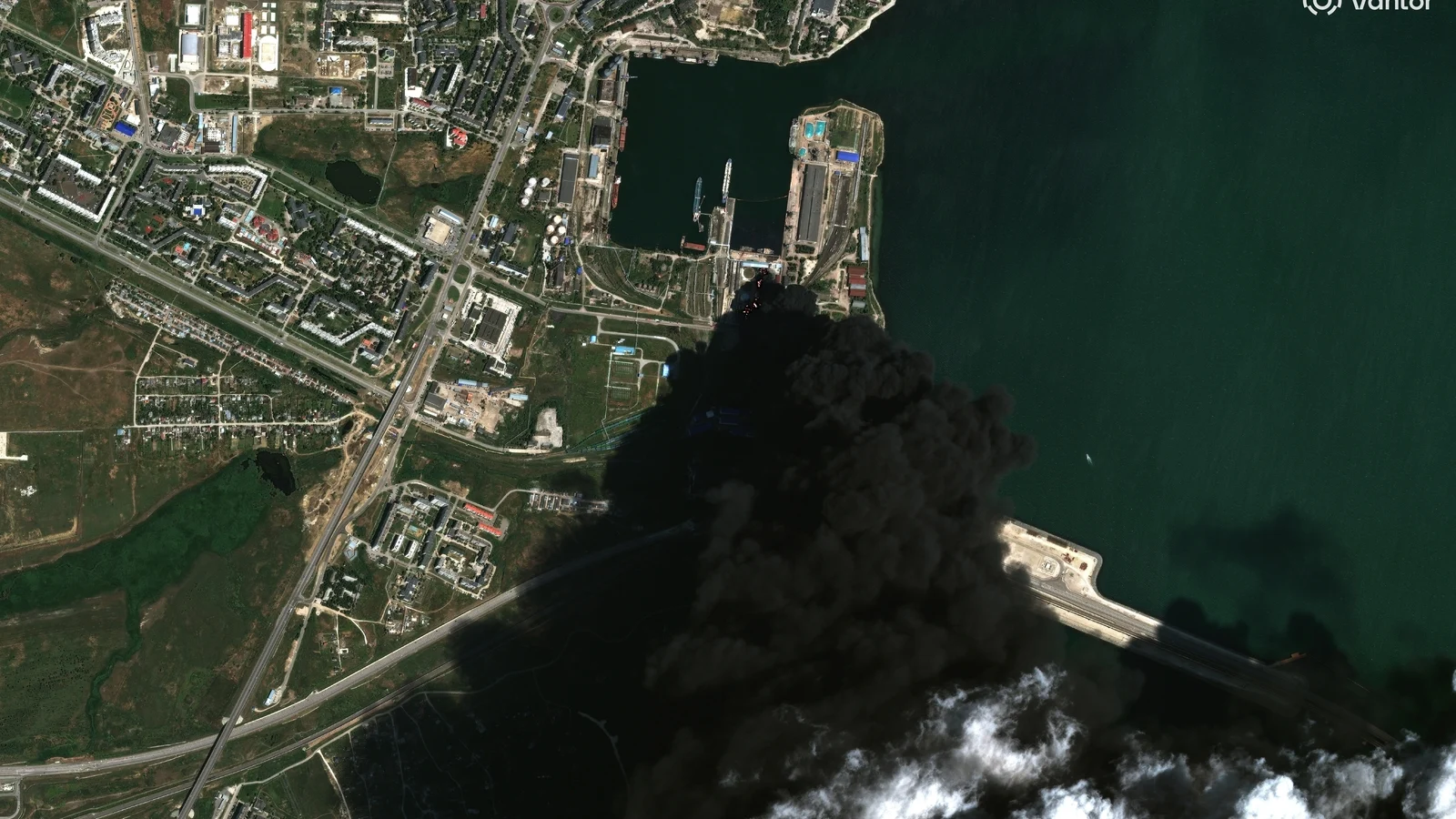
Ukraine has also targeted bridges connecting on the Crimean peninsula
The operation, the General Staff said, formed part of an aerial campaign aimed at energy facilities and military industries — an effort that has intensified as Kyiv develops longer-range weapons while Russia’s all-out invasion enters its fifth year.
In response, Moscow has ordered the redeployment of some air defence systems from Russian regions to the capital and to Crimea’s Kerch Bridge, a vital supply route for Russian forces, Mr Zelensky said.
The bridge connects the Crimean Peninsula with the Russian mainland.
“It is important that as many Russians as possible come to understand that it is the Russian leadership’s rejection of diplomacy that is prolonging the war,” Mr Zelensky said on X.
Mr Zelensky has accepted an unconditional ceasefire demanded by US President Donald Trump, but Russian President Vladimir Putin has refused.
The General Staff said the overnight strike hit the Orenburg gas processing plant, part of a larger complex that also includes what it described as Russia’s only helium plant.
It said the attack sparked a fire at the complex.
Orenburg, it added, lies more than 1,200 kilometres behind the front line that runs through eastern and southern Ukraine.
The General Staff described the plant as one of the world’s largest gas complexes.
It said the facility produces helium — used in liquid-fuel rocket engines and guidance systems — and ethane, which it called a key component in making solid rocket fuel and gunpowder, among other products.
The General Staff’s account could not be independently verified, and Russian officials did not immediately comment.
The Ukrainian statement did not specify whether drones or missiles were used, though Ukraine has recently used drones to strike Moscow and St Petersburg.
We need your consent to load this rte-player contentWe use rte-player to manage extra content that can set cookies on your device and collect data about your activity. Please review their details and accept them to load the content.Manage Preferences
The General Staff also said the overnight assaults struck two satellite communications centres used by the Russian military.
It said one target was the Dubna Space Communications Centre near Moscow, which it described as the largest ground-based satellite communications complex in Russia, while the other facility was in the Vladimir region east of the capital.
Ukraine’s air force reported that Russia launched 101 drones overnight, and said 95 were destroyed.
Russian drones struck Balakliia in north-eastern Ukraine, killing a 56-year-old woman, according to Oleh Syniehubov, head of the Kharkiv regional military administration.
In the Sumy region, a 57-year-old tram driver died after a Russian guided aerial bomb hit the outskirts of Sumy, said Oleh Hryhorov, head of the regional military administration.
US-led efforts to end what has become Europe’s deadliest conflict since World War II remain effectively stalled, with Washington’s focus diverted towards the Middle East since it launched attacks on Iran with Israel in late February.