What looked like a minor rule tweak from FIFA last December is now reshaping how the World Cup is watched — and sold.”Players to benefit from hydration breaks at FIFA World Cup 2026.”
That was the low-key headline FIFA used when it confirmed that every match at the men’s tournament in the US, Canada and Mexico this summer would include three-minute water breaks.
FIFA says the pauses are meant to help players handle a hot North American summer and, crucially, will be used in every game whether it is scorching or not, to guarantee what it calls “equal conditions for everyone”.
Yet as many broadcasters use the stoppages for full screen advertising — and as some fans in stadiums respond with boos — a bigger issue has emerged: beyond player welfare, who stands to gain?
FIFA
FIFA President Gianni Infantino insisted earlier this week that the governing body is not profiting from the extra breaks.
“There is no additional revenue for FIFA, as all commercial agreements were signed well in advance. So, this is not a financial issue for us. For us, it is purely a sporting matter.”
FIFA is expected to take in $3.9bn in revenue from broadcasting rights deals for the World Cup.
FIFA has yet to confirm whether hydration breaks will be permanent features at World Cups
That figure represents another jump in an already rising trajectory: $3.4bn for Qatar 2022 and $3.1bn for Russia 2018.
FIFA maintains it will not earn more from the advertising shown during the hydration breaks. But broadcasters who paid for the rights can, and that extra inventory can make those rights more valuable.
More room to sell ads boosts broadcasters’ earning potential — and, over time, that kind of market power can strengthen FIFA’s hand when it comes to negotiating future rights fees.
FIFA has yet to confirm whether hydration breaks will be permanent features at World Cups.
Mr Infantino said this week that the primary driver is “the heat”.
With next year’s women’s tournament in Brazil and the next men’s World Cup scheduled for Spain, Portugal and Morocco, the conditions that prompted the policy are unlikely to disappear — making a reversal less probable.
So even if FIFA sees no immediate financial upside this summer, the eventual value of future broadcasting agreements may offer the clearest measure of whether the controversy proves worthwhile for FIFA’s bottom line.
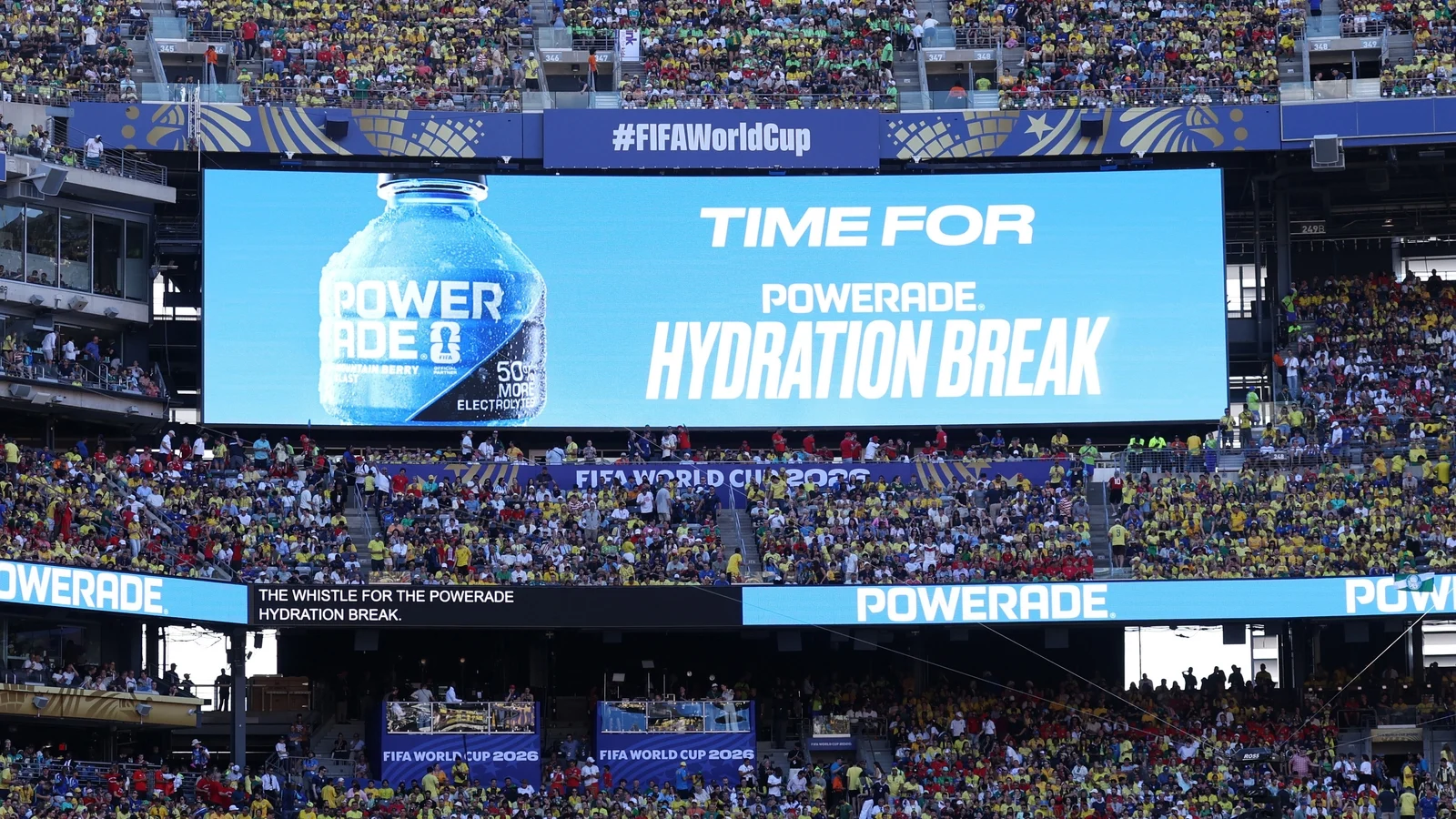
There is also branding on the ground. Each hydration break has been accompanied by perimeter boards lighting up in the bright blue colours of Powerade, the official sports drink of the FIFA World Cup.
Inside the stadium, oversized LED screens display the message ‘Time For Powerade Hydration Break’, and FIFA’s initial announcement last December was paired with photos featuring Powerade bottles.
None of that indicates new money beyond existing deals, but the expanded, high-visibility exposure inevitably strengthens the value of the sports drink partnership — and potentially any similar agreements in the future.
Broadcasters
Across much of the world, broadcasters have treated the hydration breaks as ready-made commercial windows, often switching to full screen ads.
RTÉ has shown ads during water breaks on occasion but has mostly stuck to showing the players as they take on water and instruction.
FIFA is expected to take in $3.9bn in revenue from broadcasting rights deals for the World Cup
During the very first hydration break of the opening match between Mexico and South Africa, ads appeared — prompting an immediate rebuke from pundit Richie Sadlier.
He said: “This is my first experience watching a game of football that’s been broken during the first half by advertisement breaks.
“I understand it’s a water break, I know that’s a decision taken externally, but ads during a match is wrong.
“There’s a commercial argument that is legitimate, but the event is still ongoing.
“The players are still on the pitch, there’s interactions between the coaches and players, there’s something happening which may be relevant and we’ve decided ‘nah forget about it, let’s just promote stuff’.”
Since then, RTÉ has only occasionally cut away for commercials during hydration breaks — though it did so during Scotland’s match against Brazil and during Argentina’s win over Austria on Monday.
In a statement, RTÉ said that, to date, it “has made only limited use of the advertising capacity available during these breaks and does not anticipate extensive utilisation over the course of the tournament, in order to protect the viewer experience”.
“This approach supports our ability to bring the FIFA World Cup and other major international sporting events free-to-air to audiences across Ireland.”
It added: “RTÉ takes its commercial responsibilities seriously and seeks to strike an appropriate balance between generating revenue and delivering a high-quality viewing experience.”
RTÉ did not provide figures for the cost of ad space during World Cup matches or water breaks, saying it expects to be better placed to share that information closer to the tournament’s end.
It does, however, publish rates for other major sporting broadcasts.
For example, the spot rate for a 30-second ad during the Champions League Final is €21,000 while the same ad during the All-Ireland hurling or football finals would cost €35,000.
A 30-second ad during this weekend’s football quarter finals has a €10,500 price tag while earlier rounds of the Champions League cost €9,000 for a 30-second ad.
RTÉ has shown ads during water breaks on occasion but has mostly stuck to showing the players as they take on water and instruction
Audience size will also shape the economics, with viewership typically far lower for matches played in the small hours than for primetime fixtures.
Even so, the hydration breaks create meaningful inventory. With just over eight 30-second slots potentially available per game during those intervals, the earnings potential is clear.
In the UK, the BBC does not run advertising at any time and the World Cup has been no exception, while ITV’s ability to cut to ads is constrained by British broadcast rules.
Regulator Ofcom limits the number of ads that can be shown in 60 minutes.
In the US, sports fans are accustomed to commercial pauses via timeouts and stoppages in play. Football’s long, uninterrupted halves have traditionally offered fewer openings for brands.
Hydration breaks change that by adding another 260 seconds of potential advertising time.
Two breaks are scheduled — 22 minutes into each half — and each lasts three minutes.
FIFA has set parameters: broadcasters must wait 20 seconds after play stops before switching to ads and must return at least 30 seconds before play restarts.
The Wall Street Journal has reported that, early in the tournament, a 30-second US ad could cost around $200,000.
That price can climb to $750,000 for matches involving the US and for knockout fixtures.
On that basis, Fox Sports could generate between $1.7m and $6.5m per game in hydration-break advertising.
Using conservative estimates, the US broadcaster could be taking $250m from ad revenue from the hydration breaks across the tournament.
It is widely reported that Fox paid just under $500m for the English language rights to broadcast the World Cup in the US.
By any measure, revenue tied to hydration breaks alone appears to have significantly offset what Fox paid FIFA for the rights.
FIFA President Gianni Infantino reiterated this week FIFA gains ‘absolutely nothing’ from the breaks’
Not every US broadcaster is going all-in on full screen commercials.
Telemundo, which holds the Spanish language audience, has chosen not to cut away, instead running smaller ads in a box while keeping the break and replays visible in another.
Speaking to Sports Business Journal ahead of the tournament, Telemundo senior vice president for sports content Miguel Lorenzo confirmed that the match feed would remain on screen during the breaks.
“Our goal is to create an authentic World Cup viewing experience,” he said.
“We think we can do that in a lot of ways, and one of the most impactful ways is by never leaving the pitch once the clock starts running.”
As some broadcasters chase the most immediate return, Telemundo’s split-screen model suggests a compromise that could keep advertisers satisfied without fully alienating viewers.
Altering the ‘cultural conception’ of football
FIFA’s rule is unequivocal: every World Cup match will include two hydration breaks, no matter the conditions.
Mr Infantino explained his rationale this week: “It’s very difficult to accept that a coach might have the opportunity to influence a match by making adjustments simply because it’s hotter, while in another match, where the temperature is slightly lower, the same coach doesn’t have the same opportunity.”
But even with FIFA framing the measure as both welfare-driven and competitively fair, it has drawn criticism from within the game.
“Playing four periods instead of two alters the cultural conception that has been constructed to interpret football,” said the outspoken Uruguay national team manager Marcelo Bielsa.
“This change of culture doesn’t add anything and takes away a lot.
“When the game was divided into four, no one thought about the effect it could have on what made football a sport that people love, but rather other kinds of repercussions were in mind.”
Whatever FIFA’s underlying motives, the three-minute pauses are already doing more than handing out water. They may prove a turning point — for tactics, for the viewing experience, and, perhaps most of all, for the financial model surrounding football’s biggest event.