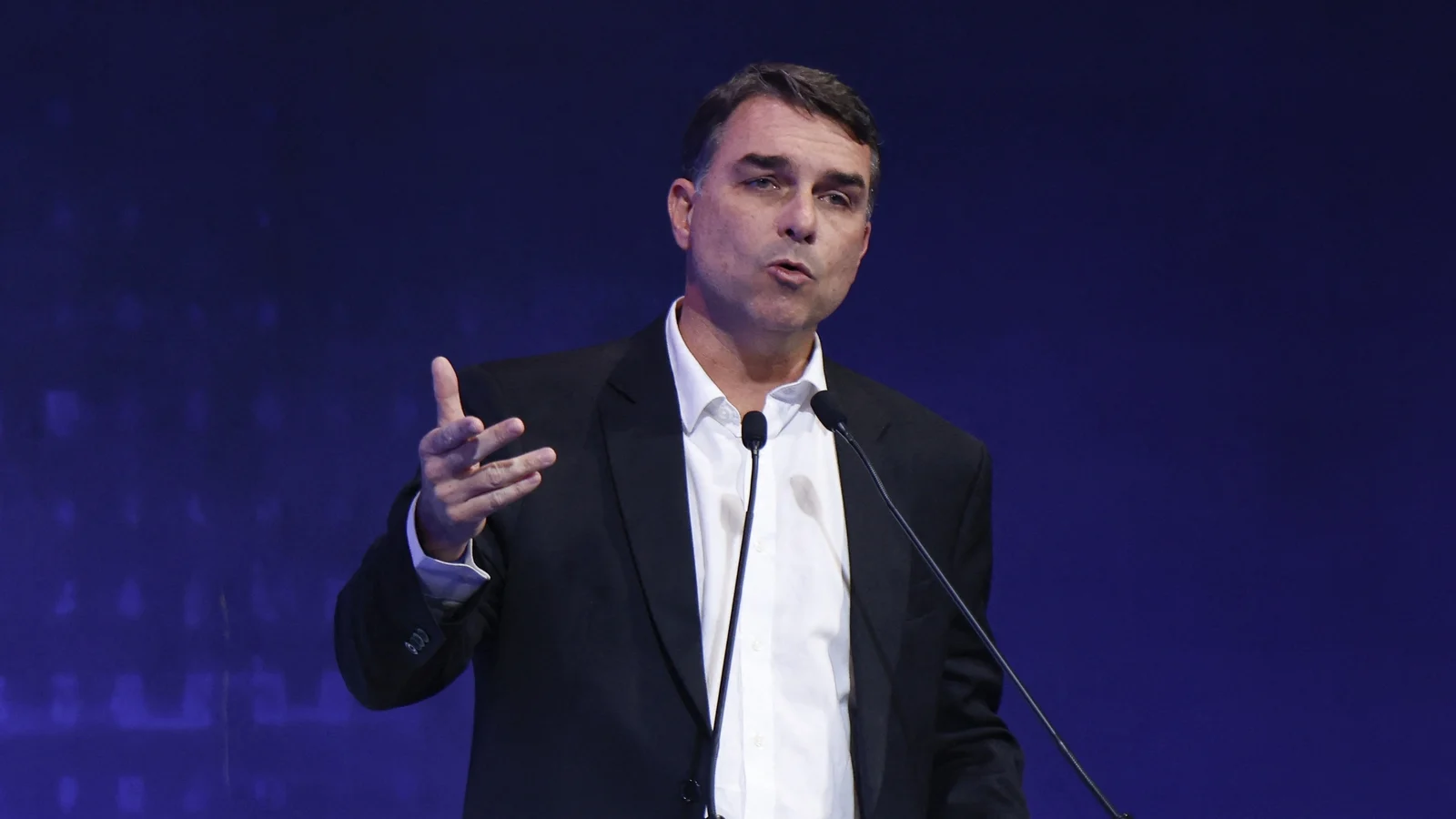
Under a harsh spotlight after weeks of political turmoil, Flavio Bolsonaro is set to formally kick off his bid for Brazil’s October presidential election today, aiming to inherit the right-wing mantle once carried by his father, Jair Bolsonaro.
Far-right firebrand Jair Bolsonaro tapped his eldest son as his political heir after being sentenced to 27 years in prison for plotting a coup following his loss to leftist President Luiz Inacio Lula da Silva in Brazil’s 2022 election.
The Liberal Party (PL) will make it official at a convention in Sao Paulo, naming senator Flavio Bolsonaro, 45, as its candidate, with Argentina’s libertarian President Javier Milei attending as guest of honor.
Bolsonaro is selling his candidacy as a course correction. He says he will “free” Brazil from crime, inflation, high taxes and Mr Lula, who is seeking a fourth term in office.
“We are on a plane without a pilot,” he said last week.
Brazilian President Luiz Inacio Lula da Silva
Until recently, the senator was running neck-and-neck with Mr Lula in polling. Then came a cluster of setbacks: alleged links to a disgraced banker, a family dispute that spilled into public view, and fresh tariffs imposed by ally US President Donald Trump.
Pollster Datafolha published a survey yesterday showing that in a runoff election Mr Lula would win 48 percent of votes to Flavio Bolsonaro’s 43 percent.
“It is a moment of weakening for Flavio…there is uncertainty over the viability of his candidacy because rejection of him has increased,” said Marco Teixeira, a political science professor at the Getulio Vargas Foundation.
A wave of scandals
The first major blow landed in May, when an audio recording surfaced of Flavio Bolsonaro asking banker Daniel Vorcaro — accused in a multi-million dollar fraud case — to finance a film about his father.
Before the recording emerged, he had denied any contact with Mr Vorcaro and, only hours ahead of its publication, told a reporter the allegation was “a lie”. He now says any connection between the two was limited to the movie project.
On Thursday, a Supreme Court justice ordered an investigation into the financing of the film.
Then a second crisis erupted when his stepmother, Michelle Bolsonaro, posted an Instagram video accusing him of disrespect, saying he had “disrespected me and mistreated me … he said I didn’t understand anything about politics”.
The former first lady is widely seen as central to the right-wing movement’s reach among Brazil’s large female and evangelical electorate.
As the rift widened, Flavio Bolsonaro read out a letter on social media from Jair Bolsonaro calling for unity — a move that contravened the conditions of his father’s house arrest.
Jair Bolsonaro
After that, a Supreme Court justice barred Flavio Bolsonaro from visiting his father until after the first round of voting.
Seeking to steady the right ahead of the convention, Flavio Bolsonaro posted a video this week apologising to Michelle Bolsonaro. She quickly accepted the reconciliation.
While Flavio Bolsonaro has tried to position himself as a more moderate alternative to his father, he remains a hardliner on crime and, this week, echoed Jair Bolsonaro by raising debunked concerns about Brazil’s electronic voting system.
He has also struggled to lock down support from Brazil’s powerful centrist bloc, with key parties saying they will remain neutral in the 4 October election.
Tariff troubles
Adding to the pressure, Flavio Bolsonaro has faced criticism after Mr Trump’s administration imposed two new rounds of tariffs on Brazil this month.
The Bolsonaro family last year supported tariffs on Brazil introduced in retaliation for the trial against the former president, a political ally of Mr Trump.
Those duties were later partly reversed following talks between Brasilia and Washington.
Flavio Bolsonaro tried and failed to persuade the Trump administration to “postpone” the latest tariffs until after the election, arguing it would otherwise hand Mr Lula a “political victory”.
Mr Lula has turned strained relations with the United States into a central campaign line, accusing his opponent of being a “traitor” and of putting political interests above economic interests.