Austria has rewritten its weather history, with Vienna recording a blistering 40.8C today — the highest temperature ever measured in the country, according to the national weather agency.
The record reading was taken in Stammersdorf, on the eastern edge of the capital, GeoSphere Austria said in a statement. It edges out the previous national peak of 40.5C, set on 8 August, 2013 in Bad Deutsch-Altenburg in eastern Austria.
Today’s spike lands amid an already extraordinary stretch of heat and scant rainfall that has been building for months, pushing multiple local stations beyond their usual limits.
Austria has just logged its fourth-warmest July on record and, “at some measuring stations, the precipitation deficit reached 90%”, the agency said.
Evidence of the strain is also turning up in agriculture: apricots are ripening about 20 days earlier than the average seen over the 1961-1991 period — a shift the agency cited as an example of global warming’s effect on crops.
In Vienna, the heat has thinned out daily life. Nasir Dis, 60, who runs a restaurant in the city, said “very few” people were coming in, describing the weather as “a catastrophe”.
“We just wait for this heat to be over. What can we do? Nothing… No one wants to eat or drink anything. Everyone just wants to barricade themselves at home,” he said.
Austria had also already recorded its longest heatwave in June.
The extremes have not stopped at the border. In neighbouring Slovakia, Bratislava hit 40.8C — its highest temperature ever recorded — breaking the record set just a day earlier of 39.9C, according to the weather service.
Further west, France also set a major benchmark: July became the hottest month ever recorded there since measurements began in 1900, outstripping previous highs reached during the heatwaves of August 2003 and July 2006, the country’s weather service said.
That same month was France’s third driest July on record, with rainfall almost 70% below average, leaving soils parched and raising the risk of wildfires, Meteo-France added.
We need your consent to load this rte-player contentWe use rte-player to manage extra content that can set cookies on your device and collect data about your activity. Please review their details and accept them to load the content.Manage Preferences
John Kennedy, the Head of Climate Information at the World Meteorological Organisation, said Europe should expect heatwaves to become longer, more intense and more frequent “as long as we keep emitting greenhouse gases into the atmosphere”.
He said persistent high-pressure systems have helped drive an uptick in wildfires and drought across the continent.
Forecasts point to another bout of extreme heat in parts of western Europe this week, as governments scramble to respond to the toll of prolonged periods of very high temperatures.
In Greece, firefighters are battling a major wildfire near Athens, while Italy is placing nearly all of its major cities on the highest “red” alert for dangerous heat.
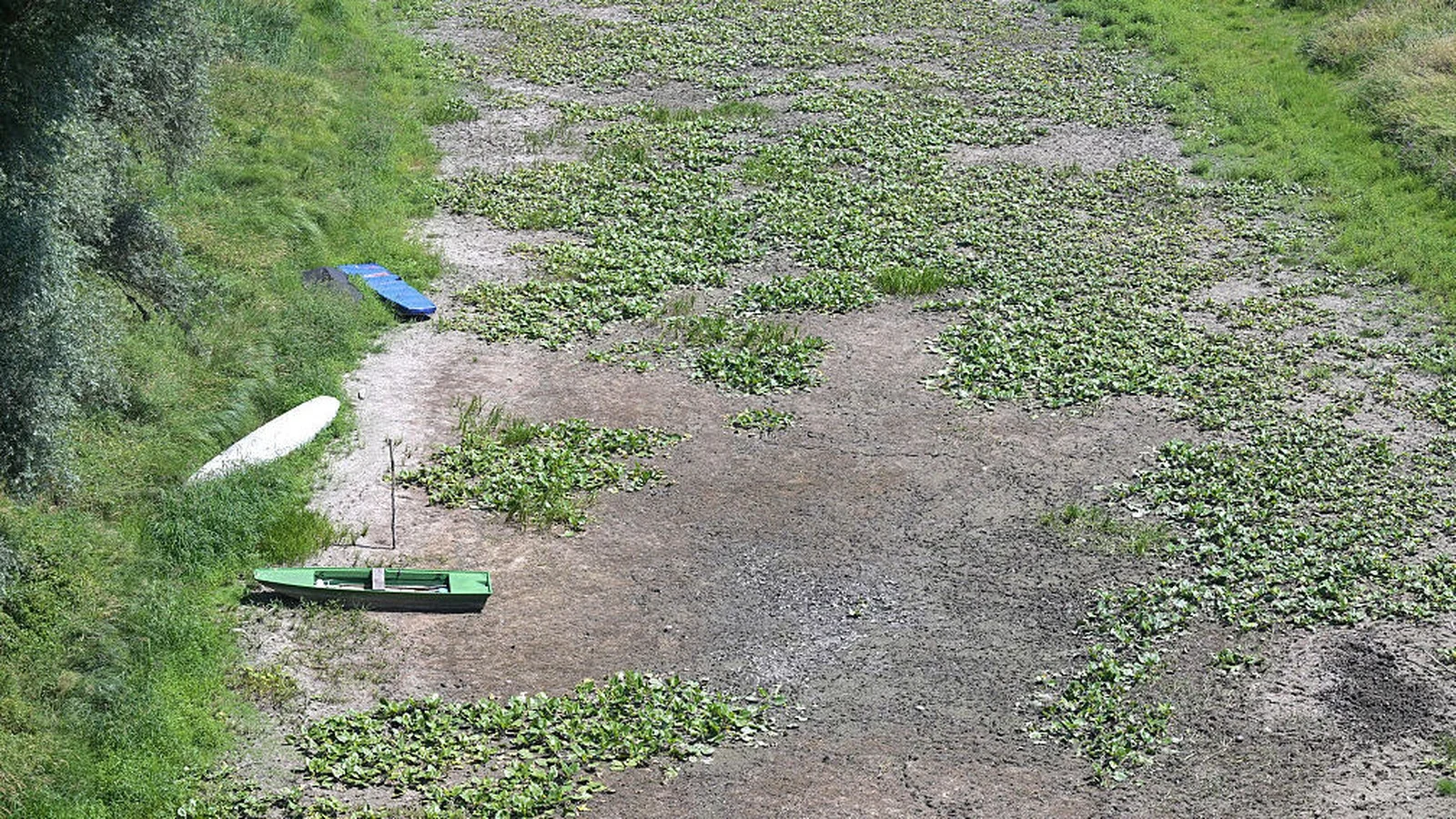
Hungary and Romania, among others, have voiced serious concern about pressure on energy infrastructure as the Danube River falls to a record low level.
Mr Kennedy said the heat that began in spring has persisted through June and July, repeatedly toppling records, including all-time highs in France, Germany and Spain.
Speaking on RTÉ’s Morning Ireland programme, he said: “There are a number of factors that contribute to these heatwaves… we have these blocking situations where high pressure squats over the continents.
“Once that high pressure gets established, it can last for days or even weeks.”
The wreckage of a World War II German warship emerges from the Danube near Prahovo in Serbia
Such systems typically bring a double hit — soaring temperatures and suppressed rainfall — conditions that help set the stage for impacts like drought and wildfires, he said.
Mr Kennedy added that some heatwaves are then followed by bursts of intense rain.
“We are getting a combination of extreme heat and extreme rainfall, these things can exist together, but we don’t necessarily see them at the same time every summer,” he said.
He said the World Meteorological Organisation supplies data, forecasts and projections to help European governments make informed infrastructure decisions.
Greece gains ground against blaze near Athens
In Greece, firefighters made headway today against a wildfire burning for a fifth day on the outskirts of Athens, as lighter winds allowed water-bombing aircraft to return in force.
More than 30 aircraft were deployed alongside 575 firefighters tackling the blaze near the coastal village of Psatha, about 60 kilometres (37 miles) northwest of the capital, the fire service said.
“The situation has clearly improved compared to the last few days, but there are still many scattered hotspots, which means that forces remain on site to prevent a possible flare-up,” fire department communications chief Vassilis Vathrakoyannis said.
Even so, vast burned areas continue to hide active and smouldering pockets that could reignite quickly if winds strengthen again.
“It’s a huge area and there could be a flare-up again at any moment,” deputy fire department spokesman Yiannis Artopios had earlier told state TV ERT.
Most of the damage from the fire — which started on Friday — was reported in villages on the Gulf of Corinth, including Porto Germeno, where scores of homes are believed to have been destroyed or damaged.
At Porto Germeno today, police established checkpoints limiting entry as officials began assessing destruction.
Hillsides that were once dense with pine forest have been burned to ash around the popular summer getaway for Athenians. Dozens of homes sat gutted and deserted, and a blackened fire engine lay amid debris nearby.
The civil protection ministry said the wider Athens region, neighbouring Evia and several Aegean islands — including Chios and Lesbos — have been placed under near-maximum fire risk for tomorrow.
“This is the period where we usually see the biggest fires. Therefore we need to be very careful until August 20-25,” National Observatory research director Kostas Lagouvardos told ERT, as he warned temperatures were expected to climb during the week.
The wildfires have killed five firefighters since last week.
On Sunday, two Bell helicopters collided while operating on the western outskirts of Athens, killing a Danish pilot and his Greek co-pilot.
Three other firefighters died in Crete and the Peloponnese last week.
Elsewhere, other blazes — including one on the Ionian island of Cephalonia — were largely brought under control, the Greek fire service said.
“I would say that it is definitely one of the worst fire crises I’ve seen in the past, maybe eight to ten years,” Theodore Giannaros, a senior wildfire meteorologist at the National Observatory, told AFP.
The observatory said winds at the end of July were the strongest in 15 years, and that more than 13,000 hectares of forest and agricultural land have been affected by the fire near Athens since it broke out on Friday.
Police have arrested two people — including a local mayor — over the blaze, which is believed to have been triggered by a faulty power cable.
More than 30 people have been detained in total in connection with fires allegedly set deliberately or sparked through negligence, including the mayor of the tourist island of Paros over a landfill fire last week.
Prime Minister Kyriakos Mitsotakis has warned that Greece faces “extremely difficult” days ahead as high temperatures and dry conditions continue to feed fires.
As in much of the Mediterranean, Greece has seen wildfires become more frequent and more intense — a trend scientists link to climate change.