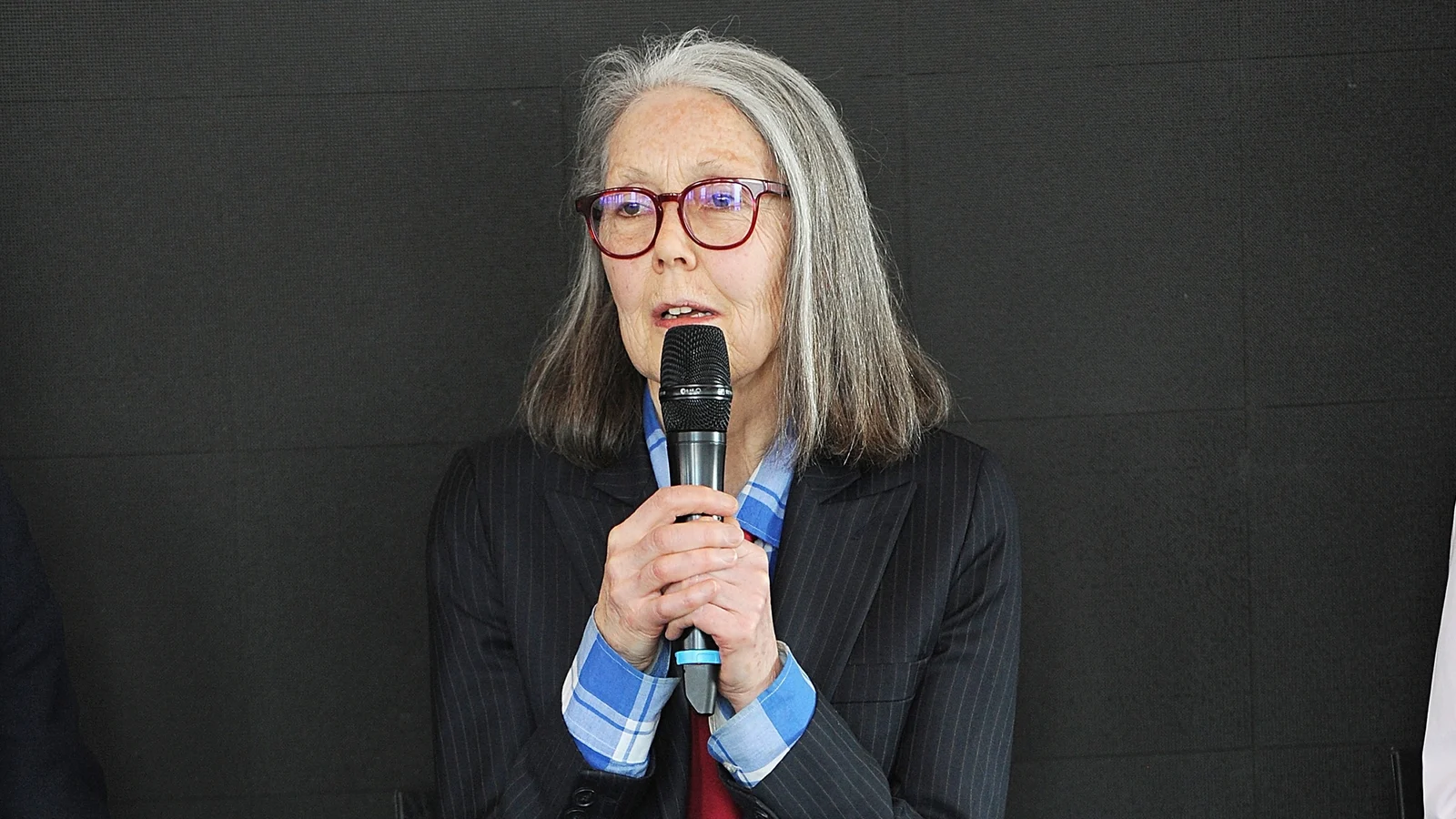
Anne Carson, the Canadian poet and writer celebrated for bending literary rules and reviving ancient voices for modern readers, has been awarded the 2026 Nobel Prize in Literature. The Swedish Academy said today it chose Carson “for her bold and inventive oeuvre that, in playful dialogue with the classical tradition, has created new forms for contemporary literature,” the award-giving body said today.
The prize, bestowed by the Swedish Academy, carries a value of 12 million Swedish crowns (€1.07m).
Carson, a poet and essayist, has built a reputation on work that refuses to stay in one lane, fusing verse, prose, dialogue and translation into hybrid forms that push against conventional genre boundaries.
She is particularly recognised for translations of classical Greek writing, a foundation that runs through a body of work spanning opera libretti, literary criticism and verse novels, including her 1998 book ‘Autobiography of Red’.
That approach is on display in ‘Norma Jeane Baker of Troy’ from 2019, a performance piece that splices together Helen of Troy as portrayed in Euripides’ play ‘Helen’ with the figure of Marilyn Monroe.
Copies of Anne Carson’s books on display at the Swedish Academy in Stockholm today
Writer in Iceland ‘listening to the wind’
Reacting to the news, Ms Carson said the Swedish Academy members were “crazy” for selecting her.
“Crazy. I think they’re all crazy… Well, you know, it’s crazy,” Ms Carson, who is currently in Iceland, told public broadcaster RUV shortly after the announcement.
Ingrid Carlberg, the Academy’s permanent secretary, said when revealing the 2026 winner that she had briefly reached Ms Carson by phone and that the author was in Iceland “listening to the wind”.
“You can’t help but listen to the wind here,” Ms Carson told RUV, gripping her cap so it would not blow away.
Ms Carson has spent part of each year in Iceland for more than 15 years and holds citizenship there, according to RUV.
Asked whether the Nobel would bring her more readers, Ms Carson offered a characteristically dry answer: “Well, I guess the publisher hopes so.”
“I’ll get a sticker on the front of my books,” she added.
Canadian Prime Minister Mark Carney called the award a “proud moment” for Canada.
Writing on X, he said the 76-year-old’s work is marked by “wit, imagination, and a style entirely her own”.
“She has brought ancient stories to new audiences and transformed the way we think about literature,” he said, calling the award “an extraordinary achievement and a proud moment for Canada.”
Ms Carson is due to accept the prize from King Carl XVI Gustaf in Stockholm on 10 December.
With the honour, Ms Carson joins a roll of Nobel Literature laureates that includes Alexander Solzhenitsyn, Alice Munro and Ernest Hemingway — a list that has long sparked debate among readers and critics alike.
Over the decades the Swedish Academy has faced criticism for overlooking major figures of the past 120 years, including Leo Tolstoy, Virginia Woolf and Jorge Luis Borges. It has also been faulted for bypassing US writers, even as it awarded the 2016 prize to singer-songwriter Bob Dylan, and has been accused at times of favouring difficult or obscure choices.
Supporters counter that the Academy has also recognised widely read authors, pointing to laureates such as Colombia’s Gabriel Garcia Marquez in 1982 and Doris Lessing in 2007, and argue that part of its mission is to draw attention to lesser-known literary traditions and nudge readers beyond familiar shelves.
The Nobel prizes were created under the will of Swedish dynamite inventor and businessman Alfred Nobel, with awards for achievements in literature, science and peace being handed out since 1901.
Last year’s literature prize went to Hungarian writer Laszlo Krasznahorkai, described as the “master of the apocalypse” by American critic Susan Sontag.