U.S. Air Travel Gradually Rebounds After Days of Widespread Disruptions
 Caalamka
After three days of snarled schedules and packed terminals, US air travel was gradually edging back toward normal following an extraordinary nationwide order that stopped planes from taking off.
The ground stop, issued Friday afternoon, marked only the second time US aviation authorities have halted departures across the country’s busy airspace since flights were grounded after the 9/11 attacks. The Trump administration said a faulty upgrade to communications equipment was to blame.
By this morning, more than 250 US-related flights — including those operating within, into or out of the United States — scheduled for the same day had been cancelled, according to industry tracker FlightAware.
The tally underscored how sharply conditions had improved from the previous day, when more than 2,300 flights were cancelled. Airlines on Saturday had cancelled nearly 6,700 US flights and delayed more than 9,100.
Delays also eased: more than 700 US-related flights scheduled for today were running late, compared with more than 10,000 the day before.
Even as operations stabilized, the Trump administration moved to reassure frustrated travellers amid lingering questions about how sweeping disruption could hit the world’s largest economy — and a nation that touts its technological edge.
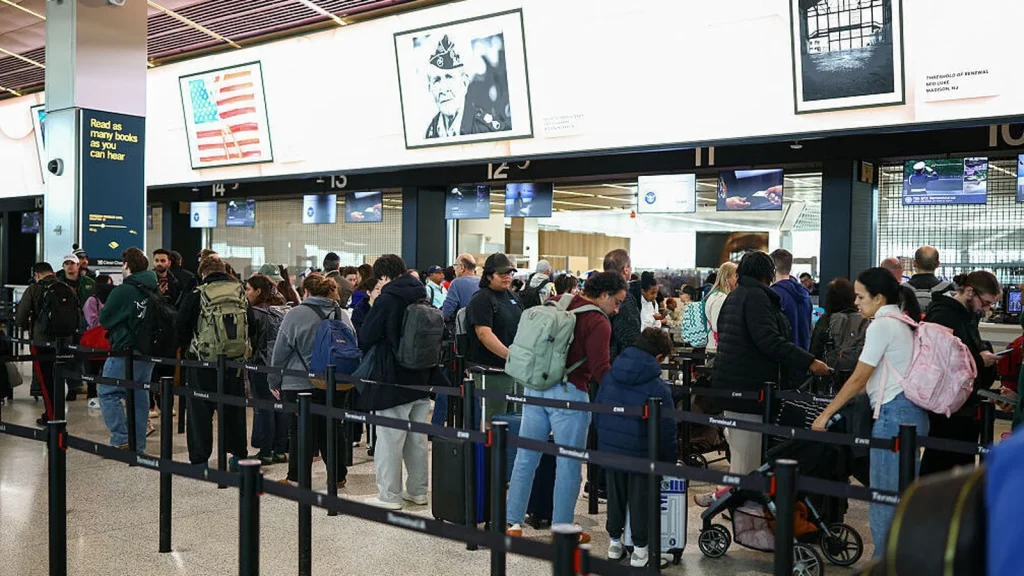
Throughout the weekend, stranded passengers drifted through crowded airports, some sitting on floors while waiting for updates, new seats or rebooked itineraries.
A stranded traveler sleeps in a terminal chair in Orlando, Florida
Officials traced Friday’s massive disruption to problems during work to upgrade air traffic control communication cables.
They said FAA contractor L3Harris installed at least one new router at a remote facility, setting off a cascade in which other air traffic control centres were inundated with data — an overload that hampered communications systems.
According to officials, replacing a router at an FAA facility in El Dorado, Arkansas, triggered issues with a recently replaced router in Amarillo, Texas, which began broadcasting and in turn overwhelmed routers at other air traffic control centres nationwide.
The FAA said the “functionality of the originating routers” has been disabled, adding that it took the same step with about 60 similar routers across the air traffic control system.
Still, the agency said it does not yet know the underlying cause of the failure, which occurred during maintenance work that had been carried out thousands of times previously without incident.
The FAA issued a nationwide ground stop on Friday that halted nearly all departing flights for almost five hours
US President Donald Trump yesterday broke an uncharacteristic stretch of silence about the ground stop, using his remarks to blame his predecessor, Joe Biden, for the breakdown.
Mr Trump argued he inherited a mess from the Biden administration and said Congress — controlled by his party for the past two years — must approve funding to modernize what he called America’s outdated air traffic control system.
“The Biden Administration was an FAA disaster,” Mr Trump said, referring to the Federal Aviation Administration.
“Everything they touched turned bad. Big money spent unwisely, making an old and broken system worse than when they began,” Mr Trump said.
FAA chief Bryan Bedford said Saturday that air travel for millions of Americans stranded at airports would return to normal by the close of business yesterday.
But Transportation Secretary Sean Duffy said yesterday morning that the recovery would take longer, as airlines and airports worked to reposition aircraft, crews and travellers thrown off course by the shutdown.
“We’re going to see things come back to normal today, but probably fully normal tomorrow,” Mr Duffy said on ABC News.
“We had airplanes and crews out of position because of Friday, so it takes a little bit of time to do that,” he added.
‘I’m the secretary’
US Secretary of Transportation Sean Duffy Duffy called for $50 billion in funding to upgrade air traffic control systems
Mr Duffy also pushed back on calls for him to resign over the travel chaos, saying he took office overseeing an air traffic control network hamstrung by aging infrastructure — including radar equipment dating to the 1960s.
“So when we do work and things go wrong, of course I’m the secretary. But I also have to acknowledge what was delivered to me,” Mr Duffy said in an interview on CNN.
The ground stop not only upended travel plans across the country, it also sharpened scrutiny of the nation’s aging infrastructure.
Mr Duffy has urged Congress to approve $50 billion (€45bn) to upgrade and modernize the air traffic control system, calling on lawmakers who control federal spending to “meet this moment”.
Democrats, however, quickly countered that Congress under Trump’s Republicans already had opportunities to act.
His push for additional funding drew scepticism from US Representatives Rick Larsen and André Carson, the top Democrats on the House of Representatives Committee on Transportation and Infrastructure and its aviation subcommittee, respectively.
They said in a statement on Saturday that of the $12.5 billion approved in 2025 for upgrades to the air traffic control system, about $11 billion remains unspent.
Mr Duffy said the funds approved last year were designated only for certain purposes and did not include money for new software to manage the airspace.
Some air travel observers have also argued that private capital should play a larger role.
“We can’t rely only on government investments. … You have to have private investment,” said Justin Erbacci, director general of the Airports Council International global trade group.
Speaking at a Montreal aviation infrastructure forum, Mr Erbacci did not reference Friday’s ground stop, but said investment is needed in air transport to handle rising traffic and modernize outdated systems.
Global air passenger traffic is expected to more than double by 2050, according to data from airline trade group IATA.