Ukraine Hits Key Bridge Connecting Occupied Crimea With Russia
 Caalamka
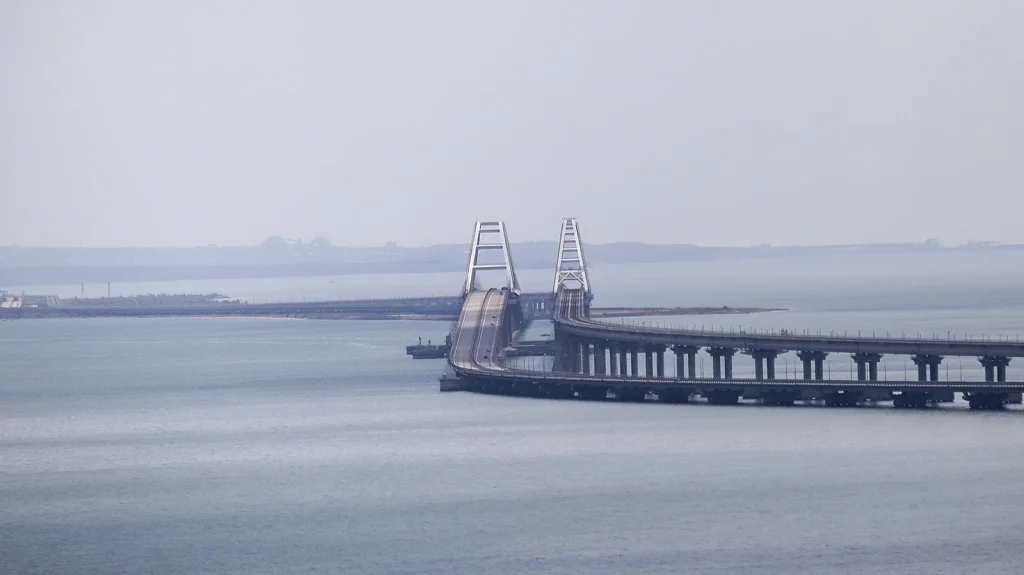
A fresh Ukrainian strike hit the Crimean Bridge for a second consecutive day, with imagery circulating online suggesting heavy damage to the main span of the strategic crossing that ties southern Russia to Crimea — an attack President Volodymyr Zelensky said was payback for Russian blows against Ukraine’s infrastructure.
Footage and photographs posted on X by Mr Zelensky appeared to show the bridge’s primary road arch crumpled into the Kerch Strait, a collapse that would obstruct shipping through the channel.
Sergei Aksyonov, Crimea’s Russian-installed governor, said two people were killed and that traffic on the 19-km (12-mile) road-and-rail link had been suspended.
Ukraine’s General Staff reported that “powerful blows” caused an arch and part of the roadway span to give way. It said the rail portion remained standing, though it described the arch there as damaged.
The bridge has been one of Moscow’s most high-profile symbols since Russia annexed Crimea from Ukraine in 2014, a signature project closely tied to President Vladimir Putin.
Kremlin spokesperson Dmitry Peskov acknowledged structural damage and said a repair plan would be prepared, adding that the bridge would be rebuilt stronger than before.
The Kremlin also said the first attack this week resulted in only minor damage.
The Crimea bridge on 17 November 2026 versus 2022 (Pic: AFP photo / Ukrainian Security Service)
The Kremlin said Mr Putin had been briefed on the latest strike as he prepares to begin meetings tomorrow in China, ahead of what Moscow described as a showcase trilateral summit later in the week with US President Donald Trump and Chinese President Xi Jinping.
Mr Zelensky publicly confirmed the strike and framed it as a direct response to Russia’s attacks on Ukrainian infrastructure, including bridges.
“We are … reminding Russia that war will always return to where it began,” he wrote on X.
Kyiv Mayor Vitali Klitschko said Russian forces hit two bridges across the Dnipro River and other infrastructure in the capital.
The 19km bridge linking Crimea with Russia’s Krasnodar region once served as a crucial supply artery for Russian forces operating in Ukraine.
Now, it is used mainly by residents and visitors, as the Russian military can move supplies via a land corridor through Russian-controlled territory in southern Ukraine.
Grateful to the Security Service of Ukraine, all units of Ukraine’s Defense Forces involved, Ukraine’s Minister of Defense, the Commander-in-Chief of the Armed Forces of Ukraine and the General Staff, and all our weapons manufacturers for an unprecedented operation in response to Russian strikes on our infrastructure. Today, everyone can see the consequences for the main military crossing from Russian territory into our Ukrainian Crimea. This is the result of the seventh stage of an operation carried out over several weeks, developed and coordinated by the Security Service of Ukraine together with the General Staff of the Armed Forces of Ukraine. Our warriors gradually destroyed air defense systems, radars, electronic warfare equipment, and other designated targets on the way to the final objective. For this, they used “Dovbush,” “Vendetta,” “Da Vinci,” “Sichen,” “Mich-2000,” “Ruta,” “Palianytsia,” “An-197,” “FP-1,” “FP-5 Flamingo,” and “R-360 Neptune.” Today, at the key stage, the “Palianytsia” drones performed exceptionally well, striking the road section of the bridge, while “Neptune” missiles, “Ruta” drones, and FP-5 drones struck the railway section. Using “Flamingo,” our warriors carried out a precision-guided strike – and the communications uplink worked flawlessly until the very last seconds. We have repeatedly offered Russia steps toward de-escalation – and every proposal has been met with loud rejection. Russia strikes our infrastructure every day, including bridges in Zaporizhzhia, Dnipro, Kyiv, and the Odesa region. We are restoring our infrastructure. But we are also reminding Russia that war will always return to where it began. Ukraine’s defensive capabilities are strong and will remain so, and we will never leave terror against our cities and people unanswered. I thank the true warriors of the Security Service of Ukraine, all our Defense Forces, our intelligence agencies, and EVERY manufacturer of weapons effectively used to defend Ukraine, Ukrainians, and our national interests. Glory to Ukraine!
— Volodymyr Zelenskyy / Володимир Зеленський (@ZelenskyyUa) November 17, 2026
Beyond its military symbolism, the bridge has functioned as a key maritime gateway for Russia between the Sea of Azov and the Black Sea, used by ships transporting grain, oil and liquefied petroleum gas — even as Black Sea trade routes have been sharply affected by an expanding drone war at sea.
Ukraine has targeted the crossing several times since Mr Putin launched the full-scale invasion of Ukraine in February 2022.
In October 2022, a truck bomb killed four people and reduced the bridge’s capacity for months.
State news agencies described the overnight attack on Crimea as part of the largest Ukrainian drone assault on Russia since the full-scale war began in 2022.
Russia’s Defence Ministry said it downed 1,441 drones across 22 regions, topping yesterday’s claimed record of 1,336.
Russian state media, citing local officials, reported that air defences turned back a significant Ukrainian drone attack on the industrial cities of Ufa and Salavat in Bashkortostan, a region that hosts several oil refineries.
Moscow Mayor Sergei Sobyanin said roughly 800 Ukrainian drones had headed toward the broader Moscow region, with 321 shot down before reaching the capital.
The tempo and scale of Ukrainian drone strikes have risen as Russia has intensified its own drone and missile campaign in a grinding war of attrition, with both sides focusing on energy networks and other strategic targets.
Strikes have continued even after US-brokered peace talks held in Abu Dhabi last week — the first in nine months — as well as separate meetings between US envoys and Mr Putin and Mr Zelenskiy.
Kyiv’s bridges struck
In Kyiv, Reuters witnesses reported multiple loud overnight blasts.
Mr Klitschko said Russia hit the capital’s north and south bridges — a claim Moscow later confirmed — and that the metro system suffered partial damage.
He said the attacks triggered some power and water outages and led to transport restrictions.
Kyiv’s bridges have been targeted before, causing widespread disruption across the city.
Deputy Energy Minister Artem Nekrasov said overnight strikes on the power grid left consumers without electricity in eight Ukrainian regions.
He said outages were reported in Dnipropetrovsk, Donetsk, Zaporizhzhia, Mykolaiv, Odesa, Sumy, Chernihiv and Chernivtsi.
“The situation is extremely difficult in the Dnipropetrovsk and Zaporizhzhia regions. Since last week, Russia has been continuously attacking energy facilities in the Dnipro region,” Mr Nekrasov said.
Elsewhere, local officials said on Telegram that three people were injured in the Cherkasy region.
They said Kharkiv, Ukraine’s second-biggest city, along with Dnipropetrovsk and Zaporizhzhia regions and other areas, were also hit.
Russia’s defence ministry said on Telegram that its strikes struck transport, military and energy sites in Kyiv, Zaporizhzhia, Cherkasy and Dnipropetrovsk, as well as port infrastructure and cargo ships.
Reuters said it could not immediately verify the reports independently. Both Russia and Ukraine deny intentionally targeting civilians.
Refinery pressure
Since late October, Ukraine has significantly stepped up strikes on Russian oil refineries, part of a campaign Mr Zelensky said had disabled more than half of Russia’s refining capacity — a claim Reuters could not immediately verify.
Two industry sources told Reuters last week that the renewed attacks had cut Russian refining capacity by about 30%.
Russian officials and media have said the strikes have contributed to fuel shortages in at least six regions, though without a repeat of the lengthy queues seen at petrol stations over the summer.
Kyiv and Moscow agreed to a major prisoner exchange during last week’s talks, but no breakthrough emerged on wider issues, including territory.
Russia controls about a fifth of Ukraine, but the war’s front line has remained largely static for months.