Nightfall over Mrauk-U: A Hospital in Ruins and a Community Asking Why
There are places whose names carry the weight of history. Mrauk-U is one of them: an ancient city of stone pagodas and misty river mornings on the edge of Rakhine state, where monks chant at sunrise and fishermen mend nets on the Kaladan. On a recent night, though, those same streets were pierced by the sound of jet engines and the thunder of an explosion that turned a place of care into a scene of grief.
“We were trying to keep the doors open,” said a weary aid volunteer who was at the general hospital when the aircraft struck. “Then the roof fell in. We pulled people from the rubble — children, elders, people who only came for fever checks. We counted 31 dead. There are dozens more injured and we’re still finding bodies.”
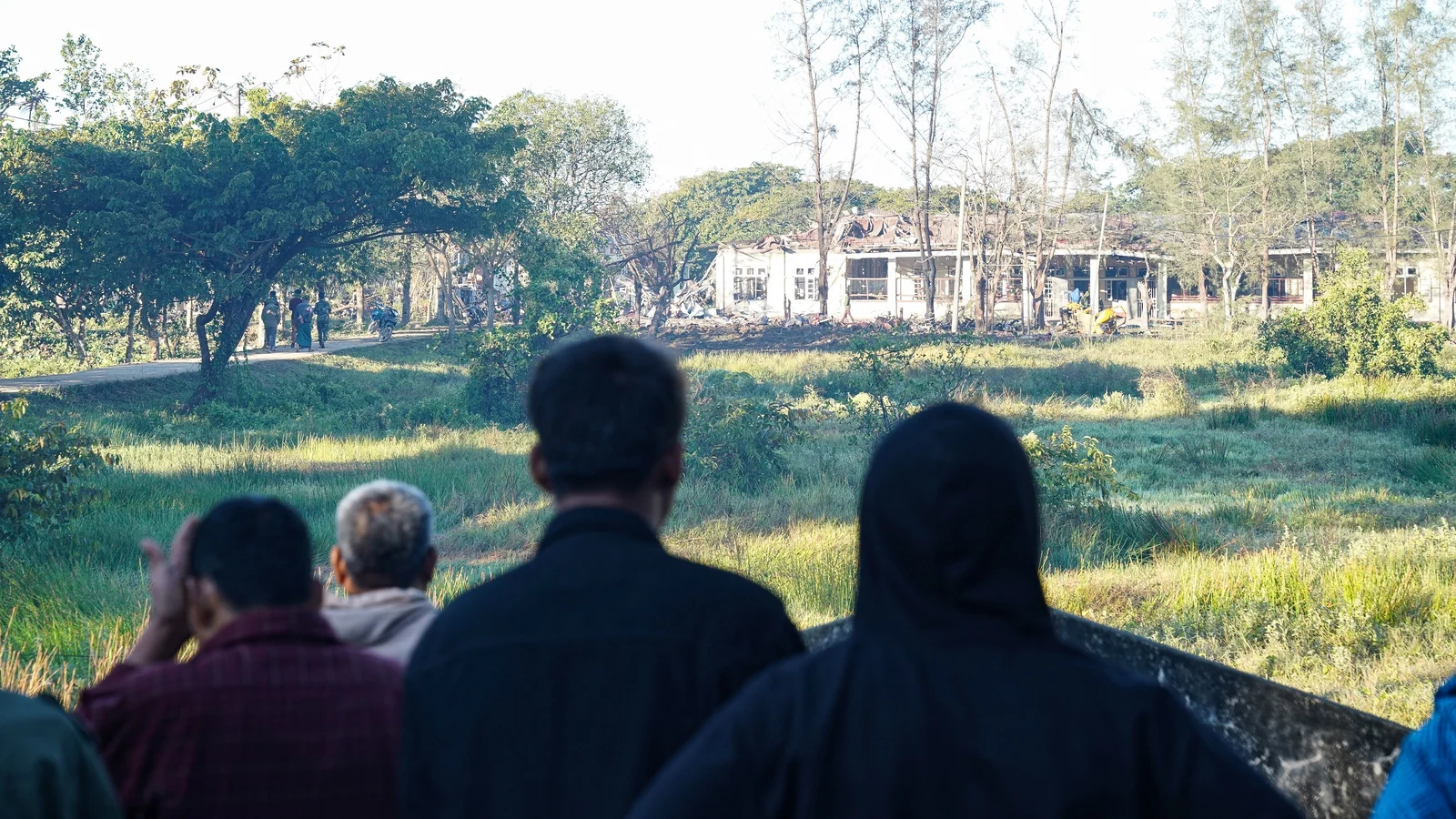
The strike, blamed on a military jet, hit Mrauk-U General Hospital in western Rakhine state one evening this week. Local health responders and the Arakan Army’s (AA) health department reported at least 31 fatalities and 68 wounded — numbers that may yet rise as rescue teams struggle to reach parts of the damaged facility. The AA also said that ten patients died instantly when the blast tore through the wards.
The explosion and its echo
Mrauk-U’s hospital is not a military installation; it is a lifeline for townspeople, rice farmers, boatmen, and monks. Witnesses describe a scene that reads like a catalogue of modern civilian vulnerability: practitioners scrambling with limited supplies, patients on gurneys, and electricity cut off as the night thickened with smoke.
“We treated people with simple illnesses, then they became targets,” said a nurse who asked to remain anonymous. “You could hear the planes first, the way birds fall silent. Then the building shook.”
The strike comes as Myanmar’s ruling junta accelerates a military offensive ahead of elections the junta has scheduled to begin on 28 December. The generals present the vote as a route to stability, but critics — from United Nations monitors to regional analysts — say the campaign of air attacks, forced conscription, and ground offensives is a grim effort to regain territory lost to powerful armed groups.
Between pagodas and frontlines: Rakhine under the Arakan Army
Rakhine state has become one of the defining battlegrounds of Myanmar’s grinding civil war. The Arakan Army, an ethnic Rakhine force that predates the 2021 coup, now controls most of the state — reportedly all but three of Rakhine’s 17 townships. Its fighters emerged as a potent opponent to the junta, joining other ethnic and pro-democracy forces in a conflict that has shifted dramatically since 2023.
“People here know how to live with the river and with the monasteries,” said U Hla, a local monk who has spent decades tending to Mrauk-U’s temples. “We teach compassion. But violence has come to our doorstep. The wounded cannot find care. The festival lights are dimmer this year.”
The Arakan Army has been part of a broader alliance of rebel groups that mounted a significant offensive beginning in 2023, which forced the military to replenish its ranks with conscripts and to rely more heavily on air power. Two of the initial members of that “Three Brotherhood Alliance” negotiated ceasefires this year under Chinese mediation, leaving the AA as one of the most prominent armed actors still contesting the junta’s control.
Why a hospital?
Attacks on medical facilities are among the most jarring indicators of a conflict’s descent into lawlessness. International humanitarian law is clear: hospitals and healthcare workers are protected. Yet, in Myanmar there have been repeated reports — from local groups, the UN, and aid agencies — that hospitals and ambulances have been struck with increasing frequency as the junta ramps up its aerial campaign.
“When hospitals become targets, it isn’t just buildings that collapse,” said a humanitarian law expert who has tracked the region’s violence. “A whole chain of trust is severed: people stop coming for treatment, vaccinations fall behind, and small wounds become deadly. This has long-term effects that outlast any single battle.”
Numbers, narratives, and wider consequences
Here are some of the hard facts that can’t be ignored:
- Casualties at Mrauk-U General Hospital: Local responders report at least 31 dead and 68 wounded from the strike; numbers may rise as rescue operations continue.
- Control in Rakhine: Conflict monitors say the Arakan Army now controls all but three of the state’s 17 townships.
- Political backdrop: The junta seized power in a 2021 coup, ending a decade-long democratic experiment and setting off a wider insurgency across the country.
- Elections: The military has scheduled polls to start on 28 December, a move criticised by the United Nations and many international observers as lacking legitimacy and unlikely to reduce violence.
Beyond these numbers lies an almost impossible human arithmetic: how many children will grow up without vaccinations? How many livelihoods will be disrupted as patients avoid clinics and markets shrink? How many culturally significant sites in and around Mrauk-U will be left to the elements while the smoke clears?
Voices from the ground
In the market near the old pagodas, vendors now fold up their tarpaulins early. “People are afraid to stay late,” said Ma Nyein, a vendor who sells dried fish. “If you hear a jet, you run. That’s how life is now.”
An AA statement from its health department confirmed the immediate casualties and described frantic efforts to evacuate the injured to clinics beyond the frontline. Meanwhile, a spokesperson for the junta did not deny carrying out airstrikes against “terrorist elements” but said the military took measures to avoid civilian harm. The claim did little to reassure a city whose hospital is being counted among the dead.
What now — for Mrauk-U, for Myanmar, and for the world watching?
When hospitals are struck, the global legal frameworks meant to protect life feel fragile. The international community has routinely condemned strikes on medical facilities in Myanmar, and nations like China have urged a return to “social stability,” arguing for a path that includes the elections. Yet on the ground, civilians see little evidence of a political off-ramp.
“Words from afar don’t stitch our wounds,” said an aid coordinator who has worked in Rakhine for years. “We need safe corridors, neutral zones, and real guarantees that healthcare will be protected. Otherwise, this is a slow-motion calamity.”
So what should you — a reader in Tokyo, Lagos, London, or Dhaka — take away from this? First, that the war in Myanmar is not a distant story confined to headlines. It is about hospitals, markets, and temple courtyards where life persists amid fear. Second, that elections created by those who seized power rarely end wars on their own; they might entrench grievances if large swaths of society are excluded. Finally, it highlights a universal question: when institutions meant to safeguard life are targeted, how should the world respond?
There are no simple answers. What is clear, though, is the image of a hospital ward in Mrauk-U — beds overturned, a lullaby interrupted, a community trying to pull itself back together under a sky that felt, for one terrible night, like it belonged to the fighters and not the people.
Will international pressure be enough to protect hospitals hereafter? Will humanitarian aid find secure routes into the hardest-hit zones? For now, the pagodas stand; the river still moves. And the people of Mrauk-U, like millions across Myanmar, will face another dawn carrying the evidence of a night that should never have happened.