When Celebration Turns to Catastrophe: The Liuyang Fireworks Blast
On an ordinary late afternoon in Hunan province, the sky above a cluster of low factories and green hills went from blue to black with smoke. At 4:43pm local time, a massive explosion ripped through the Liuyang Huasheng Fireworks Manufacturing and Display Company, sending a shock that could be heard and felt across the valley. By the time the smoke thinned, 26 lives had been lost and 61 people were wounded — numbers that read like a headline but represent families, futures, and a community left reeling.
The Moment
Witnesses described a cacophony: a series of explosive booms that sounded like rolling thunder, followed by the sight of roofs torn open and a plume of acrid, chalky smoke climbing into the air. Videos shared on social media showed continuous detonations, a sky streaked with ash, and emergency lights flashing through haze.
“It was like the mountain itself was coughing up fire,” said one neighbor, Mrs. Zhang, whose small tea shop sits a few hundred meters from the factory gates. “We ran out with our children. The air tasted of sulfur. I couldn’t recognize the road; everything was covered in powder.”
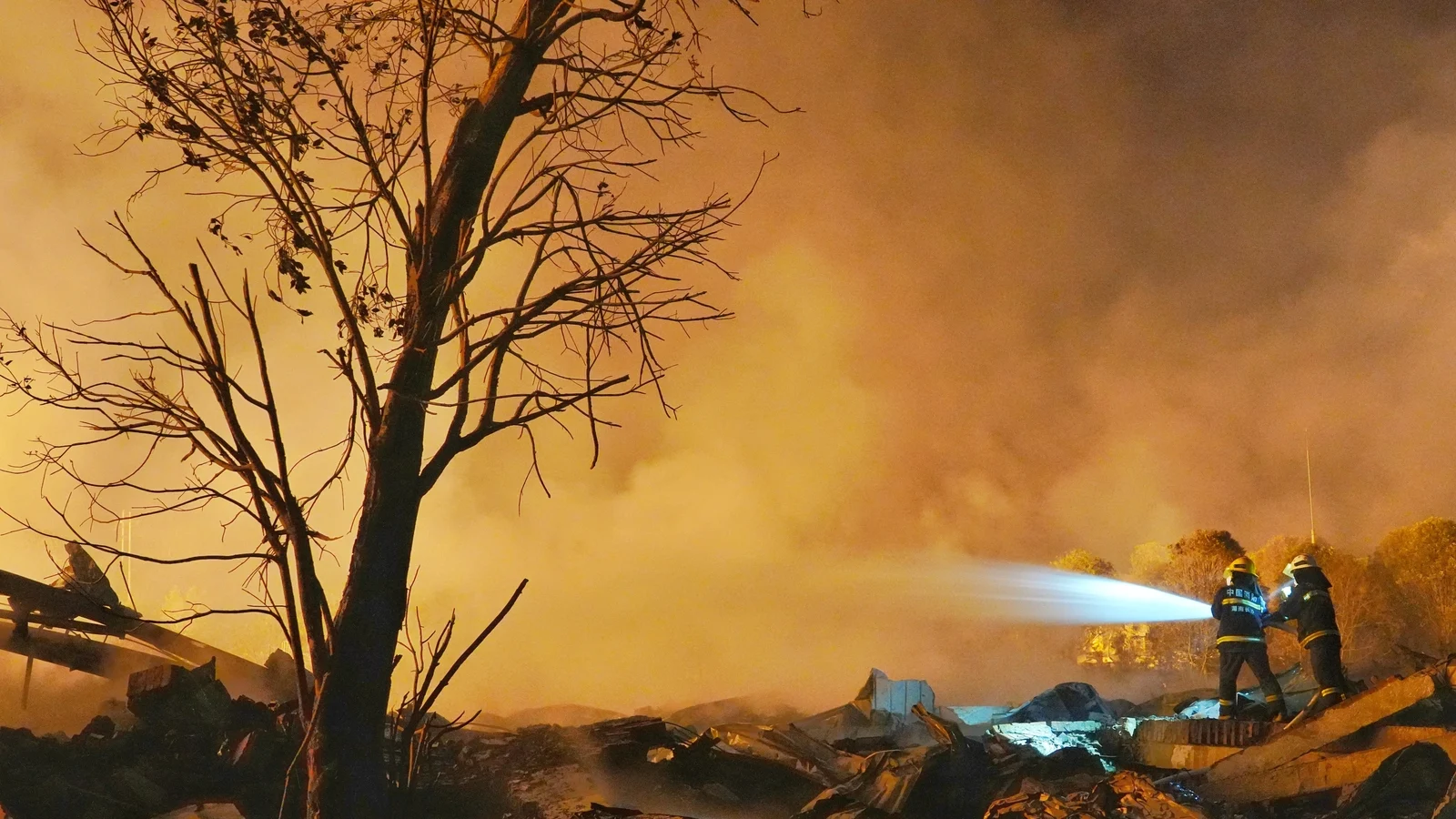
Drone footage released by state media later showed a swathe of smouldering debris where buildings had stood, rescue workers and excavators scouring the rubble for signs of life. Smoke still curled from some structures, their roofs sheared away like the petals of a splintered flower.
At the Center: People and Procedure
The local mayor, Chen Bozhang, spoke with a measured sorrow at a press briefing: “We feel deeply grieved and filled with remorse,” he said, adding that search and rescue operations were “basically complete.” Authorities established a 3-kilometre control zone around the site and evacuated residents nearby. More than 480 rescuers — firefighters, medics, and specialized teams — were rushed to the scene, guided by experts sent from the central government.
Chinese state media reported that the company’s management had been detained and that investigations were underway. President Xi Jinping urged “all-out efforts” to treat the injured and account for the missing, and demanded those responsible be held to account, signaling a top-level imperative to get answers quickly.
Liuyang: The Town That Lights the Sky
To understand why this blast feels so seismic, you have to understand Liuyang itself. This city, cradled by rolling hills and a tapestry of rice paddies, has been the pulse of China’s pyrotechnic industry for generations. Local craftspeople and large manufacturers alike shape the paper, fuse the cores, and paint the shells that become fireworks sold all over the world.
Liuyang produces roughly 60% of the fireworks sold inside China and about 70% of those exported, according to local industry figures — numbers that make its factories both economically vital and, when disaster strikes, devastating in reach. The town’s identity is woven with festivals: the smell of gunpowder before Lunar New Year, nightly displays during weddings, and a craftsmanship that is as much cultural heritage as it is commerce.
“We learn the trade from our grandparents,” said 42-year-old Li Ming, who grew up in a family that has made fireworks for three generations. “It’s how we celebrate. It’s how we feed our children. We love the colors in the sky. But the work is dangerous — we’ve always known that.”
Why These Accidents Keep Happening
Industrial accidents remain distressingly common in fireworks production in China. A string of recent tragedies underlines structural vulnerabilities: a Hunan factory blast last year killed nine; in 2023, explosions in the northern port city of Tianjin damaged residential blocks and killed three. Earlier this year, separate incidents at fireworks shops in Hubei and Jiangsu killed 12 and eight people.
Experts point to several recurring problems: facilities clustered in semi-rural zones where small workshops and larger factories mix; supply chains that pressure speed over safety; and variable enforcement of regulations. “You have a high-value, time-sensitive product made with volatile materials,” said Dr. Emily Chen, a safety analyst who studies industrial risk in manufacturing hubs. “If management shortcuts protocols or storage practices are lax, the consequences are catastrophic.”
She added, “Regulation plays catch-up, and after a major incident, inspections get tougher for a while — but without systemic investment in training, safer technologies, and community planning, the cycle repeats.”
On the Ground: Stories of Loss and Resilience
At the edges of the cordon, life continued in a quiet, fractured rhythm. A vendor selling steamed buns set up farther down the lane, his cart a microcosm of everyday defiance against the abnormal. Neighbors comforted each other with tea, rice, and the small rituals of consolation that communities invent when official answers are slow.
“We don’t know if my cousin was working that day,” said one young man, gripping a photograph. “He texted at noon and said he’d be home for dinner. He never came.” His voice stopped, then continued in a whisper: “We need more than condolences. We need change.”
Rescuers, exhausted but resolute, spoke of the visceral difficulty of searching in an environment that could still be volatile. “Every step is calculated,” said one firefighter, Wu Jian, rubbing grime from his hands. “We hoped for survivors until we didn’t. The hardest part is carrying someone out and knowing they had a life outside of this job — a family waiting.”
A Bigger Picture
Beyond the immediate human tragedy, this blast raises questions about how industrial safety is balanced with economic livelihoods, especially in regions where traditional crafts have become global export engines. It calls on policymakers to think about zoning, worker protections, emergency response training, and the economics that push small operators to cut corners.
For consumers around the world who enjoy fireworks at celebrations, the scenes in Liuyang are a sobering reminder: the dazzling arcs that light festive skies are anchored in human labor and risk. What responsibility do buyers, festival organizers, and regulators hold for the safety of those who make these spectacles possible?
Where Do We Go From Here?
The investigation into the Liuyang explosion will take time. For now, the priorities are clear: tend to the injured, support bereaved families, and ensure the safety of the surrounding community. Longer-term, experts urge systemic reforms: rigorous inspections, improved storage and handling protocols for pyrotechnic materials, and greater support for the transition to safer technologies.
“We must honour those lost not just with words but with measures that prevent a repeat,” Dr. Chen said. “That requires political will, investment, and a shift in how local economies value safety.”
As the town cleans up — as roofs are rebuilt and lives slowly attempt to stitch themselves back together — residents will continue to tell the story of that afternoon: the sound of the blast, the taste of smoke, the way strangers became family in the hours after. Their grief is immediate; their demands for accountability are clear.
What will we, as a global audience who lights the night with fireworks at weddings and New Year’s celebrations, do with this knowledge? Will we demand safer practices, transparent supply chains, and humane working conditions? Or will the next burst of color in a distant sky simply fade into memory?