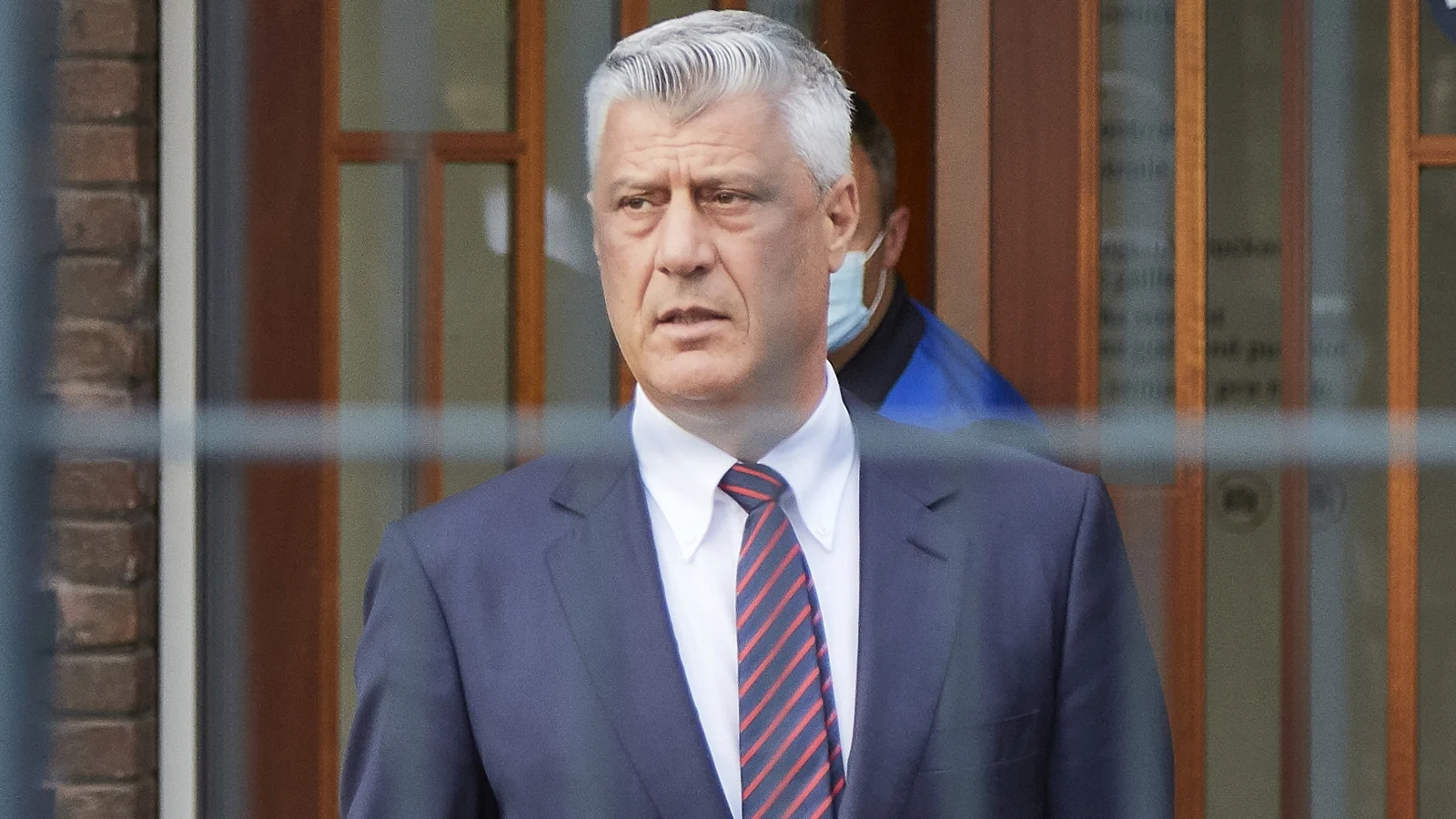
Kosovo woke to a jarring verdict from The Hague: former president Hashim Thaci has been sentenced to 25 years in prison for war crimes, a decision that reverberated across the country and ignited fury among many Kosovars.
Judges ruled that Thaci and three other former leaders of the Kosovo Liberation Army (KLA) were guilty of illegal arrests, torture, murder and cruel treatment during the 1998-1999 war for independence from Serbia.
The tribunal concluded that, as KLA leaders, they bore responsibility for murders, unlawful detentions, torture and mistreatment carried out by the guerrilla force during, after and before the conflict.
Yet for many Kosovo Albanians, Thaci and his co-defendants remain emblematic of the independence struggle. In Pristina, thousands gathered in the capital to follow the judgment live on a large screen.
When the court delivered its decision, the crowd fell quiet. Many looked stunned, especially after weeks in which Thaci’s supporters had been preparing for the possibility of an acquittal. As soon as the proceedings ended, people began to drift away, and the gathering quickly dissolved.
“This process was not about justice, but politics,” pensioner Tahir Bytyqi said.
Elsewhere in Pristina, groups of young men moved towards the headquarters of the European Union’s Rule of Law Mission in Kosovo (EULEX), waving KLA flags and chanting the former guerrilla group’s name.
Some of them clashed with riot police and hurled stones at the building.
In The Hague, demonstrators who had assembled near the court also briefly confronted police, with some climbing onto a police van as officers prevented them from reaching the court building.
Authorities used a water cannon to break up the crowd.
Protesters outside the headquarters of the EU Rule of Law Mission (EULEX) in Pristina
‘Unacceptable injustice’
The case has long cut deep inside Kosovo, where the tribunal’s work remains contentious. Prime minister Albin Kurti described the ruling as “a great and harmful punishment” and urged that it be “corrected” through the appeals process.
“These are unjust findings, but they are not final and will be subject to review on appeal,” Mr Kurti wrote on Facebook.
“The reason the KLA was born was not, and cannot, be punished or tarnished.”
Thaci was sentenced alongside three other senior former KLA figures: Jakup Krasniqi, Rexhep Selimi and Kadri Veseli. The court handed Krasniqi a 25-year term, Selimi 13 years and Veseli 18.
Judges said the men had “contributed significantly” to a common criminal purpose aimed at perceived opponents of the KLA’s political and military objectives.
All four were cleared of charges of crimes against humanity and retain the right to appeal.
Thaci stepped down as president and surrendered after he was indicted in 2020. He has been held in detention in The Hague since then, and the time already served will count toward his sentence.
After the war, Thaci remained one of Kosovo’s most prominent political figures and played a key part in the country’s 2008 declaration of independence.
Throughout the trial, billboards across Kosovo frequently displayed images of the 58-year-old former prime minister.
“We defended our homes, our country. This punishment is a shame for the international community,” high school teacher Skender Rexha said in the capital.
Murders and beatings
The Kosovo Specialist Chambers (KSC) is headquartered in the Netherlands and staffed by international judges, but it was created under Kosovo law with a specific mission: to prosecute alleged crimes committed by KLA members during the war.
From the outset, the court has been widely unpopular in Kosovo. Tensions have been heightened by its use of evidence provided by Belgrade, which still refuses to recognise Kosovo’s independence, feeding claims that the process is politically biased.
Even so, the court’s mandate has strong support from Kosovo’s international allies, and it has previously convicted several individuals for wartime crimes.
Delivering the judgment, Judge Charles Smith said the “scale and nature” of the crimes attributed to the men were “very serious”, citing 96 murders.
“Murder victims in this case were shot to death, and others died because of the severe beatings,” Smith said.
He added that the court found many bodies were discovered in a condition that amounted to a further affront to the victims’ dignity.
The offences took place between April 1998 and June 1999, spanning the war and its immediate aftermath — a conflict that left about 13,000 people dead.