As France braces for another night of unrest, Prime Minister Sebastien Lecornu said he has asked regional authorities to introduce curfews in some cities this evening.
He described the steps as “partial” and “localised”, saying they are aimed at safeguarding businesses after weekend demonstrations tipped into some of the worst street violence seen in years.
Mr Lecornu blamed the “ultra-left movement” for trying to “orchestrate deep unrest across the country” ahead of next year’s presidential election.
“There is a whole network that could be mobilised to even call into question the timetable for the presidential election and the holding of the presidential election itself,” Mr Lecornu said after a crisis meeting.
Interior Minister Laurent Nunez, meanwhile, acknowledged that police “lost control” in parts of the country as violence flared in multiple cities.
Mr Nunez said preparations suffered from a “lack of anticipation” and that he offered to resign to French President Emmanuel Macron “because I felt responsible for everything that happened.”
Mr Macron did not accept his resignation.
Watch: France reacts to protests and violence
In Paris this morning, protesters blocked entrances to the Louvre museum in a show of support for a nationwide student protest movement and to denounce “police repression”, according to the museum’s management and unions.
Management said the museum was unable to open at its scheduled time because of the action, which was led by students from the Ecole du Louvre. Outside, a leaflet declared: “We are proud to announce that we are blocking the world’s largest museum.”
In Marseille, local authorities moved to curb disorder by prohibiting public gatherings and demonstrations across most of the day, an edict from the local administration showed, after the city was struck by violent protests and looting over the weekend.
The ban is set to run from midday until 8pm local time.
Yesterday, President Macron said the country felt “anger” and “shame” after protests against rising living costs and poor conditions in schools led to at least 2,400 arrests.
He aligned with other officials in attributing much of the violence to far-left activists, accusing them of targeting police and public buildings to stir chaos.
“Those who looted will have to pay back for the damage, and those who sought to bring down the Republic will be held accountable,” Mr Macron said in a televised address to the nation.
He condemned what he called “unrestrained violence” by “insurrectionist elements from radical far-left groups, joined by numerous criminals”.
Mr Macron had earlier convened an emergency meeting with senior officials, after masked groups set fires and attacked public buildings — including city halls — in several cities.
Police officers respond as clashes are reported in Place de la Republique in central Paris yesterday
In Limoges, in central France, the 19th-century City Hall was engulfed by flames. Its roof collapsed and the building was nearly destroyed.
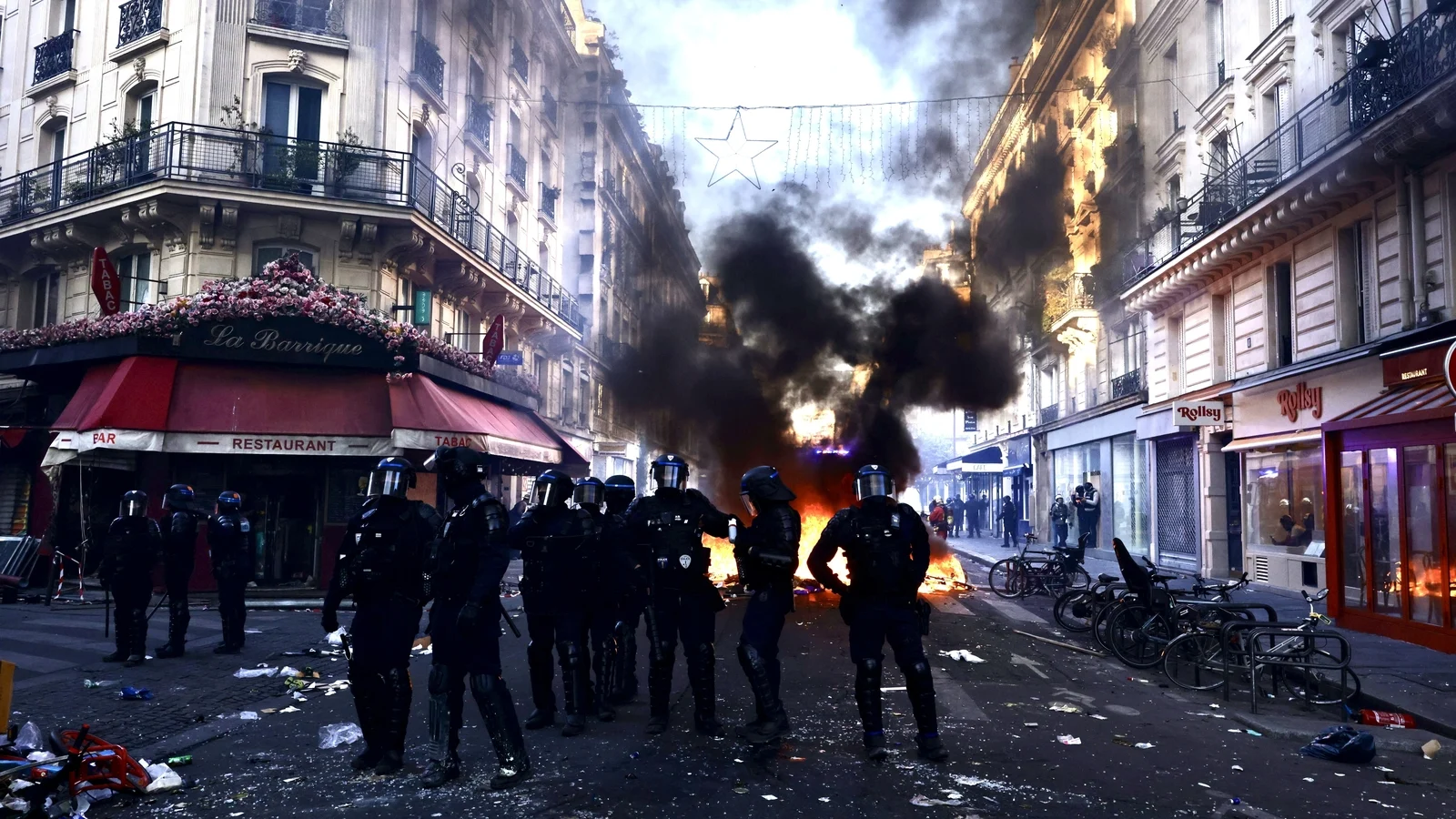
In Paris, hundreds of demonstrators returned yesterday to the Place de la Republique, where a large police presence surrounded the gathering.
Police fired tear gas as tensions rose intermittently, with small groups attempting to ignite bicycles and rubbish bins.
Watch: Moment Limoges City Hall collapses in flames
“The right to protest is a fundamental right. Deliberately and collectively sowing disorder through violence is not,” Mr Nunez wrote on X, pointing to the looting of hundreds of businesses in cities including Paris, Marseille, Lyon and Bordeaux.
‘There is clearly a huge push for there to be an Act II’
Authorities put turnout at about 550,000 for Saturday’s marches, while organisers said 800,000 took part.
Protesters responded to calls issued by a labour union, student organisations and activists seeking to reignite the “yellow vest” movement, which began in 2018 as a campaign against social injustice.
The movement has also signalled it will return to the streets on Saturday for a second wave of demonstrations, labelled “Act II”.
On its website, the group posted a map listing demonstrations planned for 24 October. The site’s editor, Benjamin Ball, said: “There is clearly a huge push for there to be an Act II.”
Large demonstrations in France are frequently followed by violence at the margins of otherwise peaceful marches, often sparking clashes with police. The arrest numbers reported yesterday neared the almost 2,000 recorded nationwide in a single day during the yellow-vest protests of December 2018.
Paris police said one person died of a heart attack, without giving further details, and Paris prosecutors said they were investigating.
By yesterday morning, the area around Place de la République bore clear signs of the night before: dislodged cobblestones, smashed shopfronts and scattered broken glass.
Authorities reported looting and damage in and around the square, as well as in other tourist and shopping districts in the city centre.
Paris police said 855 people were arrested in the capital region, while the city’s prosecutor’s office said 557 were still in police custody.
A fire breaks out at a demonstration in Paris
As residents surveyed the destruction, many took photographs of the partly dismantled base of the monument at Place de la Republique — a statue of Marianne, one of France’s most recognisable symbols.
Jean Foissy, 74, said he had intended to join the demonstration but turned back after encountering “a wall of riot police and fires everywhere”.
“I was very scared,” he said. “I’ve been a Parisian since I was born, so when I got here, it almost made me want to cry because I find it so bad, it hurts me.”
Margaux Eude, 26, said she backs the protest movement but “didn’t think it would escalate like this”.
“It’s the troublemakers who came, and it breaks my heart because it delegitimises the movement”, she said.
Across the political spectrum, leaders sought to seize on the fallout from Saturday’s riots as the country moves toward next spring’s presidential election.
Marine Le Pen, the far-right leader and presidential contender, attacked her far-left rival Jean-Luc Melenchon, who took part in the Paris march.
“Looting, ransacking, destroying and attacking law enforcement: Rioters have again spoiled the October 17 demonstrations for the protection of purchasing power,” Ms Le Pen wrote on X.
US President Donald Trump wrote “France is burning!” on his Truth Social platform, apparently tying the unrest to “the immigration of people from an entirely different world”.
“Close your borders and take control, before it is too late!” he wrote.
French authorities and police have not linked immigrants to the rioting, and have repeatedly blamed some of the violence on “radical far-left groups” as well as others who joined in to loot.
Firefighters to extinguish a blaze after bicycles and e-scooters were set alight in Paris
Meeting requested given the ‘extent of the damage’
Paris mayor Emmanuel Gregoire said an emergency unit is being set up to help businesses evaluate the damage.
“The scale of the damage is considerable and unprecedented,” Mr Gregoire wrote in an open letter.
“Paris is a city of freedoms, debate and demonstrations. It must remain so. But it must also be a city where everyone can work and run a business safely.”
The mayors of Paris, Marseille and Lyon — France’s three largest cities — have requested a meeting with the prime minister in the coming days “given the extent of the damage and the seriousness of the situation.”
In Marseille, some protesters briefly pushed into the lobby of City Hall, and a group wearing hoods and masks damaged a police station. In Lyon, a fire broke out inside a tourist office.
A protester kicks a projectile as Lyon’s tourism office is in flames on 17 October
In Limoges, Maurice Barate, prefect of the Haute-Vienne region, said a group of “radical troublemakers” forced their way into City Hall while elected officials, staff, security personnel and members of the public were inside.
“Despite the presence of so many people, they deliberately set the building on fire. It is an extremely serious and unspeakable act,” he said.
In eastern France, prosecutors in Mulhouse said an investigation has been opened after a 17-year-old girl was injured during the protests and lost an eye.
Another investigation was launched on Saturday after a young protester in Saint-Etienne lost a hand.
The injuries come as police face intense scrutiny over their use of grenades and other riot-control weapons during recent demonstrations.
‘Very serious questions to ask the government’ – senator
French senator Hélène Conway-Mouret described Mr Macron’s post-violence address as “a very weak message”.
She said two parliamentary inquiries are under way — one in the senate and another in the national assembly — to establish what happened.
“There are a lot of questions that we need to ask our intelligence services as to the lack of preparation and anticipation of our police forces that obviously lost control very rapidly, and thus the looting that followed and the scenes where there were no police forces basically to stop it,” she told RTÉ’s Today with David McCullagh.
“We have very serious questions to ask to the government.”
Ms Conway-Mouret said she felt “shock, dismay and shame” at the protests and warned that France is “entering a period of turmoil”.
“That’s coming after a dreadful summer for the farmers, the rise of the cost of living, the rise of the cost of petrol and anybody using a vehicle today to go to work or for work is impacted.
“There is that anger and some of them surf on that,” Ms Conway-Moure said.
She added: “Of course there are other countries outside of Europe that will be quite happy by reading what’s coming out in some countries.
“Not quite happy somehow to see that the role and place that France can play on the international scene, namely for Ukraine, for Gaza and so on, can be greatly diminished.
“There’s a convergence of a lot of people who have an interest for this type of thing to find the right people to do it and there seems to be many of them.”
“So, there are a lot of answers to be given by the government and of course, to look at the overall scenes across Europe, because France may be just a start, and we just have to make sure that this genuine anger across Europe doesn’t spread.”
The European Union said peaceful protest in France “must be protected”, while condemning the arson, looting and attacks reported nationwide over the weekend as “unacceptable”.
“Those who demonstrate peacefully must not be conflated with those who commit violence,” EU spokesman Markus Lammert said.
“Arson, looting, and attacks on people or public buildings are unacceptable.”
Read more:
Macron says rioters ‘must pay’ in address to the nation
France suspends stun grenades after student injury during protests
Schools closed as French students stage protests