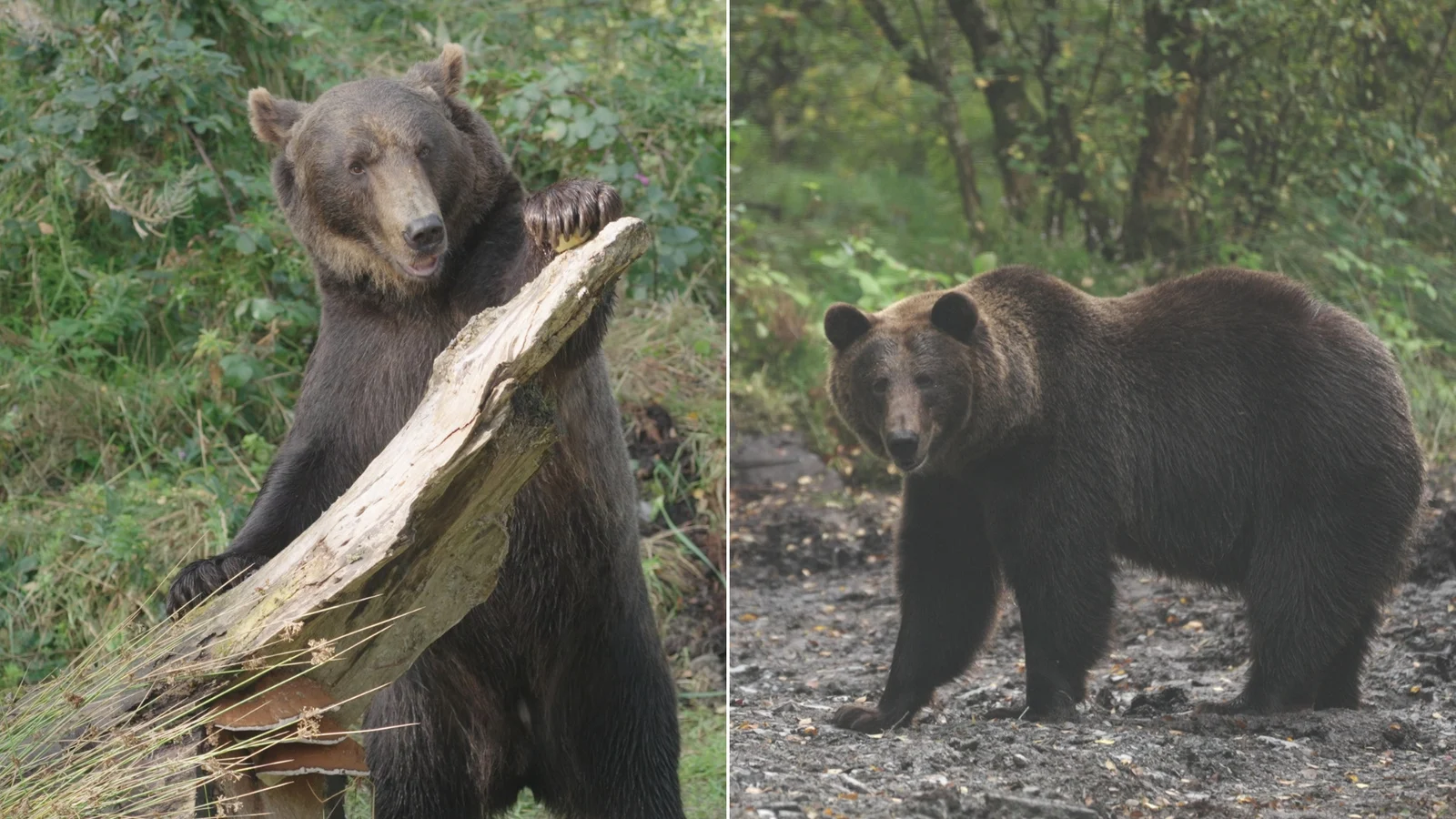
After a 13,500km odyssey that took them across two war zones, two brown bears rescued from harsh conditions in Russia’s Dagestan have begun a new life in the forests of Burnfoot, Co Donegal — the culmination of a five-year effort that their rescuers once feared might never be possible.
Wild Ireland founder and director Killian McLaughlin described the outcome as “mission accomplished” after Bu and Tyapa completed the long journey to the sanctuary.
Wild Ireland, which opened seven years ago within a rainforest setting, offers sanctuary and rehabilitation for animals including bears, wolves, arctic foxes, reindeer and lynx.
With Bu and Tyapa’s arrival, the number of brown bears at Wild Ireland in Co Donegal has risen to four — the only living brown bears in Ireland.
Brown bears once ranged across Ireland, before dying out more than 2,000 years ago.
Tyapa, one of the bears, lived in a cage with limited access to water
Mr McLaughlin said he first became aware of the two bears in 2021, when they were being kept at a dog and cat sanctuary in Dagestan that, he said, did not have the resources required for long-term bear care.
Tyapa, who had come from a petting zoo, was reportedly being raised for taxidermy — meaning he could have ended up stuffed if he was killed.
He was confined in a cage with limited access to water.
Bu’s background was in the circus.
After she was surrendered to Right to Life Sanctuary in Dagestan, she spent years in a small indoor cage and, like Tyapa, had limited access to water.
Watch: Bu and Tyapa settle into their surroundings in Donegal
Unable to properly care for the bears, the Dagestan sanctuary reached out to Mr McLaughlin via the Dutch charity Bears in Mind, an organisation he had previously worked with.
At first, the plan was straightforward: move the bears by road from Russia, through Ukraine, and onward to Co Donegal.
That route collapsed when Russia invaded Ukraine in 2022.
A map detailing the journey taken by the team and the bears
From that point, the rescue became a rolling series of delays as war, sanctions and international transport restrictions repeatedly stalled the operation, leaving the bears in Dagestan far longer than intended.
Mr McLaughlin hired a lawyer in Moscow to design a route that would not breach trade sanctions, and he assembled a volunteer team within Russia.
He also secured the support of Tiger House, a sanctuary near St Petersburg that cares for former circus tigers.
Tiger House arranged health checks, vaccinations and treatment for the bears in preparation for travel to Ireland.
In October 2025, Tiger House owners Dima and Yana Kim drove for 36 hours to Dagestan.
When they arrived, the bears had to be cut out of their cages and sedated before they could be moved.
At Tiger House, Bu and Tyapa — described as severely malnourished, showing signs of psychological trauma, and suffering kidney problems linked to dehydration — entered quarantine and received care.
Mr McLaughlin, working alongside Dima and Yana Kim, coordinated with Russian and Irish authorities and lawyers to complete the necessary documentation for transport.
The bears being unloaded in Abu Dhabi
With no direct flights between Russia and the EU because of the war in Ukraine, Mr McLaughlin pursued an alternative path through the Middle East.
Complicating matters again, the escalation of the Iran war in late-February triggered airspace closures and widespread flight disruption across the region.
Intradco Global and Etihad Cargo ultimately joined the effort to fly the bears in June.
Intradco provided specialist animal transport services free of charge, while Etihad Cargo agreed to a reduced price.
Teams at Zayed International Airport in Abu Dhabi coordinated the bears’ arrival, managed their handling and oversaw their transfer between flights.
After the route was secured, Bu and Tyapa were transported to Sheremetyevo Alexander S Pushkin International Airport in Moscow for the first flight to Abu Dhabi.
Mr McLaughlin travelled to Abu Dhabi to meet them, supervised the transfer process, and then accompanied the bears on the flight from Abu Dhabi to Dublin.
Bu and Tyapa arrived in Ireland on 3 August.
They were then transported by cattle lorry by William Gill Livestock Transport to Wild Ireland in Co Donegal, where they entered quarantine.
Bu’s physical condition has improved during her first two months at the sanctuary
Mr McLaughlin said the rescue depended on people in multiple countries cooperating to get the bears to Ireland.
He said: “There was kindness and compassion in the middle of so much strife and war.
“Maybe Bu and Tyapa’s story offers a bit of hope.”
After a veterinary inspection, Bu and Tyapa were cleared from quarantine on 7 September and introduced to their forest habitat at Wild Ireland.
Within their first two months at the sanctuary, both bears have shown marked physical improvement. Blood tests indicate their kidney function has returned to normal, following treatment and consistent access to fresh water.
Mr McLaughlin said the health progress has been welcome, but that the psychological adjustment will take more time because both bears are still afraid of open spaces.
Tyapa at the sanctuary in Co Donegal
He said: “We have experience rehabilitating rescued animals, and we will work at their pace.
“It is all part of their rehabilitation.
“Our job is to give them what they need to feel safe.”
Wild Ireland’s habitat for the pair includes woodland, water and room to roam, along with smaller houses where they can withdraw.
Mr McLaughlin said: “They can explore the forest, return to their houses or take themselves away from public view.
“Giving them that choice is part of their recovery.”
Members of the public will have a chance to see Bu and Tyapa during the October midterm break, though the sanctuary says sightings cannot be guaranteed.
“We ask visitors to bear with them while they settle,” Mr McLaughlin said.
A documentary tracking the rescue mission is expected to be released next year.
Etihad, Moondance Productions team and Killian McLaughin on the runway Abu Dhabi
Moondance Productions CEO Shane Brennan called it an “extraordinary journey” that offers hope at a time that “can often feel increasingly bleak”.
Mr McLaughlin said he has “no doubt” Bu and Tyapa will grow as healthy and confident as the sanctuary’s other two bears, helped by a habitat that “replicates their natural environment”.
He said: “The habitat that I’ve designed has everything that a bear needs to be a bear; trees to climb, pond to swim, logs and rocks to forage under.
“We’ve a fantastic, experienced animal care team that spend all day with them, hiding food, making them use their brains, encouraging them to exercise.
“By us providing them with a habitat that replicates their natural environment, that’s a huge step on their road to recovery.
“This is a perfect environment for them.
“We invite members of the public to come and learn about brown bears, learn about their history in Ireland and the plight they face in the world.”