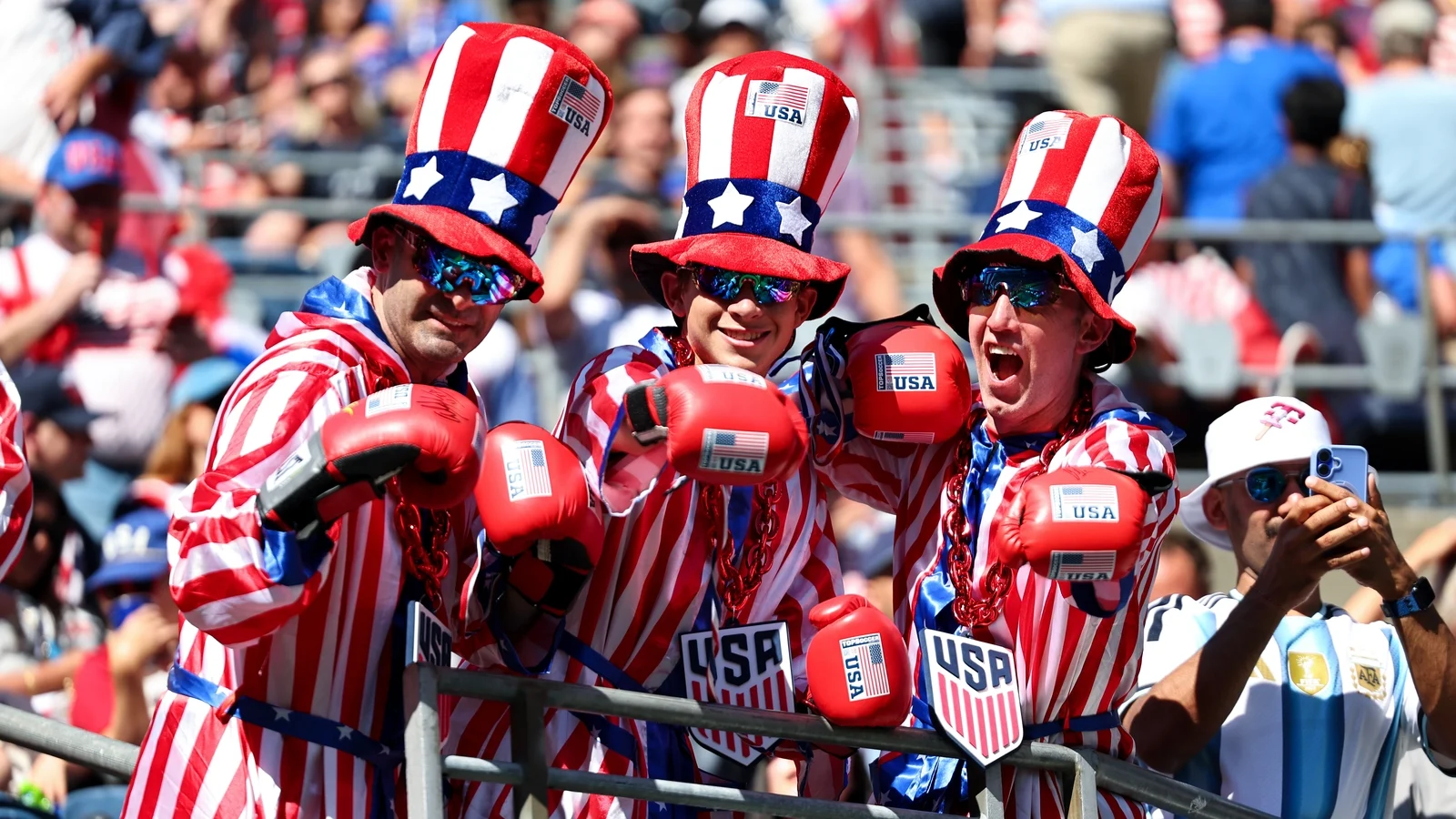
Free refills, the cavernous sprawl of Costco and an apparent national devotion to ranch dressing: in recent weeks, visiting soccer supporters have been gleefully cataloguing what they describe as America’s odd, endearing everyday moments.
The 2026 FIFA World Cup brought 48 teams to more than a dozen cities across Canada, Mexico and the United States, and fans have flooded social media with snapshots of US life that caught them off guard.
Americans, for their part, have relished the spectacle of international crowds turning familiar streets into temporary fan zones — from Norway’s Viking row in Times Square to Scottish supporters gallivanting through Boston.
Billy De Cain of the Sam Adams Boston Taproom which ran out of the brand’s flagship Boston lager in June amid Scotland fans’ celebrations — said the tournament has helped burnish the country’s reputation abroad, and that many visitors he encountered left with warmer impressions than they expected.
“Well, I speak for Boston… East Coast blue-collar city… [People were surprised by] how clean it is compared to New York. People here are much more friendly than people anticipate, particularly international visitors [are] pleasantly surprised,” he said this week.
USA player Folarin Balogun was given a red card during the USA v Bosnia and Herzegovina match
That sense of surprise and the viral evidence of it is a message the Trump administration has been eager to amplify as the World Cup draws to a close.
“What’s shocking is that they were shocked to love America,” US Transportation Secretary Sean Duffy told a rally in Washington DC recently, as he helped launch the America 250 celebrations.
Mr Duffy argued that foreign visitors had been misled by their own “liberal” media into expecting a “dark” and “dirty” United States, only to find a very different reality on arrival.
Frank Guridy, a Columbia University professor of history who specialises in sports history and African American studies, told RTÉ News he could understand the broad observation but said the administration was framing it to suit itself.
“I think everything that the administration says is self-serving, propagandistic. If anything, people who have negative feelings about the United States are not about some image of the United States as a dangerous country, but really about the United States as war-waging,” Prof Guridy said.
“I think that’s a mis-framing on their part,” he added.
In the build-up to the tournament, much of the attention had centred on high ticket prices and the impact of the Trump administration’s immigration policies, while the daily news agenda was dominated by developments in the US-Israeli war with Iran.
The Iranian backroom team was denied or delayed entry to the US, and a top soccer referee from Somalia was stopped by officials from entering the country for the event.
Supporters told media outlets they felt shut out by US travel bans and visa rules, while others said their ESTA travel authorisations shifted at the last minute to “pending”.
Donald Trump is expected to join Gianni Infantini to present the trophy at today’s match
According to Thomas Oates, professor of journalism and American studies at the University of Iowa, the relentless news cycle can flatten the day-to-day realities that many Americans value and that visitors often end up noticing.
He said the US is vast and deeply varied, and that the picture seen from abroad rarely captures the whole country.
“I think that there are some really troubling aspects of contemporary American culture, but there’s also parts of that culture that are pretty inspiring, and they sit alongside each other,” Prof Oates said.
“What this administration would like to do is tell one story and not the other. But I think that part of what people find fascinating about the United States is that it is both,” he said.
As the US marks the final of the 2026 World Cup, US President Donald Trump is expected to jointly present the trophy alongside FIFA President Gianni Infantino today, despite criticism over his intervention to reverse a red-card suspension for a US player.
“Unfortunately… the red card controversy reinforced certain things that many people despise with the United States, which is its unabashed imperial policies and the Trump administration’s government’s really uninterest in any sort of real diplomacy,” said Prof Guridy.
Still, away from the disputes that swirl around politics and sport, many Americans have embraced the upbeat reflection of their country offered by visiting supporters.
A Texan woman I spoke to at the Great American Fair seemed relieved to see the US cast in a different light than the harsher narratives that so often dominate.
“One of my favourite things on social media right now is all the international community coming in for the FIFA Cup and how much they are falling in love with places that probably are where I’m from, which is more middle America – our Buc-ee’s [motorway stores] and our free chips and salsa refills,” she said.
“When I’m watching those things online, their excitement about America, [it] makes me excited about America,” she told me.
Beyond the football, the World Cup has offered Americans a chance to view themselves through the eyes of newcomers — a rare reset in a period when politics and division have repeatedly dominated both domestic debate and international perceptions.