A New Chapter from Brussels: Hungary’s Tentative Pivot and the Money on the Table
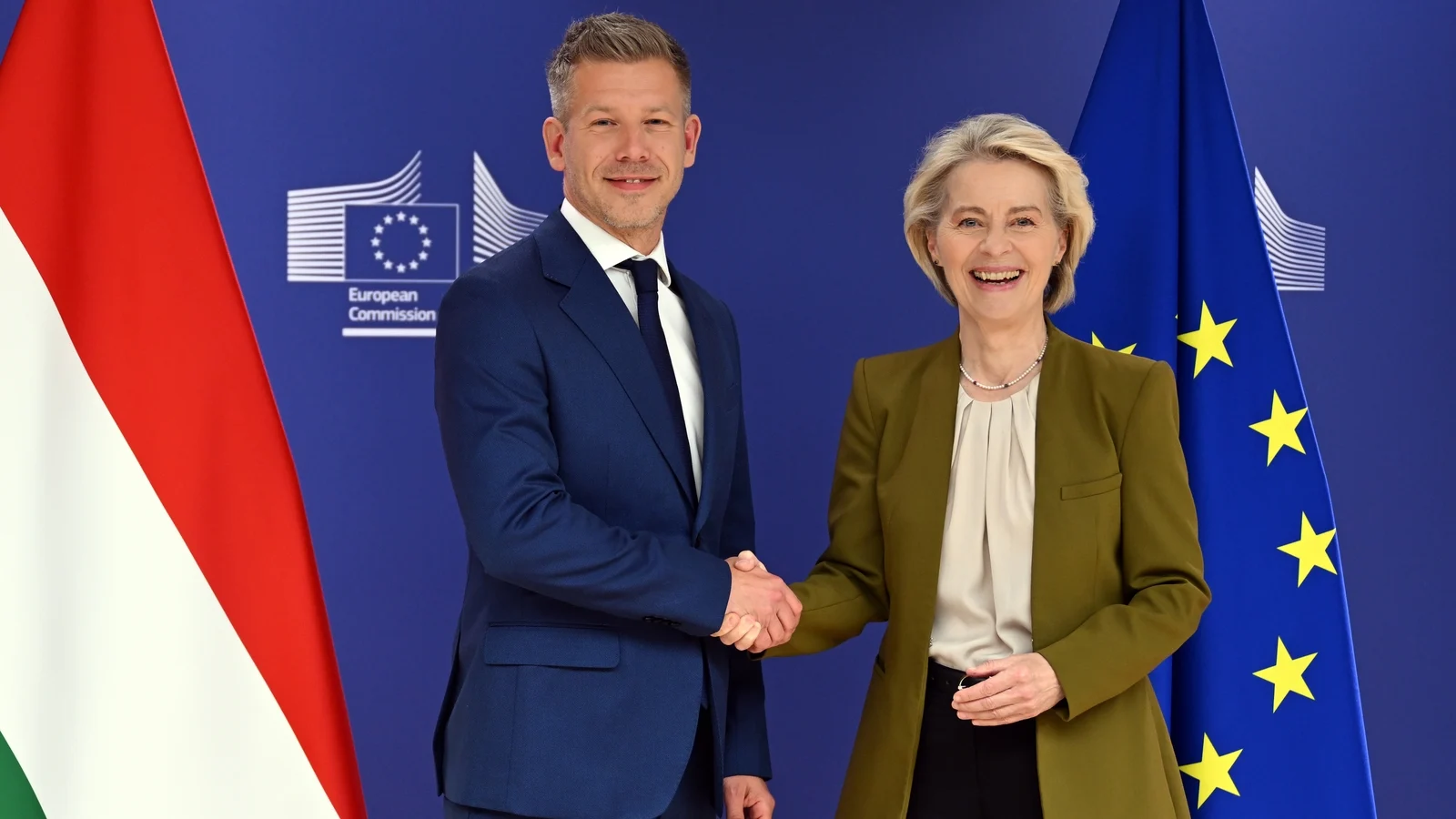
Brussels in late spring can feel like a court of old and new Europe: clattering trams, suits hurrying toward the Commission, a postcard skyline of domes and glass. This week, the city’s familiar choreography was interrupted by a newcomer — Peter Magyar — who touched down not as a triumphant visiting head of state but as an incoming leader with one urgent task stamped on his itinerary: thaw the cash that has long been frozen between Budapest and the European Union.
Magyar’s rapid flight to the Belgian capital — still weeks before his inauguration — is more than a photo-op. It is a signal. The €18 billion that Brussels has withheld over rule-of-law and corruption worries is not abstract; it feeds hospitals, roads, universities and farm subsidies. In Magyar’s telling, and increasingly in Brussels’s reception, releasing those funds is the tangible payoff of a political reset.
What’s at stake — the numbers they can’t ignore
The arithmetic is stark. Around €18bn in cohesion and structural funds have been frozen. Separately, about €16bn in preferential defence loans have been held up. And a remaining slice of roughly €10bn from pandemic recovery packages carries a ticking clock: the incoming government has until the end of August to initiate reforms that would secure that tranche, or it risks losing it.
- €18bn — frozen cohesion and structural funds
- €16bn — preferential defence loans awaiting approval
- €10bn — part of Covid recovery funds with an end-of-August deadline
Those figures aren’t just ledger entries. For a country navigating the slow burn of post-pandemic recovery, they are a potential catalyst for projects that create jobs and modernize infrastructure. “If that money starts moving, people will see new construction sites, better-equipped schools, and companies breathing easier,” said Dr. Ilona Kovács, an economist in Budapest. “It is literal fuel for the economy.”
A meeting of signals, not just sentences
The meeting in Brussels was framed by both sides as constructive. European officials publicly welcomed a willingness from the new Hungarian leadership to discuss the specific steps necessary to unlock funds, while officials in Budapest presented the talks as an opening door. That mutual enthusiasm — a rare commodity after 16 years under Viktor Orbán’s government — has prompted a cautious optimism in EU corridors.
“We saw a level of engagement we haven’t seen from a government that hasn’t taken office yet,” said an EU official who asked not to be named. “Actions will have to follow words, but the impression matters.”
And actions are precisely what Brussels wants: clear, verifiable reforms that address concerns about the independence of the judiciary, public procurement and the transparency of state-funded projects. The European Commission has, in recent years, become more willing to condition funds on good governance — a muscle it is now flexing toward Budapest.
On the streets of Budapest: hope, skepticism, everyday stakes
Back home, the mood is layered. In Józsefváros, a district reshaped by decades of change, Olivér, a café owner, poured coffee and looked at a television tuned to the Brussels coverage. “People will vote with their feet,” he said. “If there’s work, my son won’t have to leave for Germany.”
A taxi driver named Gábor, who has carried civil servants and campaigners across the capital for years, was more measured. “We’ve heard promises before,” he said. “It’s not the speeches; it’s the permits, the tenders, the jobs that will tell us if anything has changed.”
These voices underscore a truth: political rehabilitation in Brussels translates into real-world confidence — or the lack of it — for everyday Hungarians. That confidence affects investment decisions, loan rates for local governments, and the livelihoods of regions that rely on EU subsidies.
The Ukraine angle: a wider European crossroad
Magyar’s diplomacy does not exist in a vacuum. For years, Orbán’s Hungary held up portions of the EU’s collective support for Ukraine, vetoing measures that ranged from loans to sanctions and blocking certain steps in Kyiv’s EU accession progress. That obstruction has frustrated many EU partners and complicated the bloc’s unified stance against Russia’s aggression.
Magyar has signaled a readiness to change course. He has reportedly suggested a meeting with Ukrainian President Volodymyr Zelensky in June to “open a new chapter.” If hungary lifts its previous vetoes, Brussels could again move more decisively on aid packages and accession talks — but there is no appetite to rush Kyiv into membership, only to ensure the EU can keep supporting Ukraine’s defense and reconstruction.
“A shift by Budapest could be incredibly consequential,” said Maria Jensen, an analyst at a European think tank. “It’s not just funds; it’s a signal of solidarity that affects the whole architecture of European security.”
Trust is a currency that must be earned
Even as upbeat communiqués circulate in Brussels, diplomats and analysts emphasize that warm words are the start, not the finish. “We’ll need to see legislation, independent oversight, and actual implementation,” said an EU diplomat. “Commitment before office is encouraging; compliance in office is decisive.”
Magyar arrives in the job with a supermajority in parliament, which could speed reforms — or accelerate backsliding if used undemocratically. That concentration of power is why observers will watch not only the content of new laws but the process through which they are passed: were they negotiated openly? Were stakeholders consulted? Are judges and anti-corruption bodies protected?
Beyond Hungary: what this moment means for Europe
Ask yourself: what does it mean when a member state’s relationship with the EU can be reset within weeks? On one hand, it shows the Union’s leverage: funding and conditionality can nudge changes. On the other, the episode exposes an uncomfortable reality — that long-term democratic norms can be buffeted by electoral cycles and political bargains.
We are watching a test of whether Europe can pair firmness on values with pragmatic diplomacy. If Brussels and Budapest can translate dialogue into durable reforms, the result could be a template for resolving future rifts within the bloc. If not, the episode will be a reminder that the EU’s cohesion is as much political as it is financial.
Questions to carry forward
What will Hungarians feel differently in their day-to-day lives if EU money starts flowing again? Will a freshly signed law in Brussels-proof typeface reassure investors, or will deeper trust-building be necessary? And across the continent, how will governments weigh the short-term benefits of cooperation against the long-term imperative of safeguarding democratic institutions?
For now, the story is still being written in meeting rooms and parliamentary dockets. Budapest and Brussels have agreed to talk, to map steps and timelines, and to give each other the benefit of the doubt. The real story will be visible in scaffolding on streets, in transparent procurement portals, and in the courts that remain independent.
Come late August, the clock will tell whether this thaw was a springtime miracle — or the first, fragile thaw in what must become a sustained season of reform. Will Hungary become the story of a pragmatic reset, or will the old tensions reassert themselves? The answer will ripple far beyond one capital.”