Amid power cuts and air-raid threats in Kyiv, five Irish medical professionals pressed ahead with a trauma-aid course designed to help Ukrainian first responders keep injured people alive — and they have now returned to Ireland.
The training, delivered in the Ukrainian capital last week, marked the 11th edition of the programme organised by the UCD Ukraine Trauma Project since Russia’s full-scale invasion in 2022. The course provides a practical foundation in delivering essential medical care to trauma casualties.
Across the past four years, the project has trained more than 1,000 Ukrainian first responders. It is led by three senior figures from the UCD School of Medicine — Emeritus Professor Gerard Bury, Professor Chris Fitzpatrick and Dr Lyudmyla Zakharchenko — who travelled to Kyiv to teach the latest session.
“Shortly after the full-scale invasion, from talking to colleagues, we identified in Ukraine the absence of certain advanced trauma care skillsets at the frontline among first responders,” Professor Bury told RTÉ News last week from an undisclosed location where the trauma care course was being taught.
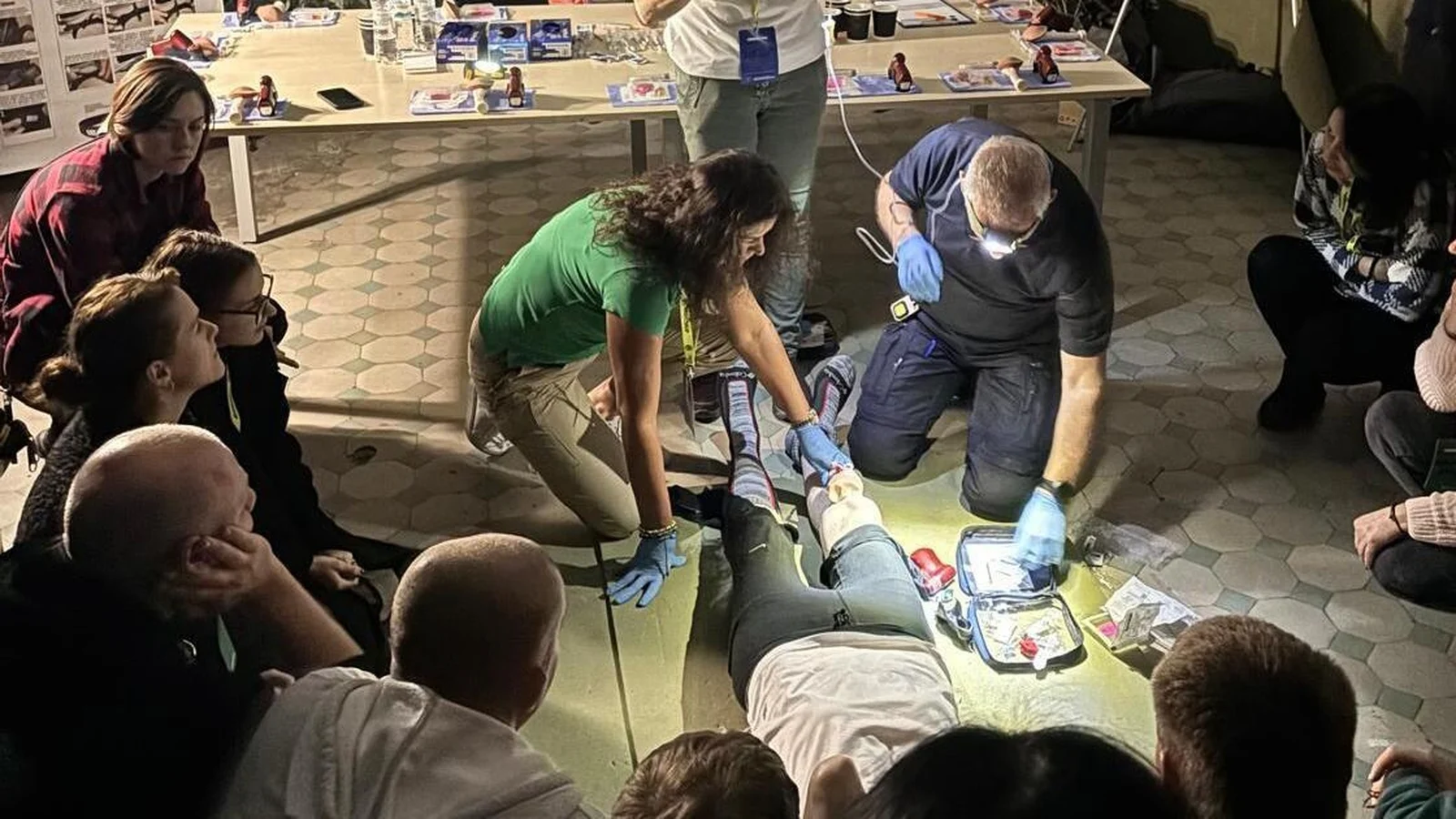
The team’s time in Kyiv coincided with intensified Russian drone and rocket strikes targeting the city’s energy grid, forcing some teaching to continue in difficult conditions.
“We lost light, heat, internet. The group of trainees are extremely resilient people. They simply took out their torches and continued the work,” said Prof Bury.
(Left to right) Professors Bury, Fitzpatrick and Zakharchenko pictured at UCD with
boxes containing trauma first aid kits before it was driven to Kyiv (pic: Shane Healy)
In total, 120 people took part last week, including combat medics, civilian paramedics, police officers, doctors and nurses. Instruction was delivered in groups of 30 students each day in an intensive format, and many attendees had travelled in from frontline regions.
One of the central practical components focused on teaching participants how to use a medical drill on bone — in this case, 3D-printed bones — so they can insert a catheter and rapidly administer tranexamic acid.
The medication helps reduce bleeding by preventing blood clots, and Irish paramedics use the procedure when responding to trauma-related casualties.
In Ukraine, the course organisers said, frontline conditions mean responders cannot afford to spend up to 30 minutes trying to locate a vein in an injured person’s arm in darkness or near-darkness while a life hangs in the balance.
“If the interventions built around tranexamic acid are not provided within that two-hour window after injury, the chance of death increases significantly,” said Prof Bury.
Two advanced paramedics, Linda O’Rourke from Ennis and Ben Heron from Dublin, volunteered as part of last week’s team. They were joined by Shane Leahy, a Limerick entrepreneur and founder of Irish charity One4Humanity, who managed a complex logistics effort and delivered hundreds of trauma first aid kits to Ukraine for the course.
Funding for the initiative has so far come to approximately €2m, with support from the Department of Foreign Affairs, HSE Global Health, the Irish Red Cross, UCD and private donors in Ireland. On the ground, the work is assisted by Ukraine’s Serhi Prytula Charity Foundation.
Back in Ireland, a support team of up to 50 volunteers helps source and pack the drugs.
Donations also cover specialised training materials, including 3D-printed bones.
Paramedic Ben Heron instructs a participant on how to use a medical drill during the course
“We have had people who’ve done the course, and then we find out subsequently that they’ve died,” said Professor Fitzpatrick, via video call last week from the training venue in Kyiv.
“Many of our participants have lost close ones, and people come here injured. We’ve had people who come in IV [intravenous] lines,” said the retired consultant obstetrician and gynaecologist.
“We had a woman here who was originally on our course, and I just happened to find out that her husband was killed on the front line a couple of days prior and [she] hadn’t even recovered the body. And yet she was a combat medic attending the course, and then she came back as a trainer”.
Professor Bury also recalled another participant who had lost a limb in combat.
For Dr Zakharchenko, each wartime return to Ukraine carries a heavy emotional weight.
Originally from northwestern Ukraine, she has lived in Ireland for 25 years. She works as a consultant neonatologist and paediatrician with Children’s Health Ireland and is now an Irish citizen.
“It’s very emotional because all my student life was in Kyiv,” said Dr Zakharchenko.
“Even if one life will be saved because of our training, because of this procedure, I will still come regardless of what’s going on”.
Since last year, the curriculum has expanded to include neonatal resuscitation.
“We signed a collaboration with one of the medical universities in Kyiv, and we are going to continue with an exchange of education and support for medical students and doctors as much as we can,” said Dr Zakharchenko.
Professors Bury, Fitzpatrick and Zakharchenko meeting Volodymyr Zelensky
and Olena Zelenska in Dublin last December (Pic: Office of the President of Ukraine)
In December, during an official visit to Dublin, Ukrainian President Volodymyr Zelensky and First Lady Olena Zelenska presented the three professors with Ukraine’s Golden Heart Award in recognition of their humanitarian work.
“He thanked us for what we did and he advised us strongly to continue with it,” said Prof Fitzpatrick recounting their meeting with Ukraine’s president.
All three professors said they intend to keep returning to Kyiv to deliver the course until the war ends.
“We are committed to continue this for the duration,” said Prof Fitzpatrick.