Before dawn in Japan, a new chapter in planetary exploration lifted off: an ambitious mission to one of Mars’s moons that could deliver the first samples ever returned from the Martian system and offer fresh clues to the origins of the Solar System—and even life on Earth.
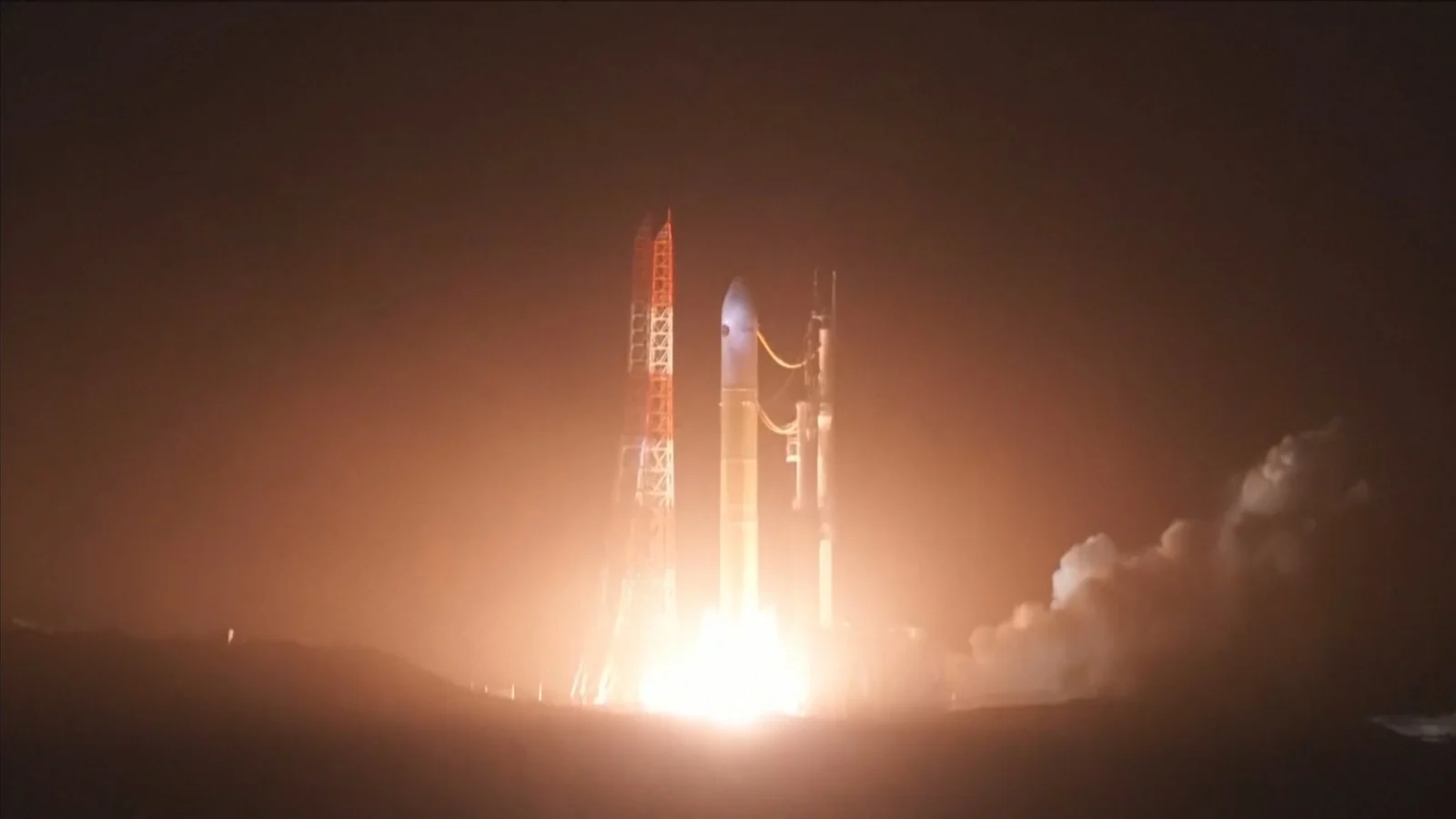
The flagship H3 rocket carrying the unmanned Martian Moons eXploration (MMX) probe roared into the sky from the Tanegashima Space Center at 4:41am (8:41pm Irish time) yesterday, according to a live stream broadcast by the Japan Aerospace Exploration Agency.
Just over an hour after launch, JAXA confirmed during the broadcast that the spacecraft had separated cleanly from the H3 and was “beginning its journey toward the Martian system”.
“I’d dreamt of this day, so I’m incredibly happy,” said JAXA scientist Mari Aida, adding: “Right now, I feel really relieved.”
Watch: Japan launches world-first mission to retrieve samples from moon of Mars
After separation, the agency said it received the expected signals from the probe, indicating MMX was functioning normally.
Even at an early hour, the launch drew a large audience: thousands tuned into the live stream and posted supportive messages as the spacecraft began its long cruise outward.
MMX is expected to reach the vicinity of Mars around August next year. From there, it will move into orbit around Phobos, the larger of the planet’s two small moons.
A French-German rover known as IDEFIX—named after the dog of comic-book hero Asterix—will become the first vehicle to traverse Phobos. Its job will be to study the surface and help confirm conditions for a safe landing.
Once in position at Phobos, the mission is designed to collect at least 10 grams of surface material during roughly three years operating near the red planet.
JAXA has described MMX as an effort to complete the first round trip to the Martian region. The project is being carried out in partnership with US and European space agencies, along with numerous universities and technology companies.
Beyond the science, researchers see the mission as a practical step toward future crewed expeditions.
“The samples from MMX will bring forth paradigm-shifting science on the Mars system for generations to come, especially as NASA prepares to send the first humans to Mars,” Nicky Fox, administrator of NASA’s Science Mission Directorate, said in a message broadcast on the JAXA live stream.
NASA’s Perseverance rover has already collected samples
JAXA says the mission could answer a foundational question: how Mars and its two moons were formed, information that feeds into broader work on how the Solar System itself emerged.
Scientists have long debated the moons’ origins. Under the “giant impact” hypothesis, Phobos and Deimos formed from debris after another body slammed into Mars.
The competing “capture” hypothesis argues the moons began as asteroids later snared by Mars’s gravitational pull.
Pinning down which scenario is correct could, JAXA said, clarify “how a habitable environment for life might have arisen on the terrestrial planets”—the four rocky worlds nearest the Sun: Mercury, Venus, Earth and Mars.
The agency also says Phobos could one day serve as a kind of “natural space station,” with MMX helping define what is required for a round trip—capabilities it calls “essential for crewed Mars exploration”.
MMX will also conduct observations of Deimos, Mars’s other moon, though it will not attempt a landing there.
Japan’s push comes as other powers continue to chase major sample-return milestones. US and Chinese space agencies have been competing to become the first to bring Martian rock back to Earth.
NASA’s Perseverance rover, operating on Mars since 2021, has already cached samples.
Plans to retrieve them, however, were effectively cancelled by the administration of US President Donald Trump following a vote by Congress in January.
China, meanwhile, has scheduled the Tianwen-3 spacecraft for launch around 2028, aiming to return samples from Mars as early as 2031—potentially ahead of the Japanese mission’s return.