When the Desert Broke Open: Mali’s Night of Blasts and an Army in Mourning
There are moments when a country’s fragile routine snaps, like a twig underfoot. Yesterday was such a day in Mali — a string of coordinated assaults that pierced the country’s already thin veil of calm, leaving one of its most powerful men dead and sending ripples of fear from the streets of Bamako to the wind-scarred towns of the north.
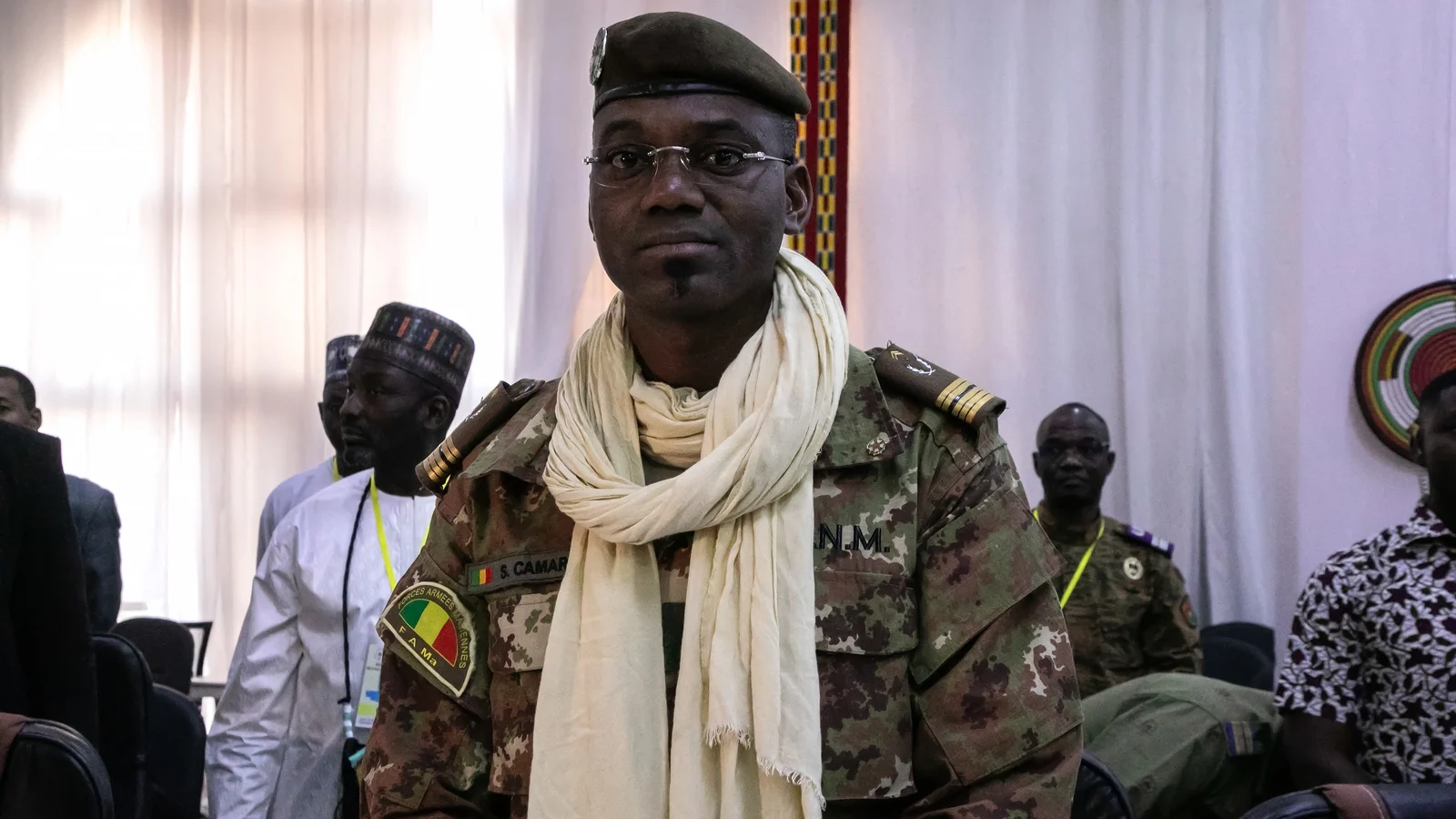
Defence Minister Sadio Camara, his second wife and two grandchildren were killed after a car bomb detonated outside his house in Kita, a town west of the capital. The news, confirmed by family members and a government official, landed on a populace already strained by a decade of insurgency and repeated coups. For many Malians, the attack felt less like a single act of violence and more like a sudden, cruel validation of everything they’ve feared.
The day the map trembled
What made yesterday’s violence extraordinary was its choreography. For the first time in years, Tuareg rebels from the Azawad Liberation Front (FLA) and fighters from the jihadi Group for the Support of Islam and Muslims (JNIM) carried out simultaneous operations across the vast Sahelian expanse — striking near Bamako, in the northern towns of Kidal and Gao, and in other strategic pockets of the country.
“They wanted to send a message,” said a military source who asked not to be named. “Not just to seize ground, but to show they can reach wherever they want. They succeeded in sowing fear.”
In the northern city of Kidal — a place that for many Tuareg is as much a symbol as it is a town — combatants say they have forced Malian forces and their Russian allies out of Camp 2. “We saw a military convoy leave at dawn,” a resident told reporters. “And then we saw our fighters take to the streets.” Kidal had been retaken by Malian forces with Wagner support in late 2023, marking a temporary end to more than a decade of rebel governance.
Why this matters beyond Mali
The death of a defence minister in a car bomb is not merely a domestic scandal; it is a geopolitical tremor. Mali’s rulers, part of a succession of juntas since the 2020 coup, have severed long-standing ties with France and much of the West, gravitating instead toward Moscow. Wagner mercenaries played a visible role in past years; more recently, Russia’s Africa Corps — under the direct control of Moscow’s defence ministry — stepped into the vacuum. Now, as armed movements reassert themselves, the question of external partners’ influence and the security architecture of the Sahel has never seemed more precarious.
United Nations Secretary-General António Guterres condemned the attacks, urging coordinated international action to tackle violent extremism and meet urgent humanitarian needs. The European Union labelled the incidents “terrorist attacks,” and the world, in general, watched a country that produces some of Africa’s most coveted minerals — Mali is one of the continent’s largest gold producers — shake under the weight of armed contestation.
On the streets: voices and anxieties
In Bamako’s markets, where the chatter of vendors is usually a backdrop to daily life, the tone has changed. “People are afraid to travel at night. My niece was due to start a new job next week and now it’s postponed,” said Aminata Traoré, a fruit seller in the markets near the Senou district. “We’ve grown used to hearing about the north, but now it is here. It feels closer.”
A resident of Kita, who saw the aftermath of the blast, spoke softly about the panic. “There was glass all over the yard,” he said. “Children were screaming; their faces were white. How do you explain to them that this is politics? That people they have never met decided they are expendable?”
An international security analyst based in Dakar, Dr. Léonard Mbaye, put the assault into a wider frame. “What we are witnessing is an evolution in tactics. Armed groups are coordinating across ideological lines — jihadi networks with ethnic rebel movements — to undermine central control. This is not about territory alone; it’s about legitimacy and spectacle.”
Human cost and the shadow of displacement
Official tallies reported 16 civilians and soldiers wounded and “limited material damage,” but statistics seldom capture the true human cost. Mali, and the broader Sahel region stretching from Senegal to Sudan, has seen waves of displacement and deepening food insecurity for years. Hundreds of thousands of people across Mali have been uprooted by violence and climate stressors that make farming unpredictable and migration more likely.
“When the fighting comes, women and children are the first to bear the burden,” said Mariam Diarra, who works with a humanitarian group that provides shelters in the capital. “We try to prepare contingency plans, but funding is always a problem and access to the north is complicated by security constraints.”
What’s next? Uncertain choreography
The junta has insisted that the situation is under control in the targeted localities. Yet control on paper looks different from control on dusty streets where fighters can disappear into the landscape. The reported withdrawal of allied Russian troops from Kidal underscores how quickly alliances can shift and how fragile any claim to stability can be.
Will Mali’s government reassert authority, or will a diffuse set of armed actors carve out de facto governance across swaths of the country? How will external partners — be they regional blocs, European donors, or Moscow — respond to prevent further deterioration? These are not merely tactical questions. They ask us to think about what kind of state Mali will become, and what model of security the Sahel will accept.
Echoes beyond borders
The fallout is not confined to Mali. Neighboring Niger and Burkina Faso have experienced coups and their own dealings with foreign mercenaries and shifting alliances. The pattern points to a larger trend in global politics: the retreat of traditional post-colonial ties, the rise of alternative security providers, and the increasing privatization of conflict through mercenary groups. All of this happens against the backdrop of climate change, economic fragility, and a global appetite for the minerals that countries like Mali hold.
So, what do we owe the people of Mali? Sympathy is not enough. We must watch, yes — but also ask: who will fund the humanitarian response? Who will back political solutions that include local voices, from Tuareg elders in Kidal to market women in Bamako? How will the international community balance counterterrorism priorities with the urgent need for development and climate resilience?
For now, Mali stands at a crossroads. In the short term, families bury their dead and count their wounded. In the longer term, a nation wrestles with questions of identity, power, and survival. The night the desert broke open will be remembered not only for its explosions, but for how Mali, and the wider world, chose to respond.
- Defence Minister Sadio Camara, his second wife and two grandchildren were killed in a car bomb attack in Kita.
- Attacks were coordinated between Tuareg rebels (FLA) and JNIM, striking multiple towns including Kidal and Gao.
- The UN and EU condemned the violence and called for international support to address extremism and humanitarian needs.
Where do you stand when borders blur and alliances change? How should the international community reckon with states that oscillate between fragile governance and open conflict? Mali’s answer to those questions will shape not only its own future, but the security of an entire region. Watch closely.