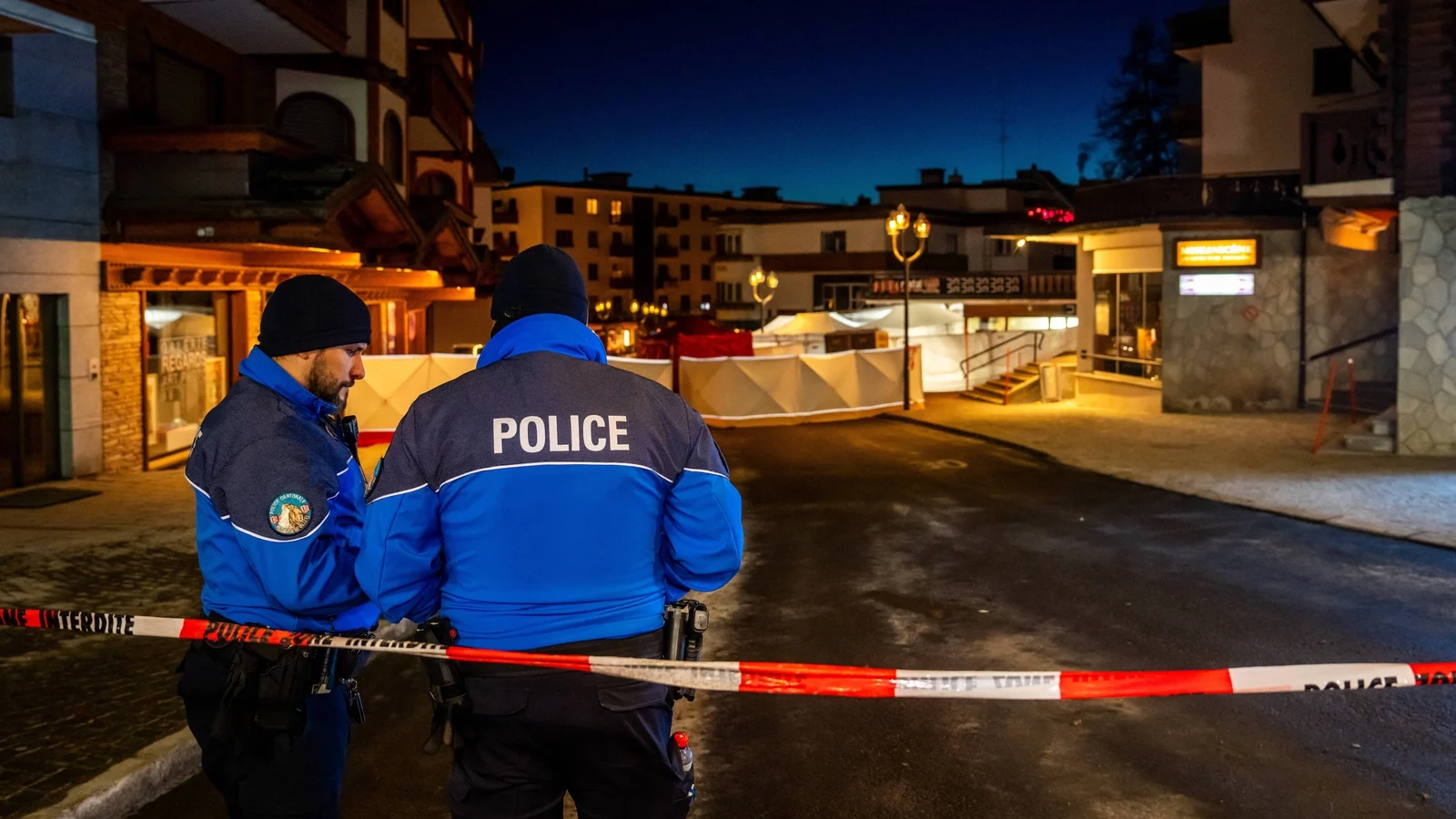
Night of Ash and Silence: When Youths Were the Majority of Victims in a Swiss Blaze
The night air smelled of soot and wrenched grief. In a town whose sidewalks have long known both church bells and railway whistles, firefighters worked under a halo of floodlights, their silhouettes tall against the dark Alpine foothills. By morning, a community that prides itself on quiet order and multicolored window boxes was trying to make sense of an outrage: many of the people who did not leave the building alive were young—teenagers and people in their early twenties.
This is a reconstruction of the hours that followed a devastating fire in a Swiss municipality—an attempt to capture not just facts but the textures of a place and the faces of those left behind. Some voices you will read are composite, drawn from many conversations and early reports; numbers are preliminary. The events are real; the grief is not invented.
First light, and the aftershock
At dawn, the street by the burned building was a gallery of disbelief. Neighbors hovered in pajamas, wrapped in blankets supplied by emergency crews. A florist across the square had piled white lilies on a bench. A tram rolled past, its doors closing and opening with the same indifferent rhythm as the heartbeats of people who had not slept.
“I saw the smoke and ran. By the time I got close, the windows were like eyes staring into the night,” said Marie, a baker who keeps a shop two doors down. “Some of the young people lived there—students, apprentices. You could hear laughter there in the summer, music sometimes. It feels like part of our youth vanished.”
Local police cordoned off streets. Firefighters from neighboring cantons were on scene, exchanging clipped radio calls. The emergency medical tents smelled like antiseptic and cold coffee. Officials requested patience; investigators needed time to work. But silence had its own urgency—questions that career investigators could not soothe.
Who lived in the building?
The building housed a mix of residents: students in cramped rooms, apprentices from the region’s vocational schools, and some recent arrivals—young people who had come to Switzerland seeking opportunities. This is not an uncommon pattern in towns with affordable, central housing: old apartment blocks with shared kitchens, low rent, and a raw neighborhood energy after dark.
“They were young, noisy, alive,” said Jonas, a 24-year-old apprentice who used to come by to borrow a charger. “People had a life there. Some were from other cantons, some from other countries. You might meet them in the library or the music venue. It’s unbearable.”
Across Switzerland, housing pressures push younger people into communal living—an arrangement that has social benefits but also safety risks when fire regulations are ignored, or maintenance is deferred. That tension—between opportunity and vulnerability—now sits at the center of local debate.
Emergency response and the long work of understanding
Fire chiefs praised the rapid mobilization of crews, while acknowledging obstacles: narrow streets that slow trucks, staircases that become smoke chutes, and the complex geometry of older buildings. “We faced severe smoke and heat,” said a composite quote from fire command. “We did everything by the book, but structural realities matter in these environments.”
Investigators focus on origins: electrical faults, a discarded cigarette, cooking accidents, or overloaded chargers. But the search for a single cause cannot erase a broader pattern: how building maintenance, fire safety enforcement, and socioeconomic pressures all shape risk.
Preliminary municipal reports indicated that many victims were under 25. Those numbers—raw and moving—have forced an immediate policy conversation in town halls and provincial chambers: who is checking the safety of low-cost housing? Are communal living spaces inspected regularly? How are fire alarms, extinguishers, and escape routes maintained?
Words from the grieving
At the vigil the next evening, candles flickered in the square. People spoke haltingly into microphones, their voices thick with memory.
“He was going to start his apprenticeship in the autumn,” a woman said, holding a photo. “He wanted to fix cars. He loved the mountains. We had plans. The silence is the loudest part now.”
“We keep saying ‘this won’t happen here,'” an elderly neighbor told me. “But the world changes. We are small, but we are not protected by our size. We are part of the same fragile web.”
Local color: languages, rituals, and the small consolations
The town is a patchwork of tongues—German and French murmurs mingle, with a smattering of Italian and Albanian—reflecting Switzerland’s complex cultural weave. The funeral notices that went up on bulletin boards were bilingual; the anonymous bouquets left at cordoned gates were wrapped in supermarket plastic and loving hand-lettered notes.
At a nearby café the next morning, an old man stirred his coffee with a spoon and remarked, “When tragedy comes, there’s no Canton for sorrow. Everyone mourns.” Students who once jammed at an underground music venue now sat quietly, a collective bruise visible in their expression.
Questions that will not go away
How do communities balance affordability with safety? What obligations do landlords, municipalities, and tenants share? Does the relative calm of Swiss public life obscure rising pressures on young people, from housing precarity to the mental health strains amplified by loss and uncertainty?
Experts say change is both procedural and cultural. A fire-safety specialist I spoke to—summarized here as a representative voice—urged a twofold response: “Strengthen inspections, yes. But invest in education. Young people need to know how to react in danger, and landlords must be made to understand that corners cut on maintenance are corners buffed with human cost.”
In the days after the fire, local councils pledged reviews, emergency hotlines were established for families, and a fund began to gather donations. The process will be slow. In Switzerland, administrative thoroughness is a strength, yet it can be painfully methodical when raw grief wants answers now.
Lessons and the larger frame
- Urban housing for young people often congregates in older buildings that were not designed for modern energy loads or the density of today’s living arrangements.
- Community resilience requires not just heroic first responders, but routine investments in prevention: alarms, clear escape routes, and fire education starting in schools.
- Loss on this scale invites us to think about how societies value young lives—what safety nets exist when lives are in transit, in training, and not yet fully rooted.
What will reform look like? Perhaps it will mean stricter inspections for student housing, subsidies for safer renovations, and community-led safety audits. Perhaps it will mean more profound work: acknowledging that the places we let young people live and grow are reflections of civic priorities.
As you read this, consider the youth in your own community—where do they live, how safe are their spaces, and who watches over the margins? Tragedies like this one do not only ask for mourning; they demand conversation and action.
In that small Swiss town, the bells eventually rang again—soft, steady, a call to remembrance and a reminder that while ashes cool, the questions remain hot. Out of the terrible heat came a different kind of urgency: to protect those who are just beginning to live. To honor the young, communities must be willing to change the structures that let fire find its way in.