When taps run dry: Gaza’s water crisis and the quiet violence of scarcity
There is a sound I won’t forget: the hollow clank of plastic jerrycans being set down on a concrete roof in the late light, followed by a long, exhausted exhale. It was the sound of a city improvising its survival.
Across Gaza, ordinary life has been reduced to a question that would have seemed absurd a few years ago: where will the next glass of water come from? Médecins Sans Frontières (MSF) says it knows the answer — and it is not comfortable. In a stinging new report, the medical charity argues that the systematic destruction of water systems and repeated obstruction of supplies have made water itself a weapon, and that this engineered scarcity has turned daily life into something cruel and precarious.
The claim and the counterclaim
MSF’s report, titled “Water as a Weapon,” lays out a bleak portrait. Drawing on field interviews and data collected through 2024 and 2025, the charity says desalination plants, boreholes, pipelines and sewage systems have been rendered inoperable or inaccessible — with nearly 90% of Gaza’s water and sanitation infrastructure either damaged or destroyed, according to UN, EU and World Bank figures the report cites.
“They know that without water life ends,” an MSF emergency manager told reporters. “In Gaza they have used access to water as a weapon to collectively punish Palestinians.”
Israel’s response was immediate and sharp. COGAT, the Israeli defense body responsible for Palestinian civilian affairs, dismissed MSF’s findings as “baseless,” saying that water supply in Gaza “consistently exceeds humanitarian thresholds” and that Israel even facilitates delivery of water from its own sources. The agency accused MSF of operational failures and procedural disagreements — a familiar diplomatic back-and-forth that leaves people in Gaza waiting with empty containers.
Voices from the ground
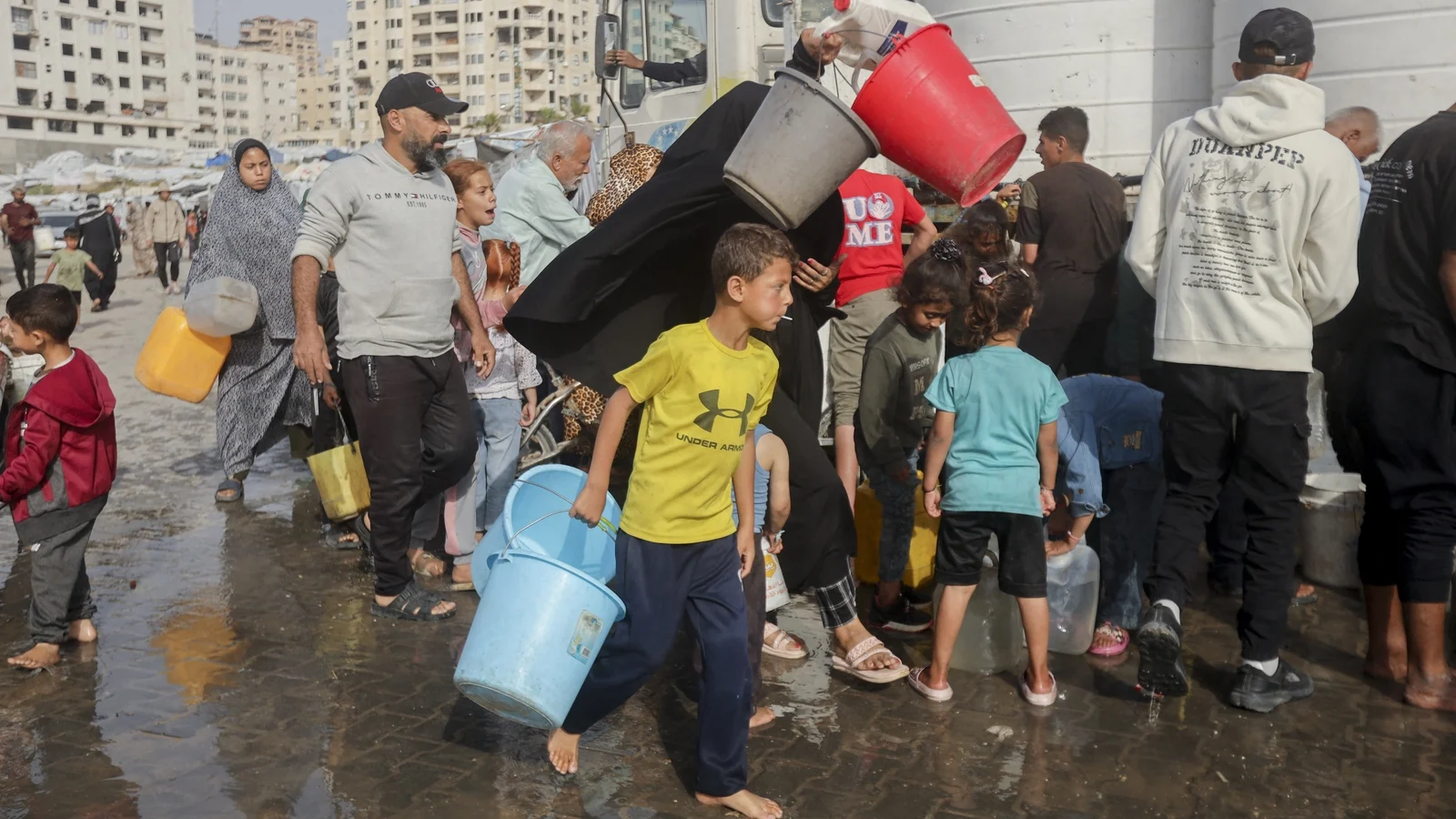
Walk through Gaza City and you will see the improvisations people have made: plastic tanks lashed to rooftops, wind-up pumps covered in tarpaulin, children queuing at small municipal tanks where the nominal flow has been throttled to a trickle. A baker in the Shujayea neighborhood told me, “We used to bake with the radio on and customers chatting. Now we time our ovens for when water arrives so we can scrub trays. There is less talking and more waiting.”
A nurse at a crowded clinic described the clinical consequences in plain terms. “You cannot run an operating room without adequate water. You cannot keep wounds clean. You cannot sterilize instruments properly. Every cut, every IV, is a risk,” she said. “We patch, we pray, we ration.”
One elderly woman, who asked to be identified only as Fatima, explained how she had stopped offering coffee to visitors — a small cultural ritual of hospitality that is now unaffordable in both water and spirit. “Water used to be a blessing. Now it is a calculation,” she said, holding a small cup as if to gauge how many sips were left in her supply.
What the numbers tell us
Numbers do not capture the full human cost, but they anchor the emergency: MSF reports that its teams supplied more than 5.3 million litres of water a day last month — enough to meet the minimum needs of roughly 407,000 people, about one-fifth of Gaza’s population. That, by itself, exposes the scale of the gap; Gaza is home to roughly 2.2–2.4 million people, depending on the dataset, and international emergency standards recommend at least 15 litres of water per person per day in crisis settings — a bare minimum for drinking, cooking and sanitation.
MSF also documents incidents in which water trucks and boreholes bearing clear humanitarian markings were shot at or destroyed. And the charity says one-third of its requests to bring in critical supplies — pumps, desalination units, chlorine and other water-treatment chemicals — were rejected or left unanswered.
Put another way: systems that once pushed clean water through pipelines are broken; the equipment that could fix them is often delayed at crossings or denied; and the trucks that try to deliver are sometimes at risk. The result is not only thirst but a higher risk of disease outbreaks, longer hospital stays, and the erosion of dignity.
Why water becomes a weapon
It is tempting to see damaged pipes as the collateral damage of war — the chaotic byproduct of bombing and fighting. MSF and several humanitarian observers say the pattern looks different: repeated targeting of the same infrastructure, tactical restrictions on materials needed to repair it, and operational obstacles placed in front of humanitarian agencies. When infrastructure is systematically degraded and denied repair, the effect on civilians can be as lethal as more visible forms of violence.
“Water is a basic axis of life — sanitation, health, food security,” a water specialist working with a UN agency explained. “If you interrupt that axis deliberately, you are not merely wounding a system. You are wounding society.”
Everyday survival and small economies
What does this mean for daily life? For many families, it means spending scarce funds on buying water from private vendors at inflated prices. For others, it means relying on shallow wells or even surface puddles — a risky choice that increases exposure to cholera, dysentery and other waterborne diseases. For NGOs, it means choosing which neighborhoods to serve and watching as military orders close off entire zones where people used to get regular deliveries.
The coping strategies are creative and sorrowful. People collect condensing water from rooftop air conditioners. They re-use washing water for cooking in desperate times. They prioritize water for babies, then ill family members, then cleaning. Cultural rhythms — the call to prayer, the cadence of market life, the hustle at school gates — settle into new patterns around the arrival of tanker trucks.
Questions for the reader — and for the world
Should access to water ever be a bargaining chip in a conflict? If an entire population’s access to a basic survival necessity is degraded, what moral and legal frameworks should stop that? And where does the international community step in when the lines between military necessity and humanitarian obligation blur?
These are urgent questions not only for policymakers and courts, but for everyday citizens who want to act. Humanitarian organizations can do only so much when equipment is stalled at crossings and staff are kept out of entire neighborhoods by displacement orders. International pressure, diplomatic leverage, and sustained media attention are all part of the toolkit — but they require sustained commitment.
What can be done — and what you should know
- Humanitarian agencies warn that restoring water systems requires access to materials, security guarantees for repair crews, and uninterrupted supply chains for chemicals and spare parts.
- Donors can support organizations providing emergency water deliveries and invest in longer-term repair and desalination capacity.
- The public can push for transparency and accountability from their governments about what measures they are taking to protect civilians’ access to water in Gaza and other conflict zones.
In the end, the crisis in Gaza is not only about broken pipes and bombed plants. It is about mornings spent counting gulps, about schools without safe sanitation, and about a stubborn human impulse to keep going despite the odds. It is also a reminder that a basic necessity — a simple glass of water — is bound up in politics, power and the moral choices of those who hold access.
“We are not statistics,” Fatima told me before the jerrycan clanked again. “We are people who used to offer tea.” Her eyes were steady. “Give us back the water, and maybe we can give it back to each other.”
Will the world listen?