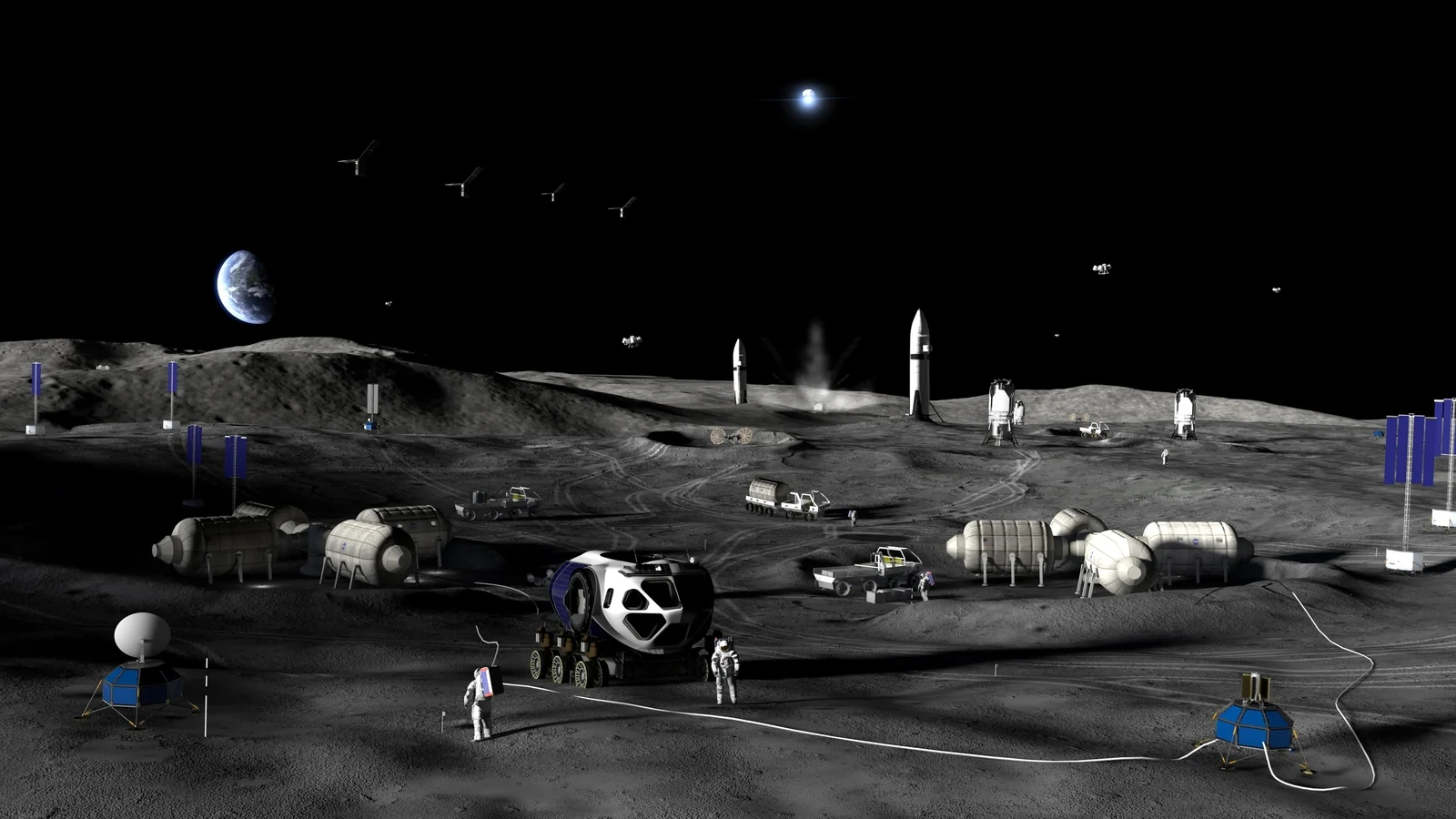
Nasa is laying out an ambitious roadmap for its first Moon base, a project the agency says could put people living and working on the lunar surface within six years.
The proposed outpost would sit at the Moon’s south pole and expand over time, potentially spreading across hundreds of square miles as additional sites and equipment are added. Nasa plans to build up the settlement in phases, gradually increasing capability and permanence.
The agency says the base is aimed at accelerating new scientific discoveries while maturing the technologies required for deeper-space exploration, including future missions to Mars.
The announcement comes after the Artemis II crew carried out a record-breaking flyby of the Moon in April, a milestone Nasa described as a critical step on the path to returning astronauts to the surface.
From now through 2029, the first phase would rely on robotic missions to scout the south polar region, validate key systems and lay the groundwork for surface operations.
Those early efforts include deploying drones to help explore and map difficult terrain, alongside remote and crewed lunar vehicles designed to function in the Moon’s punishing conditions.
Nasa also expects the period to serve as a proving ground for commercial lunar landing services and the delivery of payloads essential to later stages of construction.
Under the blueprint, the second phase running from 2029 to 2032 would introduce early habitation and begin establishing semi-permanent infrastructure.
NASA outlined plans for a sustained presence on the Moon
That stage is expected to include trials of technologies that could eventually support nuclear power systems on the Moon.
It would also bring pressurised rover vehicles that allow astronauts to work in shirt sleeves for as long as 30 days while conducting experiments and other tasks.
The third and final phase, beginning in 2032, is intended to deliver a continual human presence with routine crew rotations.
Nasa said that long-term operations would require larger habitation modules with upgraded environmental control, power and life-support systems, as well as large-scale uncrewed cargo return capability from the lunar surface back to Earth.
Across all three phases, the plan depends on multiple launches and landings to deliver equipment, supplies and crews.
The south polar region was selected because Nasa considers it among the Moon’s most strategically and scientifically important locations and well suited to long-duration exploration.
Unlike many lunar areas that endure lengthy stretches of darkness followed by lengthy periods of daylight, the south pole offers extended sunlight with shorter intervals of shadow.
Nasa says those lighting patterns can support more consistent solar power generation and steadier temperatures for exploration hardware and surface work.
Introducing the proposal, Nasa chief Jared Isaacman said public interest in a Moon base reflected excitement about a return to the lunar surface and what he called a “grand return”.
He said: “It means people are looking up again, believing in big things again, and paying attention as America returns to the moon again, and this time to stay.”
Mr Isaacman added: “We are leveraging the Nasa playbook from the 1960s figuring out what works and what doesn’t in this epic science of survival. Because the moon base is as beautiful as it is hostile.”
He highlighted the extreme temperature swings astronauts and equipment must handle: in sunlight, he said, the Moon’s surface can rise above 121C, while in darkness it can drop well below minus 128C.
And in permanently shaded craters—areas that may not have seen sunlight for billions of years—temperatures can fall well below minus 240C.
NASA’s Artemis II mission flew around the Moon last month
Mr Isaacman said: “There is no atmosphere to moderate these extremes, no protection from radiation and solar particle events and the surface is exposed to meteorite impacts.”
He went on: “Recognising this reality, I’m often asked why we send our astronauts into such a harsh and dangerous and unforgiving environment of space or the lunar surface and at such great cost.
“We go for the technology we will pioneer to get there, the science and all that we will learn that will make life better here on earth, to advance humankind on this great adventure, to inspire the next generation to do it better than we can and to be very clear to master the skills for where we will inevitably go next.”
Vowing to “never give up the Moon again”, Mr Isaacman said: “For those waiting patiently, the grand return is close at hand, and we will not slow down.
“We are moving with the competence and the purpose to accomplish the missions that only NASA is capable of achieving, and we are really just getting started.”
Dr Lori Glaze of Nasa’s exploration systems development mission directorate, said: “The incredible success of the Artemis II mission has taken Nasa from proving what is possible to making the extraordinary routine.
“Just last month, humanity returned to deep space.
“Artemis II is not only a historic journey, it was a comprehensive test of Nasa’s capabilities as we push farther from Earth.”
Carlos Garcia-Galan, Moon base programme executive, said: “We envision the Moon base to be hundreds of square miles with different assets all building up to the objective of permanent lunar presence on the moon.”
Speaking later during a Q&A, Mr Isaacman said the goal was ultimately to establish “a lot of outposts” across the lunar surface, adding that caves had also been examined as potential shelter from the hostile environment.
On the scale of the proposal, he added: “There’s certainly going to be a whole lot of inspiration that’s coming out of this for the next generation, but number one, we want to be in an environment where we can learn the skills, so that astronauts can go and plant the stars and stripes on Mars someday.”