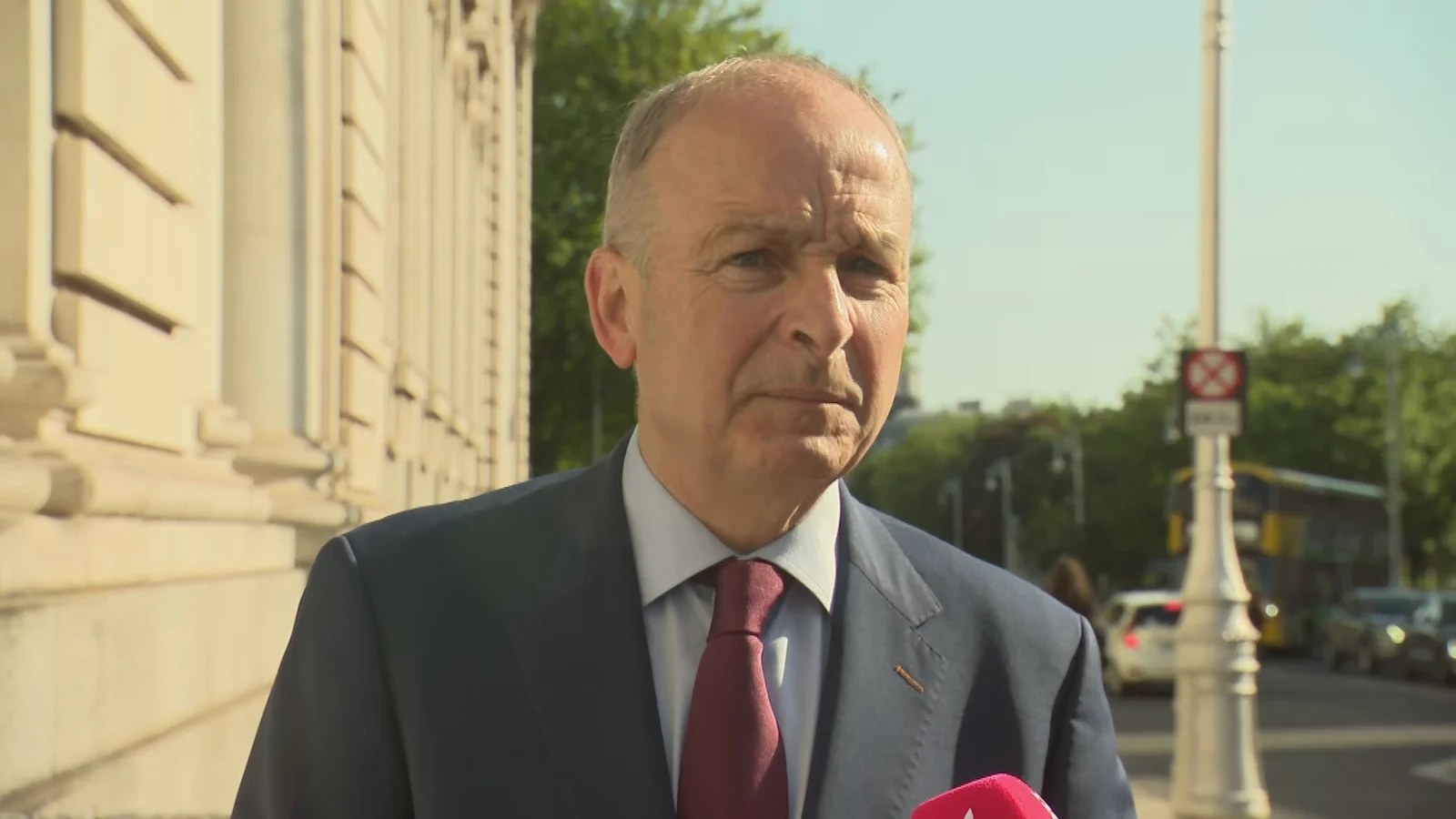
Taoiseach Micheál Martin has ruled out widening the Occupied Territories Bill to cover services, saying such a move is “not implementable” and could expose Ireland to significant economic fallout.
The Cabinet approved the text of the legislation this morning. The bill is designed to prohibit the import of goods from Israeli settlements in the occupied Palestinian territories, with the Government aiming for enactment within weeks.
Before the Cabinet meeting, Mr Martin warned that extending the measure beyond goods could rebound on Ireland.
He said it could do so “more than anybody else in terms of potential impacts on US multinationals based here back in America.
“We need to be realistic and need to be honest with people in respect of what we can achieve via this legislation,” he said.
The Taoiseach framed the bill as part of a broader sequence of actions taken by the Irish Government, calling it “further initiative in a long line of decisions the Irish Government has taken, from the recognition of a Palestinian state to intervention in the South African legal case on genocide to the ICJ, respect UN resolutions and so forth”.
After the Cabinet meeting, Minister for Foreign Affairs and Trade Helen McEntee said she welcomed Government approval of the text of the Israeli Settlements (Prohibition of Importation of Goods) Bill.
The coalition wants the legislation on the statute book before the summer recess in July.
Ms McEntee told ministerial colleagues that Ireland has long argued for a peaceful resolution to the conflict between Israelis and Palestinians.
In an interview on RTÉ’s News at One, she said the legislation “won’t change the decisions or the actions by the Israeli government”, but argued that every effort should be made to pursue the wider aim of “a peaceful solution, a two-state solution”.
She also pressed for stronger EU-wide measures: “… In tandem to this legislation I will continue to advocate for Europe to act collectively to respond to not just the increase in settler violence and expansion but the other actions that are taken in Lebanon, be it in Gaza or indeed the reintroduction of the death penalty.”
“If you look at goods or trade more generally in the occupied territories, if you were to ban that across the EU you’re obviously talking about a much bigger percentage, so we are very clear the actions that we are taking here it is in solidarity with the Palestinian people.”
Watch: Helen McEntee says she hopes the OTB legislation will be enacted by summer recess
As drafted for Cabinet, the bill would make the importation of goods originating in the settlements an offence under section 14 of the Customs Act 2015.
The Government says the approach aligns with an International Court of Justice opinion issued in 2024.
That opinion urged states to take steps to prevent trade that assists in maintaining the illegal situation created by Israel in the occupied Palestinian territories.
Read more:
Ireland calls for EU ban on trade with occupied territories
Latest Middle East stories
However, coalition members on the Oireachtas Foreign Affairs Committee are seeking an explanation for why the Occupied Territories Bill stops short of banning trade in services.
Last year, the committee recommended prohibiting both goods and services.
Fianna Fáil TD and former ceann comhairle Seán Ó Fearghaíl said he has asked Ms McEntee to appear before the committee to set out why the Government is not following what was recommended.
“If we marched up the hill on this, we need to see compelling evidence to now beat a retreat”, said he said.
Mr Ó Fearghaíl said he and other TDs understood that proceeding with a goods-only ban did not reflect public opinion on the issue.
Fine Gael TD Brian Brennan said he was disappointed the legislation did not include a ban on trade in services, saying a personal visit to the frontline in the Middle East — and the devastation he witnessed — had shaped his view.
Mr Brennan said he could accept it if the Government had received legal advice limiting what could be done, but added that committee members should also have access to that guidance.
“We need to see the devil in the detail,” he said.
We need your consent to load this rte-player contentWe use rte-player to manage extra content that can set cookies on your device and collect data about your activity. Please review their details and accept them to load the content.Manage Preferences
‘Moment for courage and principled leadership’
The Irish Human Rights and Equality Commission (IHREC) called on the Government to ensure the bill applies to both goods and services.
Chief Commissioner Liam Herrick said the International Court of Justice had “made clear that states must avoid economic or trade dealings that support or entrench Israel’s unlawful presence in the Occupied Palestinian Territory”.
“That obligation does not distinguish between goods and services, and neither should this legislation.
“If Ireland is to give real meaning to its commitment to international law and human rights, the bill must include services as well as goods. This is a moment for courage and principled leadership.
Senator Frances Black, who first introduced the legislation, said the Government had announced “a partial ban” on trade with illegal Israeli settlements.
Senator Black said the Government’s version “omits the majority of Irish trade” in services such as tech, and “undermines the scope of the legislation”.
She said she will work with opposition parties to table amendments to include services when the bill comes before the Dáil in the coming weeks.
Labour leader Ivana Bacik welcomed the decision to proceed with the Occupied Territories Bill, but said she was disappointed that trade in services was excluded.
The Dublin Bay South TD warned that, without services, the plan risked being more symbolic than meaningful or impactful.
Speaking to reporters, Ms Bacik said she plans to raise the issue in the Dáil.
Government ‘speaking out of both sides of its mouth’ on Israel sanctions – Boyd Barrett
Green Party leader Roderic O’Gorman also argued that services must be covered.
He told reporters the Government was making “a political call” to weaken the bill by leaving services out.
“Maybe we’re kind of coming to the actual nub of the issue now, that it is not a legal issue,” he said.
“This is a political call, and the political call is we can annoy the Trump administration a little bit by including goods, but not that next little bit by including services.
“I don’t accept that argument.”
Mr O’Gorman said the bill “must be passed, including services as well”, and argued there was no legal barrier to doing so.
People Before Profit TD Richard Boyd Barrett said the Government’s approach would gut the original bill by excluding services, adding that services accounted for 70% of trade with Israel.
He also said the proposed ban on goods might not cover all goods.
Mr Martin said Deputy Boyd Barrett was seeking an Israeli boycott. He said the Deputy was campaigning and attacking the Government rather than explaining what was being proposed.
The Taoiseach also said a full Israeli boycott would affect thousands of workers in Ireland. Mr Martin defended the Government’s stance, saying Ireland was one of the few EU states that had stood up on the issue.