

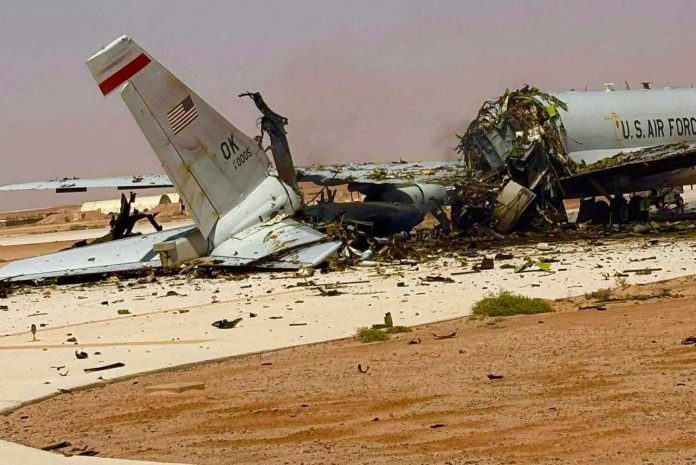
Mar 29(Jowhar)-Sida ay muujinayaan sawiro lahelay mid kamid ah diyaaradaha Milateriga Mareykanka ay leeyihiin, gaar ahaana ciidanka Cirka ayaa si buuxda ugu burburtay kadib weerar ay Iran ku qaaday saldhigga Prince Sultan ee ku yaalla Saudi Arabia, Gantaalada Tehrana ay si xoogan uhalakeeyeen.
Anti-Trump Protests Sweep US on ‘No Kings’ Day
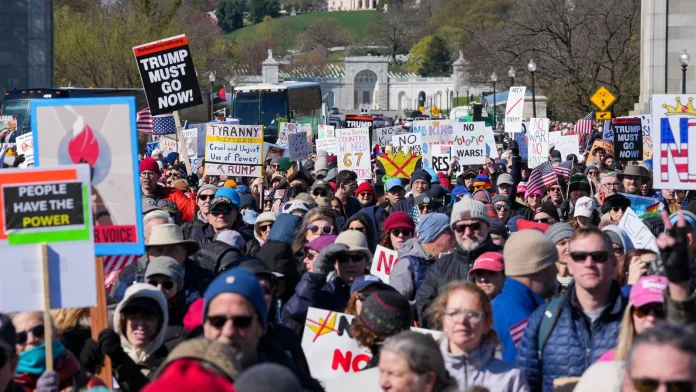
The Day the Streets Remembered: A Nation—and the World—Speaks Back
Just after dawn, a wind off the Potomac smelled faintly of exhaust and frying oil, the familiar tang of a city that never entirely shuts itself off. By midmorning, the bridge into the National Mall was a river of jackets, handmade signs and patient chants. Somewhere above them, the Lincoln Memorial—stone and stubborn—watched another chapter of public grief and defiance being written.
It is hard to describe the sound of a protest until you stand inside it: not just a chorus but a layered score of different lives insisting on being heard. A woman with a wool cap and a cardboard sign that read “We Are Losing Our Democracy” hugged a friend and said, “I came because I kept hoping the next election would fix it. It didn’t. Now I’m here, and I want my neighbors who stayed home to know they have to come out, too.” Nearby, a young man hoisted a banner that said “Trump Must Go Now!” and laughed nervously. “It feels like the country is on a hinge,” he said. “Either we swing forward or it breaks.”
No Kings, No Quiet
Three separate mass days of action in less than a year have done more than puncture the usual headline cycle. They have created a rhythm: No Kings, the grassroots coalition organizing the demonstrations, has turned public anger into choreography. The first nationwide day of protest last June—coinciding with President Donald Trump’s 79th birthday and a military parade in Washington—drew several million people from city sidewalks to small-town squares, according to organizers.
In October, organizers estimated turnout reached seven million. This latest round was billed as an attempt to surpass even those figures: more than 3,000 rallies were planned in cities and towns across the United States, and solidarity demonstrations appeared in Europe—from Amsterdam and Madrid to Rome—and as far afield as Portugal, where US nationals gathered in Lisbon’s Praça do Comércio to hold placards and exchange stories of exile and alarm.
What is at stake, according to the thousands who came out
- Concerns about an increasingly authoritarian style of governance, critics say, including ruling by executive order.
- Allegations that the Justice Department is being used to target opponents.
- Policy shifts on climate, racial and gender equity programs that activists call a rollback of basic rights.
- And, most urgently now, a controversial war with Iran conducted alongside Israel, with shifting goals and no clear endgame.
“This isn’t hobby politics,” said Jamal Rivers, a high school teacher from Detroit who traveled to the Lincoln Memorial. “It’s the accumulation of all the little things that add up to a different country. We used to assume institutions would hold. Now people are asking whether they still will.”
Across the Map: From Minneapolis to Kotzebue
In Atlanta, thousands gathered in a park, layering voices into a steady hum that made the trees tremble. In West Bloomfield, Michigan—near Detroit—protesters braved below-freezing temperatures, wrapped in donated blankets, holding homemade signs and trading thermoses of coffee. In St. Paul, Minnesota, the concert stage was set for a different kind of protest music: organizers had enlisted Bruce Springsteen, a longtime critic of the president, to play “Streets of Minneapolis,” a ballad reportedly written in memory of two citizens killed during demonstrations earlier this year. The song—raw and immediate—was meant to stitch mourning into resistance.
There was even a planned action above the Arctic Circle in Kotzebue, Alaska—a reminder that the political weather here extends to places where daylight can be scarce and supply boats infrequent. “If democracy is worth defending,” a Kotzebue organizer said by satellite phone, “then we’re part of that defense—even where the roads end.”
Why the World Listens
One striking detail: the movement no longer looks purely domestic. Rallies in European capitals, as well as gatherings in capitals of countries with sizable American expatriate communities, underlined how U.S. policy—especially when it involves military action—radiates outward. Protest signs in Lisbon blended English and Portuguese; a woman from Portugal who married an American veteran told me, “What happens in Washington becomes our news, our fear.”
Analysts say the current momentum matters far beyond the next ballot box. “When approval ratings dip below 40 percent, as they have for this administration in several polls, that is not just a number,” said a political scientist at a Midwestern university. “It reflects a breakdown in the tacit social contract. Large, sustained protests can either channel that energy into institutional change, or push the country further into polarization and legislative gridlock.”
Faces, Stories, and the Questions They Ask
Protesters came with different language, but a similar cadence of worry. There were grandparents who remembered the civil rights marches that passed through the same marble corridors decades ago. There were students who said the world their parents promised them—prosperity, security, a reasonable future—felt up for sale. “My mother marched for Roe,” said Ana Torres, twenty-four, showing a faded picture of her family at a demonstration three decades ago. “I never thought I’d be doing the same thing for everything else.”
Officials, too, were visible: some counseled restraint, others urged the crowds to vote rather than only shout. An elected city council member in Minneapolis told me, “Protest is essential. It operates like a diagnostic for democracy—revealing the wound. But protests need follow-through: policy proposals, candidates, civic infrastructure.”
The Long View: Democracy, Media, and Mobilization
What these gatherings illuminate is not merely opposition to a single leader. They expose fault lines in how people relate to power, truth and belonging. In a time of algorithmic news feeds and partisan lenses, mass street action becomes a counterweight: an insistence on shared public space where voices must be negotiated in person, not only in isolated columns of like-minded followers.
Are protests effective? The answer depends on what you measure. They force stories into the public square, sway undecided voters, and sometimes reshape policy. But they can also harden the other side, inflame rhetoric and distract from the patient work of coalition-building. Those who come out to the streets know both truths—why they chant, and why the real work continues at kitchen tables and in voter registration drives afterward.
After the Chants: What Comes Next
With midterm elections looming in November, political operatives are watching turnout models and polling margins as if the nation were a vast, fragile experiment. Organizers hope to parlay energy into ballots and candidate support; opponents hope to use the demonstrations as evidence of extremism. In the weeks to come, expect more marches, more speeches, and more music beneath the same stone faces and under the same gray skies.
So I leave you with this: when counted not in sound bites but in footsteps, what does democracy feel like? Is it the roar on a bridge, the hush outside a living room as a family debates whether to vote, the stubborn resilience of a small Alaskan town dialing in to a national conversation? The protests answer: all of it, at once. And if democracy is a practice, then these are the days when many are still learning to practice loudly.
Houthis Join Conflict With Iran as US Marines Deploy to Region
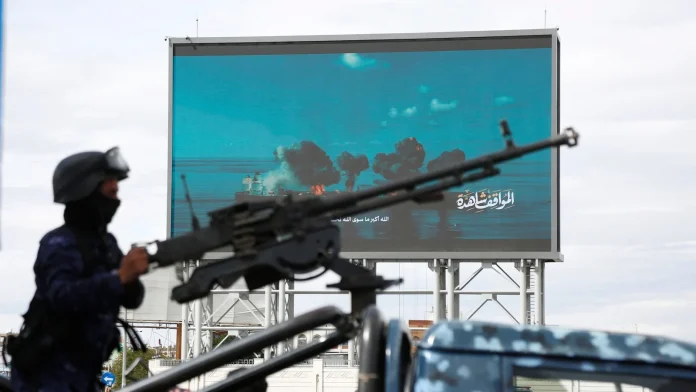
When a Region Holds Its Breath: The Middle East on the Precipice
There are nights when the air feels different — thicker, charged with a static worry. I felt that charge this week as I talked to people whose lives have been caught in an expanding conflict that began, as many wars do, with a move nobody wanted to see. What began as strikes in late February has, in the space of a month, spilled across borders, pulled in fleets and thousands of troops, and reached new fault lines: from the narrow lanes of Beirut to the tanker lanes of the Strait of Hormuz, and even to towns near Jerusalem.
“We hear the drones at night. We count the blasts like beats of a drum,” said Amal, a café owner in southern Beirut, pouring me a small cup of cardamom coffee as sirens grew in the distance. “People here have little left to lose but their fear.”
The American build‑up: Marines, the 82nd, and an uncertain plan
In Washington, officials are talking about options so broad they seem to rearrange the chessboard. In recent days, thousands of US Marines arrived aboard amphibious assault ships, another rotation among dozens of vessels now shadowing the eastern Mediterranean and Gulf waters. Reports say elements of the 82nd Airborne Division are expected to follow.
“We’re positioning forces to give policymakers flexibility,” said a senior uniformed official on background. “That’s what forward presence is about.” The line reads like a reassurance. But on the ground, in a region where every move is read for meaning, “flexibility” can be a tinderbox.
The Washington Post and other outlets have written that the Pentagon has been drawing up plans that could include raids inside Iran — operations that would blend Special Operations and conventional infantry. Whether those plans would receive presidential approval remains a question, and one that carries consequences far beyond military corridors.
New battlefronts: from Yemen to Lebanon to Israel
Yesterday, Yemen’s Houthi rebels — aligned with Iran — carried out their first strikes against Israel since the latest conflict erupted, launching missiles that crossed a sealed border of airspace and rhetoric. No casualties were reported, but the symbolism cut deep. These were not isolated flashpoints but threads in a widening tapestry.
In Lebanon, the conflict’s toll has been painfully human. A strike on a media vehicle killed three Lebanese journalists; a follow-up hit rescuers who had rushed to the scene. “They were calm, professional — they were our eyes,” said Nadim, a regional photographer who worked with one of the slain reporters. “We do not target journalists in war zones. We try to survive them.”
Israel has returned the fire, targeting what it called Iranian infrastructure in Tehran and resuming strikes against Hezbollah positions in Lebanon. Iran issued stern warnings: its president warned of strong retaliation if the country’s infrastructure or economic centers were hit. On the civilian front, hospitals treated dozens for blast injuries, including seven hospitalized after a strike near Jerusalem.
What this means for shipping and global energy
The strategic and commercial arteries of the world have felt the tremors. The Strait of Hormuz — long a chokepoint that historically carried roughly one-fifth of the world’s seaborne oil and large quantities of liquefied natural gas — has become a zone of avoidance. Insurance rates for tankers have jumped, rerouting is expensive, and analysts say the result is an immediate squeeze on supply chains already strained by post-pandemic adjustments.
“When tankers stop using the Hormuz, the cost is felt in cities and factories worldwide within weeks,” said a maritime risk analyst in Dubai. “We’re watching rerouting through longer passages and the nervousness that drives up prices at the pump.”
- Roughly 20% of global seaborne oil has historically transited Hormuz
- Insurers and shippers are increasingly diverting vessels around Africa rather than through the Red Sea/Hormuz corridors
- Market volatility has pushed crude prices upward, adding pressure to national budgets and consumers
Escalation and the nuclear shadow
At the heart of the region’s fear is the specter of higher-stakes targets. Israel’s strikes reportedly hit Iran’s nuclear infrastructure, and Russia’s state nuclear corporation said it had evacuated staff from Iran’s Bushehr power plant, citing safety concerns. The idea of strikes hitting nuclear facilities — even if unintended — sends shivers through capitals and emergency rooms alike.
“Nuclear safety isn’t just a technical concern; it’s about people’s ability to live and work near their homes,” said an independent nuclear safety expert. “Strikes near these sites create risks that can long outlast any military engagement.”
Politics at home and the global ripple
Back in the United States, the war’s unpopularity has started to produce a domestic countercurrent. Demonstrations erupted in cities across the country with organizers calling for an end to what they describe as an unnecessary escalation. With midterm elections looming, political leaders in Washington face mounting pressure from both critics demanding restraint and hawks urging decisive action.
“We need clear objectives and a clear exit strategy,” said Marco Rubio, echoing a sentiment from several voices within the administration who say that deploying ground troops is not inevitable but that options should remain open. “The president should have maximum flexibility.”
Flexibility, again, but to what end? What cost in lives, money, and the long arc of regional stability?
Faces in the crowd: daily life under threat
Walking through market streets in cities like Erbil or the narrow quarters of southern Beirut, you see ordinary rhythms contending with extraordinary danger. Shopkeepers tape windows against blasts; bakers who have carried on for decades talk of the fragility of bread lines and supply chains. “My son used to fly kites here. Now he asks if it’s safe to leave the house,” said Layla, a schoolteacher in a northern suburb. “How do you teach children about a life that might be broken tomorrow?”
Such anecdotes are the human ledger of geopolitical choices. They remind us that decisions made in capitals ripple out to touch the most basic acts of life: going to school, getting to work, tending to a sick parent.
Where do we go from here?
There are no easy answers. Diplomacy is being quietly tested — Pakistan, Turkey, and Saudi Arabia have signalled engagement on regional talks — even as missiles and drones redraw lines on the map. The path forward will be carved by a tangle of military calculations, domestic politics, the calculus of allies, and the stubborn human impulse to protect one’s family and homeland.
So I ask you, reader: when decisions about war are debated in faraway halls, whose faces do you see? Whose stories do you count when weighing the costs? In a world where local conflicts cascade into global disruption, perhaps the more meaningful question is how we build channels that prevent sparks from becoming infernos.
For now, in cities and villages, people sleep with radios by their bedside. They text their loved ones. They make coffee. They keep the lights on as long as they can. That is how life continues — resilient, fragile, and overwhelmingly human.
Has Russia launched a spring offensive in eastern Ukraine?
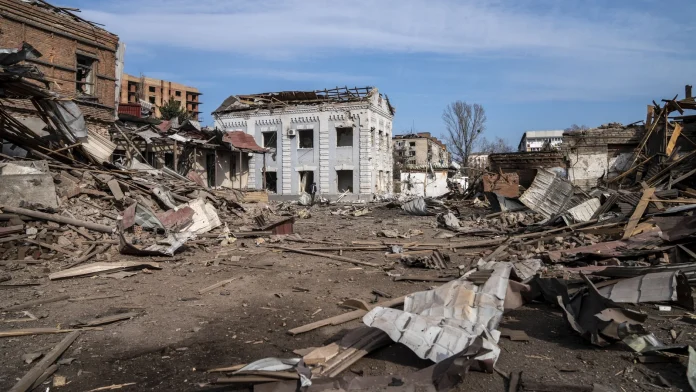
Inside the “Meat Grinder”: When Frontlines Become Factories of Loss
On a rain-gray morning in mid-March, the war looked less like a battle and more like a grim, grinding machine. Oleksandr Syrskyi, Ukraine’s top general, used a single blunt phrase that yearns to be forgotten: “meat grinder.” It was his way of naming a tactic — wave after wave of assaults stretching along a 1,200-kilometre front — and of laying bare the toll those pushes extract from flesh and morale.
Between 17 and 20 March, Ukrainian accounts say Russian forces launched more than 600 separate assault operations. Ukrainian commanders put Russian casualties in that four-day burst at more than 6,000; they tallied some 8,710 killed or seriously wounded over the whole week. Western and Ukrainian military agencies place Russia’s weekly combat losses at roughly 7,000 on average — a number that sounds abstract until you meet the people who live inside it.
“We saw them come in columns like rain,” said a platoon leader who asked not to be named for security reasons. “Not all of them were veterans. Some looked like boys who had never seen sandstorms or trenches. The drones saw them first. Then everything else followed.”
The Kill Zone: How Drones Rewrote the Rules
What turns a battlefield into a grinder is not always sheer numbers. Over the last two years, the battlefield has become a litmus test for a different instrument: the drone. Both sides now police a “kill zone” that can reach up to 20 kilometres from the contact line. In that zone, surveillance and attack drones — cheap, ubiquitous, and lethal — make concealment almost obsolete.
Multiple Ukrainian and Western sources estimate that around 70% of Russian combat losses along the line have been inflicted by Ukrainian drones. The same devices hunt Ukrainian positions in turn. That mutual visibility reshapes tactics: small infantry probes are no longer harmless reconnaissance; once spotted, they become targets.
“A battlefield where the sky is an enemy is a battlefield with no dark corners,” said Marta Koval, a Kyiv-based analyst who studies unmanned systems. “The drone doesn’t care about the politics of the fight. It counts signatures, heat, and movement. It is impartial, precise, and unforgiving.”
Last week’s torrent of assaults — and the unusually high casualty figures — suggested, to many analysts, that Russian commanders briefly reverted to massed infantry tactics despite the drone revolution. The result, in this instance, looked all too predictable: heavy losses for precious little ground.
Probes, Mechanised Pushes, and the Shape of a Future Offensive
The U.S.-based Institute for the Study of War (ISW) noted in its reporting that some late-February and March activity looked like “reconnaissance-in-force” — mechanised probes smaller than the usual company formations, testing Ukrainian lines and preparing for a broader campaign. ISW also flagged shelling near Kramatorsk and strikes on dams near Kostyantynivka and toward Pokrovsk as part of an apparent strategy to disrupt logistics and, perhaps, drown approaches to defensive belts.
“These are classic preparatory moves — probing defences, finding weaknesses, and, crucially, degrading the opponent’s ability to sustain front-line troops,” said Dr. Alan Richter, a retired military planner who now consults for several European defence think-tanks. “But the presence of drones shifts the calculus. You can probe, but if your probes are erased by overwatch, you don’t just lose information — you lose men.”
Last year, Russia’s advances were minimal. Throughout 2025, Moscow captured less than 1% of Ukrainian territory, a sobering metric that underscores how attrition, air power, and precise long-range strikes have combined to make large territorial gains costly and rare.
What the Numbers Mask
Statistics offer a frame, not the picture. For civilians on the receiving end, the math becomes human. In Lviv, nearly 900 kilometres from the fiercest fighting, a Russian drone strike last Tuesday damaged the 16th-century Bernardine monastery — a tiny, sacred corner of a city that has become a refuge for families fleeing the east.
“We heard this low thud and then the church shuddered like a living thing,” said Olena, 58, a volunteer who helps catalogue damaged heritage sites. “You think cultural sites are safe because they are old. Then you learn the war chooses whatever it wants to frighten you.”
Across the country, almost 1,000 drones were reported launched at once across eleven regions that day — a volume of strikes so large some analysts called it a new form of offensive. Whether aimed at infrastructure, logistics, or psychological shock, the raids underscore the war’s diffuse geography.
Trenches, Towns, and the Taxonomy of Loss
On the ground, the war remains a study in contrasts. In Odesa, a charred main battle tank sits as a macabre exhibit — a relic in a port city famous for its black bread and seaside promenades. In the east, the 18th Sloviansk Brigade trains on muddy ridgelines, its soldiers learning to move small units under constant aerial scrutiny.
“We train to be invisible,” said Captain Roman, as the squad worked through a night drill. “But invisibility is expensive. You wear it like armor and sometimes it’s not enough.”
Families keep counts at kitchen tables. Mothers stitch balaclavas at sewing machines to send to sons in the field. Volunteers haul generators into bombed-out apartment blocks and light up rooms so children can finish algebra homework by lamplight.
Why It Matters Beyond Ukraine
Ask yourself: what happens when warfare becomes easier, cheaper, and more distributed? Drones democratize killing in a way artillery and tanks never did. They allow states — and non-state actors — to reach into cities, sanctuaries, and cultural sites with lower risk to their own operators. The result blurs the front line into the home front.
That has consequences for global norms around conflict. It alters how militaries prepare, how societies fortify, and how international law will try — often unsuccessfully — to keep pace.
- Proliferation: Small, effective drones are now widely available.
- Attribution: Denying or deflecting blame becomes easier in the fog of swarm attacks.
- Psychology: Striking cultural sites aims to erode a population’s sense of identity and safety.
Endings and Open Questions
Ukraine’s forces say they repulsed the mid-March push. Whether that was a one-off costly probe, an early curtain-raiser for a larger 2026 campaign, or simply the continuation of attritional warfare, the human cost is immediate and unanswerable in numbers alone.
“We will bury our dead,” said a volunteer grave-digger in Donetsk region, voice flat with a professional sorrow. “And we will teach our children how to bury properly.” It is a small, bitter ritual of resilience.
So what should we watch for now? Look at drone production lines as much as tank battalions. Watch logistics hubs and dam strikes as much as trenches. And listen — to the soldiers, to the mothers, to the cathedral caretakers — because their stories are the ledger no general can fully reconcile.
Where does this leave the rest of the world? With hard questions about how to deter not just invasions, but attrition by technology; how to protect heritage and civilians when the sky itself has turned into an instrument of war; and how to keep the humanity of war visible in a world that increasingly battles through screens and sensors.
We continue to watch and to ask: in the age of drones and “meat grinders,” what is the cost we are prepared to accept — and what is the price we refuse to pay?
Paris police thwart suspected bomb plot targeting U.S. bank branch
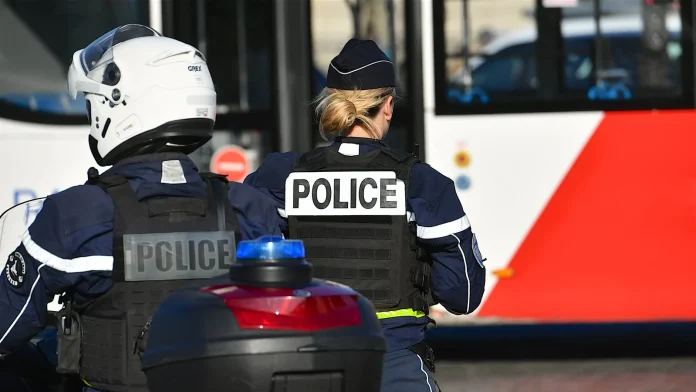
Predawn in the 8th: How a Quiet Paris Street Nearly Became a Headline
It was a thin, silver hour when Paris nearly woke to a darker alarm. At roughly 3:30 a.m. local time, a man was stopped on a flinty stretch of the 8th arrondissement — a few streets from the Champs-Élysées, where shopfronts wear the hush of shutters and the city’s luxury pulse slows to a whisper.
Police sources say the man had placed a homemade device near the façade of a Bank of America building, a scene that would have felt jarringly incongruous in one of the world’s most photographed neighborhoods. The device reportedly contained about five litres of liquid — believed to be fuel — and an ignition system. Rather than the flash of terror we fear, what followed was the careful choreography of prevention: officers arrived, made the arrest and began disentangling the why and the how.
A city of contrasts: beauty, commerce and vulnerability
The 8th arrondissement is a study in contrasts. By day, it blooms with tourists, diplomats, and shoppers who saunter between flagship stores and the sweeping vistas that run from Place de la Concorde to the Arc de Triomphe. By night, it keeps secrets: closed cafés with chairs stacked on tables, the hush of haute couture houses, and lamplight that gilds historic facades.
“It’s a place of glitter and routine,” said Marie Dubois, who has run a tiny boulangerie near the scene for two decades. “You don’t expect danger here. People come for the light, the beauty. This morning, I heard sirens and thought, ‘Not here.'”
For a city that hosts millions of visitors every year and serves as a financial hub for Europe, the episode is an unwelcome reminder of how public spaces, and by extension public safety, can suddenly be tested.
What authorities have said — and what remains unknown
Officials say the man was apprehended immediately after placing the device, preventing any explosion or injuries. Paris law enforcement moved quickly: uniformed officers secured the perimeter; more discreetly, detectives and bomb disposal experts examined the materials. Items recovered — the canister of liquid and an ignition mechanism — are now evidence in an ongoing inquiry.
“Our first priority was the safety of residents and everyone in the area,” a Paris police source told reporters. “We detained an individual and rendered the device inert. The investigation is active and we cannot rule out any lines of inquiry.”
Who the man is, and whether he acted alone or was part of a broader network, are questions investigators are still parsing. Questions about motive — whether political, ideological, personal, or criminal — remain open. For now, prosecutors and counterterror units are sifting through CCTV footage, phone records, and forensic traces.
The wider security backdrop
France has a long memory when it comes to urban violence: from the 2015 attacks that shook Paris to other incidents across the country, security services have been adapting and evolving for years. The nation’s counterterrorism architecture includes the national anti-terror prosecutor’s office and intelligence branches tasked with detecting threats before they materialize.
“The challenge for any democratic city is to remain open and vibrant while also being vigilant,” said Dr. Amina Benali, a security studies lecturer in Lyon. “What we saw tonight — swift interdiction — reflects better coordination among police, intelligence and emergency services. But it also raises questions about prevention: community engagement, online radicalization, and the social fractures that can push someone toward violence.”
On the ground: witnesses, workers and the city that refuses to stop
At dawn, the cordon remained in place, but life in the 8th continued its slow reanimation. A florist on the avenue told me she watched the scene from her shop doorway, clutching an oversized mug.
“We are used to protests, to noise, to something every now and then,” she said, asking to be identified only as Sophie. “But this was different. There was that terrible silence before the lights — like the city held its breath.”
A security guard at a neighboring bank described the professionalism of the teams that arrived: “Bomb techs in white suits, police in dark — they worked like a machine. Calm, efficient. That’s what stopped it from being a nightmare.”
Why a financial institution? Why the 8th?
Attacks on symbols of finance are not new in modern political violence. Global banks represent more than money; they can be stand-ins for complex grievances about globalization, inequality, foreign policy, or simply convenient, high-profile targets in dense urban centers.
But motives can be many and mixed. “It would be irresponsible to leap to conclusions without evidence,” said Inspector Laurent Martin, a veteran of Parisian investigations. “We investigate facts. We trace movements, communications, purchases. Only then can we begin to understand intent.”
Local color: the human details that matter
It is easy to reduce events like this to headlines and statistics; harder, and more important, to notice the human particulars. The boulangerie that opened on schedule and offered croissants with extra sympathy. The doorman who counts the rhythm of the neighborhood — the night owls, the early birds, the tourists who never quite sleep. The custodian who swept debris from the pavement after police lifted the tape.
“Paris has been through a lot,” said Ahmed, a taxi driver who ferries late-shift workers through the 8th. “But it is a city that goes on. People are careful, yes. But they also come out. We don’t live afraid.”
Bigger questions: balancing freedom, surveillance and resilience
Every time an incident like this happens, larger debates re-emerge. How much surveillance is acceptable to keep streets safe? How do democracies hold onto open public life while investing in counterterrorism? What social policies might reduce the pool of people who turn to violence?
These questions have practical impacts: governments look at funding for police and intelligence, at community programs, at mental health services and deradicalization initiatives. Citizens argue about rights, visibility and prevention. And communities work, quietly, to stitch the social fabric tighter.
What do you think? When safety measures infringe on privacy, do they still serve the public good? When a city becomes a fortress, what is lost — and what is gained?
What comes next
As daylight fully arrived, investigators continued to comb the scene, and the life of the 8th arrondissement resumed its layered, human tempo. The man taken into custody will be questioned and charged if the evidence warrants. For now, authorities have prevented what could have been a dangerous event and turned to the long work of asking why.
In a world where the flash of danger can be as small as a canister and as symbolic as a bank façade, tonight was a reminder of resilience: the quiet competence of responders, the everyday courage of shopkeepers and residents, and the way cities — battered, bright, stubborn — continue to be the stages where our shared stories of risk and recovery unfold.
Madaxweyne Xasan oo kulan deg deg ah isugu yeeray wakiilada beesha Caalamka

Mar 28(Jowhar)-Madaxweynaha Soomaaliya Xassan Sheikh ayaa kulan iskugu yeeray wakiilada iyo diblumaasiinta Shisheeye ee kusugan Muqdisho, isagoo warbixin ka siinaya xaaladda, sida lagu sheegay warqad loo diray waliilada.
12 tonnes of KitKat bars stolen in audacious heist

The Curious Case of the Missing KitKats: A Chocolate Caper That Travels Beyond Taste
Imagine a spring morning on a quiet Italian motorway. A blue truck, its trailer brimming with wooden pallets—neatly stacked, shrink-wrapped, promising a rush of chocolatey crunch—glides past vineyards and roadside cafes. By nightfall, somewhere between those rolling hills and the flat farmlands of Poland, the truck and its cargo had simply vanished.
That was the scene recounted this week by Nestlé: twelve tonnes of KitKat bars—413,793 pieces from the chocolate maker’s new range—disappeared from the logistics system as if swept away by a gust of cocoa-scented wind. The company says the bars are traceable by a unique batch code; anyone scanning the code would receive instructions on how to contact Nestlé. But for the moment, the vehicle and its sweet freight remain unaccounted for.
More than a Missing Snack: Why This Story Resonates
At first glance, it feels almost comic: thieves with a predilection for British confectionery. “We appreciate the criminals’ exceptional taste,” a KitKat spokesperson quipped. And yet, beneath the quip lies a harder truth about modern supply chains—one that affects small shopkeepers, truck drivers, and consumers from Naples to Warsaw.
“These aren’t opportunistic kids lifting a chocolate bar,” said Marco Bellini, a veteran long-haul driver who has ferried foodstuffs across Europe for 20 years. “This is organized—timed, planned, and executed to be gone before anyone understands what’s missing. It’s a real job for some people.”
Cargo theft isn’t artful mischief; it’s part of an industry of crime that preys on the sheer scale and speed of global distribution. Industry watchdogs and logistics firms report that food and beverages are among the items most commonly targeted—easy to move, quick to fence, and often difficult to trace once mingled into secondary markets.
The Route: A Geography of Vulnerability
Think about the journey: a truck leaving central Italy would thread northward through a patchwork of landscapes—the Apennines, the busy transalpine corridors, the motorway nodes that serve as rest stops for drivers, and then the long eastward run across countries with differing enforcement standards. Each border crossing, service area, and urban periphery is both a logistic pinch point and a potential weak link.
“The human element is always the variable,” said Dr. Ivana Petrović, a supply-chain analyst based in Ljubljana. “Drivers stop to sleep, to eat; trailers are left unattended for a short time. Criminals know this and patrol exactly those places. It’s not exotic; it’s practical.”
Traceable Bars and the Digital Trail
Nestlé’s solution—batch codes on each bar—is emblematic of a broader trend toward serialization and traceability. A quick scan of a code can tell a factory where and when a bar was packaged, its expiry, and the route it was meant to take.
“Traceability is no longer a luxury,” said Martina López, a food-safety consultant in Madrid. “It’s insurance. When every unit has an ID, brands have a fighting chance to map losses, alert retailers, and, in rare cases, recover goods.”
Still, a code is only useful if the recovered goods end up in the open market. The more insidious problem is the grey economy: stolen pallets broken apart and sold piece by piece to market stalls, small retailers, or online shops where price or urgency trumps provenance.
Local Color: The Human Thread
In a Piazza in Warsaw, a small kiosk owner named Ania shrugged when asked if she’d heard about the missing KitKats. “If they show up at a bargain price, people will buy them,” she said. “Kids don’t ask where a chocolate came from. They only want it.”
In a trattoria off the A1 in Italy, an elderly proprietor named Giulia sipped espresso and lamented the modern fragility of the road. “When we were young, trucks were fewer; everyone knew each other,” she said. “Now the roads are full, and the strangers are many.”
These are not mere anecdotes. They are moments that reveal how a globalized food system—efficient on paper—relies every day on the trust and small acts of countless people.
What Can Be Done? Practical Steps and Global Implications
Companies and law enforcement are not idly watching. Tracking technologies—GPS telematics, sealed locks with tamper alarms, and serialization—are spreading. Some firms employ security escorts for high-value routes. Others are experimenting with immutable ledgers—blockchain systems that record custody changes on a distributed, tamper-resistant ledger.
- GPS and real-time telematics reduce response time when trucks deviate from planned routes.
- Seals and tamper-evident packaging make it harder to offload pallets without detection.
- Batch codes and serialization create digital breadcrumbs for brands and consumers.
Yet prevention and recovery cost money—and those costs feed back into retail prices, insurance premiums, and even wages for drivers. Industry estimates suggest cargo theft costs the global economy hundreds of millions, if not billions, of dollars each year when you account for the value of goods, lost business, and the protective measures that companies must fund.
Wider Questions: Waste, Ethics, and Consumer Choices
At a deeper level, this episode forces difficult questions. How do we weigh the value of a lost luxury good—albeit a popular one—against the backdrop of global food waste? The UN’s Food and Agriculture Organization estimates that roughly one-third of all food produced for human consumption is lost or wasted globally. When edible goods go missing in transit, they are not merely theft statistics; they are part of an alarming pattern of inefficiency in a world where people still go hungry.
And then there is the moral quandary: what would you do if you found a bar on a bench, marked with a batch code that flagged it as stolen? Return it? Keep it? Call the number?
“Consumers are the last line of defense,” Dr. Petrović said. “If people refuse suspicious bargains and report anomalies, the incentive structure for theft changes.”
Where the Story Goes From Here
For now, a sizeable mountain of KitKats sits somewhere beyond the public record. Law enforcement officers and corporate investigators will follow leads. Consumers will ask for explanations. Truck drivers will redouble their vigilance. And the snack world—parents, kids, confectionery fans—will perhaps giggle at the absurdity even as they register the serious structural problems the incident reveals.
So, dear reader: when a headline reads “thieves steal 12 tonnes of chocolate,” what registers for you? A laugh, a frown, or a deeper unease about how fragile our systems are? Beyond the novelty lies a network of human lives—drivers, storekeepers, families—entangled in a supply chain that demands better protection, smarter tech, and a little more communal care.
Keep an eye on your local shop. Look at the labels. And next time you unwrap a KitKat, consider the long journey that bar took to get to your hand—sometimes traveled safely, sometimes not. That thought might just change where, and from whom, you buy your next snack.
Attorney for social media addiction lawsuit says significant reform may be imminent

A Jury, a Young Woman and the Machines That Lured Her: What a Landmark Verdict Really Means
In a sunlit courtroom in California this week, a panel of ordinary citizens did something that still feels extraordinary: they held two of the world’s most powerful tech companies accountable for the way their products were built.
Mark Lanier, the American attorney who argued the case, left the room in a mood that mixed triumph with urgency. “This can’t be a band-aid on a bullet wound,” he told reporters, eyes fixed on the question of whether design choices in Silicon Valley should be treated as mere business decisions—or as acts that reshape young lives. The jury ordered Meta and Google to pay a combined $6 million in damages after finding that the companies had engineered features that hooked and harmed a now-20-year-old plaintiff the court knew as Kaley.
Kaley is more than a name on a complaint. She is a person whose childhood was threaded with autoplay and endless feeds. According to testimony, she started watching YouTube videos at six, opened an Instagram account by nine, and by adolescence could spend whole days lost to the apps—some days more than 16 hours scrolling, attending to an unblinking stream of images, sounds and approval-seeking metrics.
The architecture of attention
What makes a platform addictive? It’s not a single villain. The court heard about an architecture of features: infinite scrolling that erases natural stopping cues, autoplay that seeds the next inexorable minute, algorithmic suggestions that nudge users toward ever-more-engaging content. These are small choices with cumulative force—tiny design decisions that, together, create what experts call a “feedback loop.”
“They learned the levers,” said Dr. Aisha Mahmood, a psychologist who studies youth and digital behavior. “Notifications, variable rewards, personalized content—these are triggers the brain responds to in predictable ways. We didn’t need to invent a pathology; the products themselves amplify normal curiosity into compulsion.”
Companies like Meta and Google have long defended their systems as neutral platforms. Much of U.S. tech law shields platforms from liability for user-generated content. But this case focused on design rather than on posts, and it pierced a different kind of armor: the claim that a company’s interface is merely a stage for content, not an active agent that shapes behavior.
Inside the evidence
During the trial, internal documents described in testimony suggested engineers and researchers were aware of the harms certain features could cause, particularly for teens. Some of these internal memos recommended additional study or mitigation—but, the plaintiff’s team argued, the companies often decided not to publish the findings or change course.
“When you see the research and the decisions made in the boardroom, two separate things happened,” Lanier said in a radio interview after the verdict. “One was knowledge that certain engagement features were negative for teen wellbeing; the other was a corporate willingness to prioritize growth.”
Noeline Blackwell, an online safety advocate with the Children’s Rights Alliance, framed the verdict as a crack in the shield social media firms have used for decades. “For too long people have felt the harm in their bones—parents watching their children change, teachers seeing attention eroded—but there was no legal angle that touched the platforms themselves,” she remarked. “This case changed that angle.”
Faces in the gallery: parents, jurors, and a culture in question
Outside the courthouse, the scene was familiar and quietly heartbreaking: parents, grandparents, neighbors, all talking about kids who never quite learned to stop. “My son eats his lunches in front of his phone now,” said Maria Ortega, a Californian mother of two. “He says he’s ‘watching’ but sometimes I think he doesn’t even know why he’s still there.”
One juror told a local reporter they had been struck by the “ordinary” nature of the harm described. “It wasn’t dramatic,” the juror said. “It was subtle, steady. A life rerouted without a single obvious moment of catastrophe.”
These everyday glimpses echo broader trends that scholars and surveys have documented. The Pew Research Center reported in past years that a large majority of teenagers have access to a smartphone, and a substantial share say they are online “almost constantly.” Common Sense Media and other research groups have estimated that adolescents spend multiple hours a day on screens for entertainment alone—numbers that rose as platforms became more immersive.
At the same time, medical and mental-health authorities have been cautious in labeling “social-media addiction” as a clinical diagnosis. The World Health Organization recognized “gaming disorder” in 2018 but has not created a comparable diagnostic category for social media use. That ambiguity is part of the battleground: can legal systems account for harm that sits at the intersection of design, psychology and culture?
Not just silicon valley—this is global
The implications stretch beyond California. European regulators have passed laws like the Digital Services Act and the Age Appropriate Design Code to try to force safer options. Countries across Asia and Africa wrestle too—with their own family structures and schooling systems, the social calculus changes, but the human vulnerability to design choices does not.
“This is not merely a U.S. story,” said Professor Nikhil Rao, who researches technology policy at a European university. “When platforms normalize endless engagement, we see similar patterns in Lagos, São Paulo and Seoul. The architecture of attention is global because the products are.”
What might come next?
Meta and Google have said they will appeal. That’s the predictable next step in any landmark case when billions in market value and reputational capital are at stake. Appeals will likely focus on legal doctrines that protect platforms from content-based claims and on whether the evidence meets the standards for design-based liability.
But whether or not this ruling survives the appeals process, it has already accelerated conversations about design ethics, corporate transparency, and regulatory appetite. Some concrete changes are plausible: default settings that limit autoplay, clearer prompts that encourage breaks, or more visible parental controls. Policymakers might also revisit legal protections that historically favored rapid technological experimentation over harm prevention.
And there is another, quieter possibility: a cultural shift in how we teach children and adults to navigate attention-saturated environments. Schools already teach digital literacy; now they may add habits of self-regulation, awareness of persuasive design, and rituals that restore offline rhythms.
As you read this, ask yourself: how often do you reach for your phone without a reason? When was the last time a platform decided for you what you would see next? These are small questions with outsized consequences.
Closing thoughts
Kaley’s story is intimate and particular, but the forces it illuminates are systemic. The verdict is less a finish line than a hinge—a moment when the legal system, public opinion and corporate practice were briefly forced into the same frame. Whether it becomes a turning point will depend on what comes after the headlines: appeals, policy proposals, product changes, and, perhaps most importantly, collective choices about the kind of attention economy we want to inherit.
- $6 million — the combined damages the jury awarded.
- Millions — the number of young people worldwide who log daily hours on social platforms, according to multiple national and international surveys.
- 2018 — the year WHO recognized a related behavioral disorder in gaming, underscoring the complexities of classifying and responding to tech-driven harm.
There are no easy fixes. But there are questions that demand answers—and a growing impatience with explanations that sound like PR. If you care about the young people in your life, start a conversation tonight. Ask them what they like, why they stay, and whether there are moments they wish they could reclaim. That simple human act—listening—might be the best countermeasure we have, at least until the law and design catch up.
Lafta-gareen oo loo doortay madaxweynaha maamulka Koofur Galbeed

Mar 28(Jowhar)-Cabdicasiis Xassan Max’ed “Lafta-gareen” ayaa markale noqday Madaxweynaha Koonfur Galbeed, iyadoo aysan raali ka aheyn dowladda Faderaalka oo in ka badan 2 kun oo askari kusi li wada magaalada Baydhabo, si ay uga adkaato Laftagareen.
22 migrants perish off Greek coast after six days adrift at sea

The Quiet Horror Off Crete: Twenty-Two Lives Lost After Six Days Adrift
The Mediterranean can look like glass and lie like glass. On a gray morning off southern Crete, the sea gave up survivors and hid the rest—bodies, it seems, taken from the wooden truth of the boats and tossed into the deep by men who profit from despair.
Twenty-two people are reported dead after six days aboard a rubber dinghy that set out from Tobruk, in eastern Libya, bound for Greece. Twenty-six others were rescued by a Frontex vessel and taken aboard; two of them were later hospitalized in Heraklion. Survivors say the corpses were thrown overboard on the orders of the smugglers. Greek authorities have arrested two men, aged 19 and 22 and described as South Sudanese, on charges including negligent homicide and facilitating illegal entry.
“We had nothing left to give”—a survivor’s account
“We were six days without water, six nights praying for rain,” a survivor told a coastguard interviewer in Heraklion, voice raw and hands shaking. “When people fell asleep, they didn’t wake. The trafficker said we could not bring them.” Names withheld for safety, the survivor’s face was puffy from crying and salt; the humiliation and exhaustion were as visible as the bruises on his arms.
A coastguard spokesman described the odyssey succinctly: the boat lost its way and, battered by unfavorable weather and shortages of food and water, passengers perished from exhaustion. “According to testimony,” he told reporters, “the bodies of those who died were thrown into the sea on the orders of the traffickers.” The vessel was about 53 nautical miles south of Ierapetra when the Frontex ship reached it.
Local eyes on a global tragedy
In the port town of Ierapetra, fishermen who have been reading the sea for generations watched the rescue unfold like a repeat of summers past. “You can smell when a boat has been through the night too long—fear has a taste,” said Nikos, a 62-year-old fisherman who has pulled migrant dinghies into his nets before. He paused, then added, “We mend nets and we mend boats, but we cannot mend governments that let people cross like this.”
At a small kafeneio (coffee house) near the harbor, older women serving strong Greek coffee whispered about the names of places they recognized—Tobruk, Libya, a city blighted by war and lawlessness. A waitress tucked a stray lock of hair behind her ear and said, “They come because there is nowhere else. But we cannot watch them vanish.” The human compassion here is abundant; the solutions are not.
Numbers that should disturb us
The latest statistics from the EU border agency and international observers paint a stark, accelerating picture. Frontex reported that the number of migrants dying while attempting to reach EU territory more than doubled in the first two months of this year compared with the same period last year. The International Organization for Migration (IOM) recorded 559 deaths in the Mediterranean during January and February, up from 287 for the same months in the previous year.
These figures are not abstractions; they are bodies—unsent back, uncounted by some, and mourned by families who often never receive confirmation. In December, Greek authorities recovered only two survivors from a partially deflated vessel southwest of Crete; 15 more were presumed drowned and never recovered. These incidents are not anomalies but part of an increasing toll that the region is paying.
Why the crossings continue—and why they become deadlier
There are many reasons people risk everything on these voyages. War, persecution, and grinding poverty push families into the hands of increasingly vicious smuggling networks. Libya has become a particular flashpoint: chaos at sea, multiple armed groups on land, and a coastline turned into a launchpad for migratory routes to Europe.
“Smugglers are not just drivers in dinghies; they are businesses with a ruthless bottom line,” said Maria Kallias, a migration researcher based in Athens. “When enforcement tightens and front routes close, smugglers move to longer, riskier crossings. That raises the mortality rate. It’s predictable and preventable—if political will matched rhetoric.”
Experts also point to climate-driven displacement—droughts and failed crops in parts of the Sahel and Horn of Africa—and to the enduring pull of Europe: jobs, family reunification, and the hope for asylum. But that hope is being battered by harsher sea conditions and increasingly fragmented rescue regimes.
Policy responses and moral dilemmas
Against this human wreckage, the European Parliament has moved to tighten asylum and migration rules. In late March, lawmakers endorsed a controversial package that includes the creation of “return hubs”—facilities outside the EU intended to process and send migrants back to third countries. Supporters say the hubs will deter dangerous crossings; critics call them inhumane and warn they outsource responsibility to states with poor human rights records.
“You cannot build safety by outsourcing danger,” said Lena Ortiz, policy director at a European rights organization. “Return hubs risk trapping people in limbo and could expose vulnerable people to further abuse. The Mediterranean has become a graveyard precisely because we externalize our borders instead of investing in legal pathways and protection.”
An EU official familiar with the proposal, speaking on condition of anonymity, defended the move as a pragmatic attempt to disrupt smuggling networks and manage flows. “People die at sea,” the official said. “We need mechanisms that work—on the ground, in transit countries, and in cooperation with neighbours.” Many solutions are partial; many are contested.
What can be done—and what are we willing to pay?
There are no easy fixes. Humanitarian groups call for increased search-and-rescue capacity, safe legal routes for asylum, and targeted disruption of trafficking networks. Governments argue for deterrence and stricter borders. Between those poles sits the human cost: children who drown, mothers who dig graves with their hands, survivors who relive the same panic each night.
So I ask you, reader: when a rubber boat drifts away from Tobruk, whose responsibility is it to guide it to safety? When the sea becomes a ledger of lives, how do we balance deterrence with dignity?
Back in Heraklion hospital, two survivors—still trembling—were being treated for dehydration and hypothermia. Outside, the sea rolled on, indifferent yet full of stories. Fishermen resumed mending nets. The kafeneio filled again with murmured condolences and cups of coffee. Life, on the island, goes on. But elsewhere, for families who learned of the missing only when names and numbers trickled through, a silence opened.
We should remember those who did not reach shore not as statistics but as people with names, with songs, with futures stolen. That remembering must push us toward policies that reduce risk—not merely manage it—and toward international cooperation rooted in protection, not punishment.
When borders harden, the sea does not soften. It swallows. It keeps its secrets. What we do next will determine whether the Mediterranean remains a corridor of hope or a ledger of failure. Which will we choose?
Second Turkish-owned vessel passes through the Strait of Hormuz
Another Turkish-owned vessel has successfully passed through the strategically significant Strait of Hormuz, marking the second such passage in recent weeks. The vessel, carrying...
MP warns Israeli occupation in southern Lebanon has become ‘very dire’
In Southern Lebanon, Homes Become Frontlines — Voices from a Region Holding Its Breath
The sky over southern Lebanon has settled into a kind of...
U.S. and Iran hunt for missing American pilot after warplane shot down
Skyfall: When the Night Became a Hunt — Two US Jets Downed, a Pilot Missing, and a Region Holding Its Breath
The Gulf night stank...
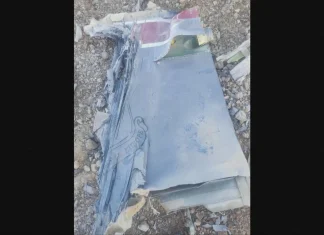
Live: US fighter jet shot down over Iranian airspace
When the Sky Broke: A Jet Falls and an Old Rivalry Reignites
The sun had not yet finished its climb when the news came in:...
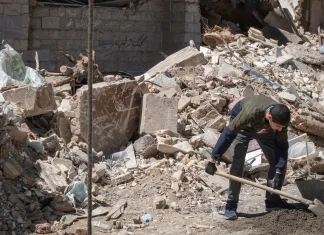
US fighter jet downed by Iran; pilot reportedly rescued
Smoke over the desert: an American warplane falls, and a region holds its breath
There are moments when the desert seems to inhale, as if...