

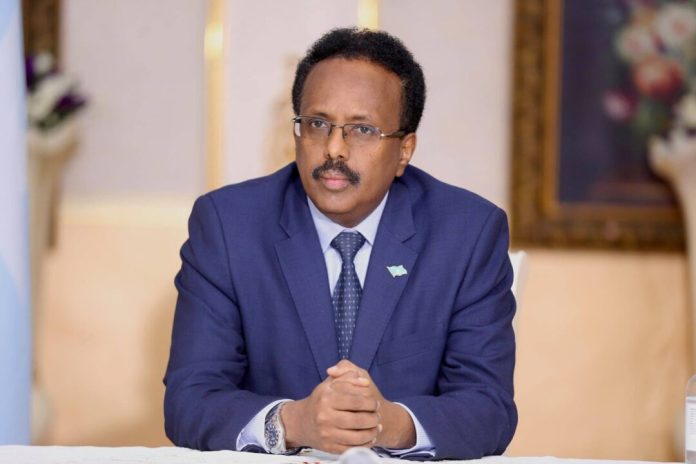
Mar 24(Jowhar)-Madaxwaynihii 9aad ee Jamhuuriyadda Federaalka Soomaaliya Mudane Maxamed Cabdullaahi Farmaajo oo walaac ka muujiyey xaalaadda siyaasadeed ee ka taagan Dowlad Goboleedka Koonfur Galbeed, ayaa ka digay halista ku gadaaman qorshaha dhiillada wata ee ay Dowladda Federaalku ku wajahday.
Slovenia braces for coalition talks following tight election results
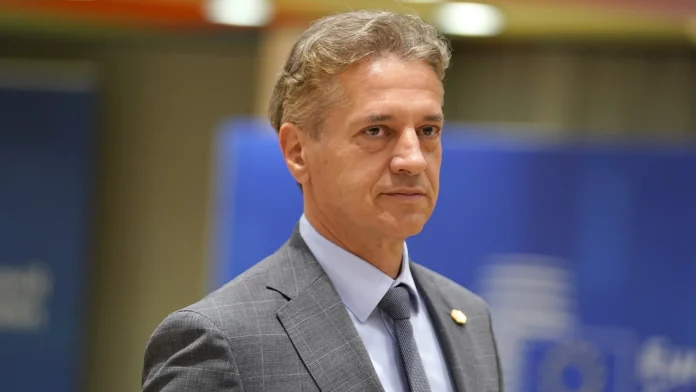
A razor-thin vote in a small Alpine nation that looms large on Europe’s stage
In a café in Ljubljana’s old town, where the scent of espresso drifts past lacquered wood and the conversation is as likely to turn to soccer as to the EU’s next crisis, people watched the election map blink and breathe on a television screen. The numbers shuffled slowly, as if reluctant to decide. Around the table, friends passed a plate of potica and argued in half-joking, half-terrified tones about what the day would mean.
“You can tell by the silence,” said Ana, a 34-year-old teacher, stirring her coffee with a flat stare. “When the room is quiet, people are thinking about mortgages, schools, whether our children will leave.”
This was not a spectacle of sweeping victory. It was a slow-motion cliffhanger — Freedom Movement (Gibanje Svoboda, GS), the progressive party of Prime Minister Robert Golob, locked in a near dead heat with the conservative Slovenian Democratic Party (SDS) of former prime minister Janez Janša. With 99.85% of ballots counted, the parliament’s 90 seats remained up for negotiation: GS at 29 seats, SDS at 28. Neither side clears the 46-seat majority. The smaller parties — those that barely cross Slovenia’s 4% threshold — suddenly become kingmakers.
The arithmetic of compromise
Numbers make sense and numbers lie. On paper, the distribution is neat enough: GS plus its usual allies would reach about 40 seats; SDS and its backers could muster roughly 43. But politics in Ljubljana is not a math problem solved with a single equation. It’s a mosaic of stubborn personalities, ideological non-negotiables, and small parties whose priorities range from pensions and regional autonomy to environmental protection and tax relief for family businesses.
“We are in for coalition talks that will be complex and potentially fragile,” said Miha Kovač, a political analyst who has watched Slovenian polities shift since the 1990s. “A minority government can govern, of course, but it will require constant trade-offs. Expect nightly horse-trading and very public compromises.”
The sense of uncertainty hung heavy even among those who leaned toward one camp or another. “I want stability,” said Marko, a small-business owner who runs a boat tour on Lake Bled. “We need consistent rules. We need tourists. But I’m also tired of arguments that sound like a TV talk show. I want a plan for workers, not just slogans.”
Voices from the leaders and the streets
Prime Minister Golob moved quickly to cast his party as ready for pragmatic talks. “We will invite all democratic parties to sit down,” he told supporters, promising a focus on health care, education, and revitalizing the economy. “Slovenia needs more than a fragile majority to implement reforms that help people.”
On the other side, Janez Janša held back from immediate coalition maneuvering, saying his party would wait for official confirmation of final results. He also raised concerns about counting discrepancies, telling supporters his party’s monitors had found shortfalls — an allegation election officials have said they would investigate. “We want a transparent and accurate count,” Janša said at a late-night rally. “Our democracy depends on trust in the process.”
Not everyone found the drama political. “This feels personal,” said Nika, a retired nurse who lives in Maribor. “My pension is what it is. I worry about cuts to health care, and I worry about media freedoms. Whoever governs, I hope they remember the people who wake up early and go to work.”
What the small parties might demand
- Greens and left-wing groups will likely press for stronger environmental protections, funding for public services, and social spending.
- Conservative and centrist parties may push for tax incentives for businesses, deregulation, and reduced state funding to select NGOs.
- Regional and pension-focused groups will demand protections for the elderly and investment in rural infrastructure.
Local color and cultural stakes
Slovenia’s political debates often carry echoes of its geography. The Alpine ridges and karst plateaus, the small wineries in the Vipava Valley, the fishermen on the Adriatic coast — all these are woven into conversations about land use, tourism, and economic development. The country of roughly 2.1 million people — a European Union member since 2004 and an early adopter of the euro in 2007 — has long punched above its weight by being outward-facing and industrially diversified.
“Politics here isn’t just about ideology,” said Luka, a beekeeper from the countryside west of Ljubljana. “It’s about how the river is managed, whether the government supports small farms, whether young people can stay or must leave to find a life.”
Local traditions make the stakes feel vivid. During elections, village taverns become salons where policy is debated alongside seasonal dishes. Language matters: Slovenian is a close cousin to neighboring tongues but remains an anchor of identity. Even the ideas about governance are filtered through the nation’s post-Yugoslav memory — independence in 1991 is still a touchstone.
What this means for Europe and beyond
While Slovenia’s population is small, its geopolitical choices matter. Under Golob, foreign policy leaned into European partners and collective responses to crises. Janša, who has voiced admiration for former U.S. President Donald Trump and courted ties with Hungary’s Viktor Orbán, has signaled a willingness to shift alliances and adopt a more nationalist, Eurosceptic tone on some issues. That potential shift has drawn attention across Brussels and beyond.
Smaller EU states often find themselves balancing sovereignty with membership responsibilities. Which direction Slovenia takes could affect EU cohesion on topics like migration policy, media freedom norms, and relations with Hungary and Poland — countries that have tested the bloc’s boundaries in recent years.
“Every vote in a small country can have outsized consequences,” noted Dr. Elena Petrović, a scholar of Central European politics. “A coalition that leans inward will shape how Slovenia votes in EU councils, how it approaches defense spending, and how it frames rule-of-law debates. For neighbors, these are not abstract choices.”
The human question beneath the headlines
Beyond the coalition math and the tweets, the election reveals a deeper tension: how to live together in a world recalibrating after a pandemic, amid climate stress, and under economic anxieties. Do voters want a steady, social-democratic hand that invests in public goods? Or do they prefer a government that looks to the market, trims the state, and promises to shake up established institutions?
“I ask my students this,” Ana the teacher said, looking back at the map on the café screen. “Which future do you want to help build? It’s not just about today’s bathroom banter. It’s about whether your child can go to a decent school, whether your neighbor gets proper care, whether the rivers don’t flood our fields next spring.”
So what happens next?
The next days will be dominated by closed-door negotiations, offers and counteroffers, and an anxious public waiting to see whether a coalition can be cobbled together. Expect appeals to centrist parties, concessions on budgets, and perhaps the odd surprise coalition arrangement. Expect also that whatever government emerges will be tested almost immediately by real-world problems: inflation, energy security, and the slow but inexorable challenge of demographic change.
Ask yourself: when a country the size of Slovenia stands at a crossroads, what should the global community care about? Is it the immediate stability for markets, the long-term health of democratic norms in Europe, or the everyday well-being of those who live in the valleys and cities? Maybe it’s all of the above.
As dusk fell over Ljubljana and the television finally dimmed, the café emptied into cobbled streets. People walked home and fell back into ordinary rhythms — cooking, checking on elderly relatives, planning for tomorrow. But the conversation, as always in this small, proud nation, continued. Because elections, even narrow ones, are not only about who gets the keys to power. They’re about the stories a country tells itself about what it values, and the kind of future it chooses to build.
Midowga Yurub oo ka walaacsan khilaafka u dhexeeya Dowladda Federaalka iyo Koonfur Galbeed

Mar 24(Jowhar)-Midowga Yurub ayaa muujiyay walaac xooggan oo ku saabsan xaaladda sii xumaanaysa ee u dhexeysa Dowladda Federaalka Soomaaliya iyo Dowlad Goboleedka Koonfur Galbeed.
Iran Launches Missiles into Israel, Rejects Talks with Trump
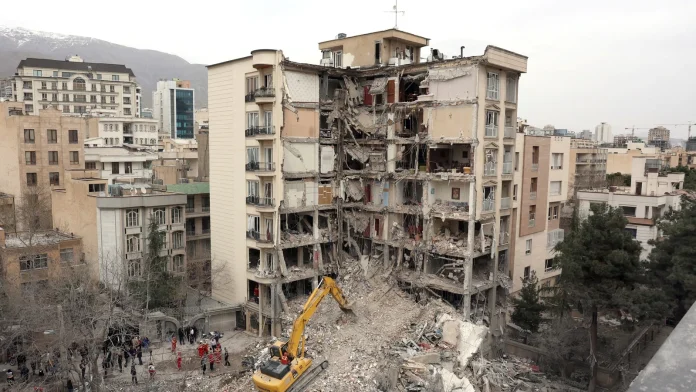
Night of Sirens: When Tel Aviv Held Its Breath
It began with a sound that fractures the ordinary: a high, insistent wail that swept through neighborhoods, over cafes, and down office towers. Air-raid sirens blared across parts of Israel — Tel Aviv among them — as what the Israeli military described as multiple waves of missiles arced toward the country. Residents poured into stairwells, balconies, and the brief refuge of shuttered shops, listening to the thunder of interceptions and the terrifying crack of debris striking roofs and streets.
“I was waiting for my coffee and then everything changed,” said Amir, a driver who stood on the corner of a bakery in northern Tel Aviv, fingering a half-empty espresso cup. “You don’t think it will come here. Then you hear it — like someone punching the sky.”
In several places, falling fragments from intercepted missiles dented cars and shattered windows. Homes in the north reported damage; no deaths were reported in the latest exchanges. Still, the psychological toll was unmistakable: a city that prides itself on its hummus-slow mornings and late-night comedy shows reduced, for a time, to quiet vigilance.
Pause and Paradox: A President’s Reprieve
Against the backdrop of the missile salvos, the White House delivered an unexpected twist: the U.S. president announced a five-day postponement of a planned strike against Iran’s electrical grid. The decision, he said, followed what were described to him as useful talks with Iranian interlocutors. The president framed the delay as a tactical pause — a breathing space in which diplomacy might yet take hold.
The immediate effect rippled through global markets. Share prices climbed and oil slipped sharply, tumbling back below the psychologically significant $100-a-barrel mark after spiking the previous days on fears of wider conflict. Traders breathed, then squinted at new data: U.S. Treasury yields nudged higher and the dollar regained some of its recent losses as investors tried to reconcile competing signals from the capitals of Tehran and Washington.
Markets and the Mood
Even in this reprieve, ambiguity loomed. The volatility underscored a raw truth: energy security and geopolitics are braided together like barbed wire and roses. The Strait of Hormuz, the crucial chokepoint through which roughly 20% of the world’s oil and liquefied natural gas transits, remains central to every forecasting model and every anxious call between ministers.
- Oil: Prices fell below $100 a barrel after the five-day postponement.
- Markets: Global equities rallied modestly on the news but remained fragile.
- Human toll: The conflict has already claimed more than 2,000 lives since late February.
Voices from the Ground and the Halls of Power
The pause did not land evenly. Within hours, Iran’s political class pushed back. Mohammad Baqer Qalibaf, a powerful parliament speaker and a figure often close to the corridors that conduct Tehran’s foreign policy, publicly denied any formal negotiations. “No talks took place,” he wrote, condemning what he called market-manipulating falsehoods. The Revolutionary Guards described the American statement as a familiar bit of psychological warfare — an attempt to shape perceptions rather than realities.
From the streets, opinions were as split as the headlines. “If there’s a chance for talks, take it,” urged Leila, a nurse in Haifa, who has treated civilians during previous escalations. “But don’t let a pause fool you. Preparation saves lives.” Meanwhile, an elderly shopkeeper in Beirut’s southern suburbs, watching smoke curl over the horizon from an earlier Israeli strike, shook his head. “We live on the edge of decisions we don’t make,” he said. “Every pause is long enough to worry and too short to heal.”
Analysts Weigh In
“What we’re seeing is a classic diplomatic gambit wrapped in the language of deterrence,” said Dr. Amina Rahman, a Middle East analyst based in Istanbul. “A temporary halt can calm markets and open channels for back-channel diplomacy, but without trust-building measures, such halts are brittle.” Her warning: progress on paper often frays in the face of competing domestic pressures and hardline actors on both sides.
Diplomacy on Fast-Forward: Islamabad, Omani Channels, and Backdoor Talks
Behind the headlines, a web of intermediaries — from Gulf states to Pakistan and Oman — have been acting as messengers in a fraught relay. Reports circulated that Pakistani officials might host talks as soon as this week, and statements from Tehran acknowledged consultations with Omani counterparts about developments in the Strait of Hormuz.
“When direct dialogue stalls, regional actors fill the vacuum,” explained Farid Al-Khalili, a diplomat who has watched similar back-channels in previous crises. “These are not full peace talks, but they often produce confidence-building gestures that prevent escalation.”
Yet even as envoys made discreet calls, hard-liners on all sides ratcheted up the rhetoric. Iran vowed reprisals against U.S. interests, hinting at new attacks, while Israeli leaders insisted operations against Hezbollah in Lebanon and potential targets in Iran would continue. The result: a diplomatic dance where every step is shadowed by the risk of a misstep.
Why the Strait of Hormuz Still Haunts Global Stability
To many outside the region, the details of meetings and missile speeds evaporate into headlines. But the Strait of Hormuz is a constant: a narrow, strategic artery that keeps lights on and economies humming across continents. When ships slow, prices rise. When insurance premiums spike, smaller economies feel the pinch first.
“If the waters remain contested, we could see prolonged disruptions to shipping that ripple through food, fuel, and manufacturing across the globe,” said Tomas Berger, an energy economist in London. “Even short closures boost volatility for months.”
What Comes Next? Questions, Risks, and a Call for Imagination
We sit now in that uneasy place between conflict and negotiation, where a five-day window becomes a crucible for choices. Will interlocutors turn a pause into a pathway toward de-escalation? Or will competing domestic pressures and mistrust erase the opening?
Here are the key questions every reader should carry with them:
- Can regional intermediaries translate face-saving measures into durable confidence-building steps?
- How will markets react if the pause dissolves into fresh strikes or if the Strait of Hormuz remains effectively closed?
- What humanitarian costs will deepen if the fighting widens or continues over months?
Every time an air-raid siren wails, it asks us to consider the human geometry of statecraft: parents choosing which room feels safest, shopkeepers tallying broken windows, traders adjusting portfolios, diplomats drafting language that might hold. The arithmetic of war is brutal and granular. It shows up in the plaster dust on a northern Israeli living room and in an insurer’s overnight memo.
For the global reader, the lesson is both immediate and American: geography matters. So does patience, nuance, and the messy work of statecraft often invisible in the cacophony of headlines. A five-day pause is not a solution. But sometimes it is enough to keep the world from tilting over for another breath — and that, in a year full of precarious balances, can feel like everything.
Colombian military plane crash after takeoff claims 34 lives
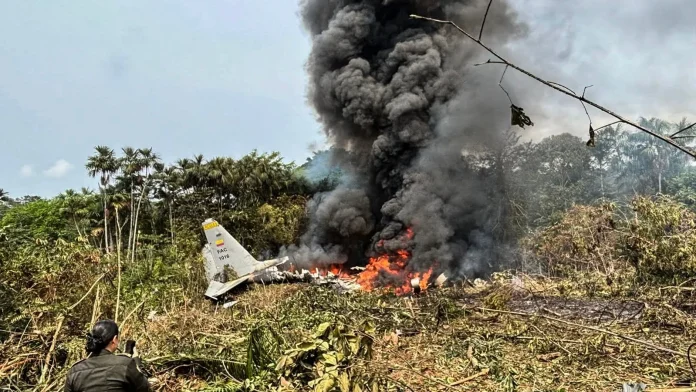
Smoke over the river: a Hercules falls in Colombia’s Amazon and a town holds its breath
They woke to the sound of a boom that did not belong to the river.
In the small riverside town of Puerto Leguízamo, where mornings usually begin with the slap of boat hulls on mud and the calls of market vendors, a different noise broke the dawn — the sickening thud of an aircraft crashing less than two kilometers from the airstrip. By midday the town square filled with people staring toward the smoke. By evening, the numbers were announced: at least 34 people dead, dozens more injured, and a community plunged into grief and questions.
What happened
Colombian authorities say a Lockheed Martin-built C-130 Hercules transport plane, operated by the Colombian Air Force, went down shortly after takeoff from Puerto Leguízamo, a remote outpost on the Putumayo River near the border with Peru.
Defense Minister Pedro Sánchez said the aircraft hit the ground roughly 1.5 kilometers from the runway. Flames followed the impact and detonations rocked the area as ammunition stored on board ignited. “There is no indication of an attack by illegal actors,” Sánchez wrote on the social platform X. He added that the aircraft had been declared airworthy and that a qualified crew had prepared the flight.
Local officials, including Mayor Luis Emilio Bustos, confirmed the grim toll. “Unfortunately, we currently have 34 confirmed deaths,” the mayor told reporters, his voice weary after hours of coordinating rescue and recovery efforts. Putumayo Governor Jhon Gabriel Molina said that some of the victims were still to be identified.
Faces and voices from the riverside
Across the town, grief and disbelief mixed with a pragmatic rush to help. “We ran down to the river when we heard it,” said one of the town’s boat captains, who asked to remain unnamed. “There was smoke, and then people were coming out from the bush. We took some to the clinic on our boats. The hospital is small — it is not ready for something like this.”
At the health center, nurses treated burns and fractures while relatives searched for missing loved ones. “My brother was a mechanic on the base,” said María, a local woman whose voice trembled. “He used to come to our house on Sundays. I am waiting to know.”
Rescue teams were hindered by the region’s geography. The Amazon’s thick forest, meandering rivers and limited road access mean that most large rescues depend on airlift capacity — the very thing that failed on this flight. “We are used to challenges here,” said a community elder, “but when a plane goes down close to your home, it feels like the whole world has fallen into the river.”
Why a Hercules matters — and why its loss echoes
The C-130 Hercules is not a glamorous jet; it is a workhorse. First flying in the 1950s and continuously developed since, C-130s haul troops, cargo, humanitarian aid and emergency supplies into places few airliners can reach. Militaries across the world still rely on them for their ruggedness and versatility.
For Colombia’s Amazon region, a C-130 is part of the lifeline — bringing medicines, food, and mobility in a vast and sparsely populated landscape where roads are few and rivers are the main highways. The crash therefore has immediate local consequences: delayed supplies, strained medical services and the loss of trusted personnel.
Questions that hang in the smoke
Accidents rarely have a single, neat cause. Aviation investigators will look at mechanical records, weather at the time of departure, crew training, weight and balance, and any potential foreign object damage or runway issues. The fact that ammunition on board detonated adds another layer of danger — it complicates recovery and investigation, and turns an already tragic accident into a chaotic scene.
An aviation safety expert who asked not to be named told me, “Takeoffs in hot, humid, and riverine environments are tricky. Short runways, dense air, and the need to carry heavy loads can reduce margins for error.” He cautioned that it was too early to speculate about any single cause.
Government officials insist there is no immediate sign of hostile action. But in a region that has seen long-running conflicts, illicit economies, and decades of armed groups, the very thought raises old fears. “We want answers,” said a local teacher. “Not speculation. We want the families to know what happened so they can bury their dead and heal.”
On the ground: response, rescue, and the human cost
Emergency crews from regional and national authorities mobilized, but the remoteness of Puerto Leguízamo — reachable by river or small aircraft — complicated immediate aid. Hospitals are small and can be overwhelmed quickly; critical patients require transfer to larger medical facilities, often far away.
Colombia’s geography helps explain why the military uses transport planes for both defense and civilian support in these areas. The region is also a frontline for environmental and social challenges: deforestation, biodiversity loss, and the displacement of indigenous communities. A crash of this scale magnifies those vulnerabilities.
- Passengers aboard: reported 125 people
- Confirmed dead (initial reports): 34
- Distance from departure point where crash occurred: ~1.5 kilometers
- Type of aircraft: Lockheed Martin C-130 Hercules (military transport)
Voices calling for transparency and care
Relatives and community leaders have asked for timely, transparent information and guarantees that the investigation will be thorough. “We need to know not only what happened, but who is responsible for the safety of our people when they fly,” said an aunt of one of the victims. “These are the people who help our towns survive.”
Humanitarian organizations and regional advocates emphasize that accidents in remote areas reveal deeper infrastructural imbalances. “When a place depends on a handful of planes for supplies and mobility, the stakes are national,” said an intellectual and human rights activist based in Bogotá. “We should ask what investments are needed so clinics and towns like Puerto Leguízamo are not so vulnerable.”
Beyond the wreckage: what this tells us about risk and resilience
As investigators comb the charred remains, as families gather names and photographs and the town moves through a ritual of mourning, there is a larger question: how does a nation protect its most distant citizens?
Modern societies pride themselves on connectivity and emergency response, but the Amazon reminds us that geography shapes vulnerability. When roads end and rivers begin, when weather can change in an hour and resources are thin, lives depend on fragile lifelines.
What kind of investment — in infrastructure, in aircraft, in local healthcare — would reduce the likelihood of such tragedies? How can we better balance the demands of national security with the everyday needs of citizens in remote areas? These aren’t easy policy debates, but they are urgent.
Remembering and reckoning
In the days to come, names will be read, funerals held, and investigations published. The people of Puerto Leguízamo will pick through the aftermath — some will return to their boats, others will spend months caring for the injured or confronting bureaucracy. For now, the town gathers around its losses the way it has gathered around countless riverfront rituals: with quiet hands, with songs swallowed on the wind.
As you read this, consider those far from the headlines who keep the gears of remote regions turning — the pilots who fly into small airstrips at dawn, the medics who stitch wounds under lantern light, the families who travel by boat because there’s no other way. What does it mean, in a globalized world, to truly leave no one behind?
When the smoke clears, the hard work of answering that question begins.
Military plane crashes in Colombia, 77 people hospitalized
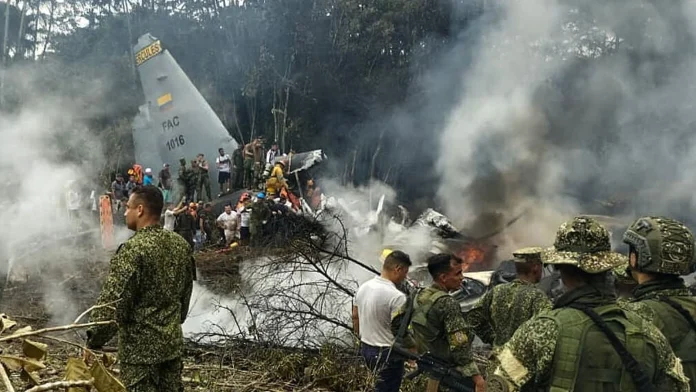
Smoke Over the Amazon: A Military Plane Falls Short of Its Journey
The sun had barely burned through the Amazon humidity when a Lockheed Martin C-130 Hercules, heavy with troops, tried to climb away from a strip of runway that seems to belong to another era.
Minutes later, black plumes stitched themselves into the sky above Puerto Leguízamo — a remote riverside town on Colombia’s southern frontier — and a country that has watched its military wings age with uneasy patience felt the sting all over again.
What happened
Colombian authorities say the air force transport was carrying 125 people — 114 passengers and 11 crew, according to military statements — when it crashed just after takeoff on the border with Peru. Initial tallies show one person dead and 77 injured and hospitalized, many with severe burns and trauma wounds. The precise list of victims and the causes remain under investigation.
“We are in the early hours of an investigation,” admitted Defence Minister Pedro Sánchez in a terse briefing. “We do not yet have all the answers, only the heartbreaking images.”
Video from the scene showed a hulking fuselage twisted and smoking, flames licking at its sides. Local rescuers and military medics worked against a sticky heat, carrying stretchers across soaked earth and into the modest hospital where corridors quickly filled.
Quick facts
- Aircraft type: Lockheed Martin C-130 Hercules, a workhorse transport first introduced in the 1950s.
- Onboard: 125 (114 passengers, 11 crew, per military statement).
- Casualties: Reported 1 dead, 77 hospitalized (figures provisional).
- Location: Puerto Leguízamo, Putumayo department — deep southern Amazon region, border with Peru.
A town that is both gateway and witness
Puerto Leguízamo is a place you hear before you see it — the drone of outboard motors on the Putumayo River; the chaotic market where fish are flayed on wooden slabs; the kind of place where a landing strip is a vital lifeline for supplies, not a luxury.
“Planes are how we live,” said María López, a market vendor whose stall sits two blocks from the municipal airfield. “They bring medicine, they bring people. To see that smoke… it felt like the sky was crying.”
Local doctors and nurses told similar stories: corridors overflowing, triage improvisations, relatives waiting with open, anxious eyes. “We did what we could,” said a nurse who asked not to be named. “We held hands, cooled burns, prayed — sometimes that’s all you can do while you wait for more help.”
Age, maintenance and the politics of modernization
The C-130 is a legend of aviation — reliable, versatile and everywhere. First flown in 1954, more than 2,500 C-130s of various models have been produced; many nations, including Colombia, have operated versions of the aircraft for decades.
But longevity brings its own perils. Colombia acquired its first Hercules aircraft in the late 1960s. Some of those airframes have been progressively modernized; others have been patched into extended service life using spare parts, program upgrades and transfers of surplus aircraft from allied nations.
President Gustavo Petro seized the moment to frame a wider argument about military renewal. “I hope there are no more lives lost in accidents that could have been prevented,” he wrote in a post on social media. “We cannot wait; bureaucratic hurdles cannot be an excuse when the lives of our young people are at stake.”
“If civilian or military administrative officials are not up to this challenge, they must be removed,” he added, casting the crash into the larger debate over procurement, transparency and readiness.
Why this matters beyond one crash
There are three threads that stretch from this singular accident into broader debates:
- Safety and maintenance: aging fleets demand more inspection cycles, better supply chains for spare parts and steady funding for upgrades.
- Procurement and politics: how governments replace or modernize military hardware is often as much about paperwork and diplomacy as it is about mechanics.
- Human cost: an aircraft filled with troops speaks to ongoing operations — training, patrols, or deployments — and each accident reverberates through families and communities.
Echoes from the region
This is not an isolated story. Only weeks earlier, at the end of February, a Bolivian Air Force C-130 went down in El Alto, a fast-growing city high above La Paz, where the wreckage scattered banknotes and grief into crowded neighborhoods. More than 20 people died and dozens were injured. The image of money drifting like confetti across rooftops became an ugly symbol of calamity and chaos.
That crash prompted questions across Latin America: are regional air fleets aging into danger? Are international surplus transfers, while useful, adequate to safely bridge capability gaps?
Lockheed Martin, the company that makes the C-130 line, extended condolences and said it would cooperate with investigators. But statements from manufacturers, while important, rarely soothe the immediate needs of families caring for burn victims or towns that suddenly must process a major emergency.
On the ground: urgency, grief and the small mercies
At the hospital in Puerto Leguízamo, local priest Father Jorge pulled up a chair near a doorway and spoke quietly of small mercies. “People arrive frightened, and we try to calm them,” he said. “In these towns we don’t have the luxury of waiting for the state to act; neighbors become the first responders.”
Surging heat and the smell of jet fuel made rescue operations dangerous and exhausting. Military units assisted local crews, but logistics are unforgiving here: the nearest advanced trauma center is hours away by air, not by road. For many injured, survival depends on quick transport and careful surgery — resources that are sometimes in short supply far from capital cities.
Questions for a global audience
When a transport plane crashes carrying troops, it prompts practical queries but also ethical ones. How should countries balance the costs and political headaches of modernizing militaries against other pressing domestic needs? How do governments ensure accountability in procurement processes spanning decades and borders?
And there’s a human question: what do we owe to those who strap into aging machines to do dangerous work? The answer might begin with better maintenance, clearer priorities and sustained investment — but it also requires a national conversation about what saving lives really costs.
After the smoke clears
Investigators will sort metal and testimony. They will file reports and subpoenas, hand over findings and recommend reforms. For now, families wait. Veterans of the air force, local fishermen, market vendors and the young soldiers who boarded that flight are bound together by one moment — the wingbeat that became an emergency.
“We have to learn,” María López said, “so that no more mothers wait for a son who doesn’t come back.”
As Colombia begins the slow work of answering how this happened, the scene in Puerto Leguízamo remains a stark reminder: in the age of advanced aircraft and global logistics, distant places still depend on fragile threads of technology, governance and human courage. How nations mend those threads will determine how many futures are spared from the smoke.
Socialists keep control of France’s largest urban centers
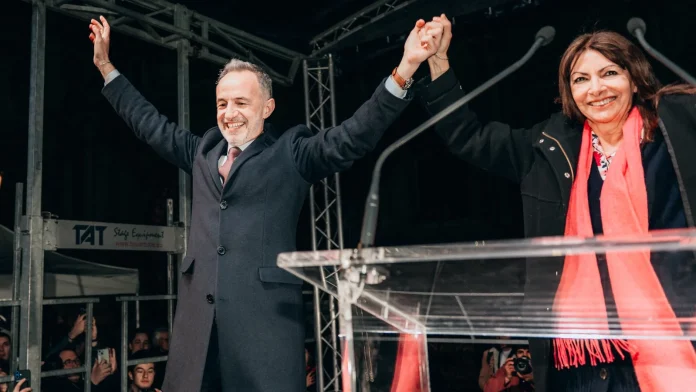
Nightfall over the port: what France’s municipal votes really tell us
In Marseille, the salt wind still carries the smell of fish and diesel the day after the votes. Market stalls along the Old Port were quieter than usual on Monday, but the conversations were anything but. “We wanted to show who we are,” said Amélie, a bouillabaisse cook who wiped her hands on her apron as she spoke. “We voted to keep our city for the people who live here, not for a political slogan.”
Across the country, from the pebble beaches of Nice to the shipyards of Toulon, a tapestry of municipal results has begun to knit a new — and sometimes surprising — picture of French politics. For the hard-right National Rally (Rassemblement National, RN), the night was a mixed bag: victories in places they had not previously controlled, a major win in Perpignan and the capture of Nice under Eric Ciotti, but stinging defeats in the cities they coveted most — Marseille and Toulon. For the left, the Socialist Party found reason to smile in France’s two biggest cities, where they clawed back control and with it a potent symbol: Paris, pedaled into by its newly elected mayor on a bicycle, remains left-wing.
Local ballots, national heartbeat
To the casual observer, hundreds of municipal contests might look parochial: a hundred issues about parking, school façades, and zoning. But France’s roughly 35,000 communes are where politics breathes, where alliances are forged and reputations are either burnished or eroded. These results are not a postal vote for 2027’s presidential race, but they are a thermometer. They show where parties can form coalitions, where voters are ready to flirt with the far right — and where they recoil.
“Municipal elections are the country’s political barometer,” said Lucie Martel, a political scientist in Lyon. “They reveal momentum and limits. The RN’s gains show it’s moving beyond protest votes into the local fabric. But its failures in big, diverse cities demonstrate a persistent ceiling.”
What happened in the big places
Paris, often treated as France’s political stage, delivered a reassuring scene for the left. Emmanuel Grégoire, the Socialist mayoral candidate, clinched the capital, defeating Rachida Dati and keeping Paris in left-leaning hands. There was theater to his victory: Grégoire cycled across the city in an almost symbolic return to the green policies he champions. “Paris will be the heart of the resistance,” he declared, speaking of a bulwark against any mainstream-right and far-right electoral marriage.
Down on the Mediterranean, Marseille — France’s second city — resisted an RN takeover. Incumbent Socialist Mayor Benoît Payan won re-election with just under 54% of the vote in runoff tallies reported by an Elabe poll for BFM TV. Payan’s victory was consolidated when his hard-left rival withdrew from the runoff to avert splitting the anti-RN vote. “This city, which some believed lost, showed its most beautiful face,” Payan said. “It proved it can resist narratives that seek to divide us.”
Toulon, however, was a sore point for the RN. The party had pinned much of its hopes on the port city but failed to take it — a result that some in the party dismissed as a temporary setback and others saw as evidence of limits to their appeal.
Wins, losses, and the RN’s narrative
The RN’s leadership framed the night differently. “The National Rally and its candidates have achieved tonight, in this municipal election, the biggest breakthrough in its entire history,” said Jordan Bardella, the party’s leader, pointing to dozens of new local offices won in places where the RN previously had little to no presence. Perpignan, held by the RN in the first round, and Nice — captured under the campaign of Eric Ciotti — were troves of symbolic value.
But the party’s mixed outcome also exposed a strategic tension: it can mobilize in less urbanized or economically distressed towns and gain footholds in small and medium cities, yet it struggles to carry major, heterogeneous metropolises with deep immigrant communities and diverse political ecosystems.
“You can see the map of France’s inequalities in these results,” offered Yann Serrat, a sociologist in Montpellier. “Where the RN won, people feel left behind — not just economically but culturally. Where it lost, there are stronger civic networks, more cross-party cooperation, and often a younger, more diverse electorate.”
Centre and right: unity, or fragmentation?
The mainstream right took comfort where it could. Edouard Philippe, the center-right former prime minister and mayor of Le Havre, won re-election, a result that will inevitably prompt speculation about a 2027 presidential bid. “There were reasons to be hopeful,” Philippe said, invoking values and an optimism that the extremes can be beaten if the center holds firm.
But even as Philippe celebrated, his camp acknowledged a lesson: unity matters. Several conservative voices insisted that only a united front could prevent the RN from converting local gains into a presidential edge. “If we split, we fall,” one local councilor in Bordeaux told me. “If we unite on ideas — not just personalities — we have a shot.”
Leftward threads and local surprises
For the left, there were bright spots beyond Paris and Marseille. In Roubaix, a city of nearly 100,000 in northern France, France Unbowed (La France Insoumise, LFI) looked set for victory, a signal that a party more associated with national agitation is planting roots locally. “Traditional parties are losing ground,” Manuel Bompard of LFI said, noting that local momentum could translate into a renewed national voice.
The Socialist Party also touted smaller but meaningful wins: pockets like Pau, where they say they bested centrist competitors. “We’re rebuilding, ward by ward,” one Socialist canvasser in Pau told me, the creases around her eyes crinkling as she named each local school, market and park as proof of the slow, granular work that produced this night.
Why this matters beyond France
These municipal snapshots offer lessons for democracies worldwide. They reveal how local governance becomes a proving ground for national ambitions, how economic dislocation, immigration debates and cultural anxieties morph into votes, and how coalitions and tactical withdrawals can shape outcomes as much as ideology.
They also demonstrate the paradox of modern politics: parties can expand rapidly but still hit glass ceilings where cities are denser, more diverse, more cosmopolitan. And they underline that the battle for hearts and minds is fought not only on television or in national debates, but in municipal halls, primary schools and local markets.
Questions to carry forward
As you read this, ask yourself: which vision of community do you want to see win — one that emphasizes borders and identity, or one that invests in local services and pluralism? How do national narratives change when tested in the mundane — the bus route, the trash-collection schedule, the park bench?
France’s municipal contests are over, but their echoes will travel to the presidential stage. The RN’s footprint has widened, but so has the determination of opponents to build alliances. The next election is a long way away; the stories that begin now — of partnership, of exclusion, of daily governance — will shape how people vote when the stakes are highest.
For residents like Amélie in Marseille, the result was personal. “It’s about the kids on my street,” she said, tying her apron. “Politics must fix the little things. If it doesn’t, what’s the point?” Her voice held hope, fatigue and a stubborn faith in democracy’s smallest units: the blocks, the markets, the municipal votes that together make a nation.
Trump oo ugu danbeyn wada-hadal ka dalbaday Iran
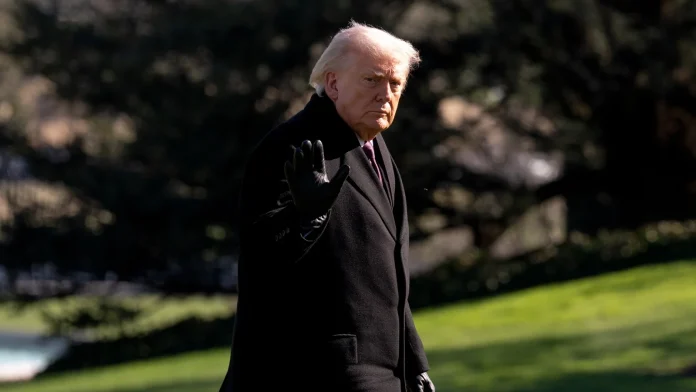
Mar 23(Jowhar)-Horumar ayaa laga gaaray wad-hadalo u socday Mareykan iyo Iran iyadoo Trump uu amray ciidankiisa iney weerar danbe qaadin.
Starmer denounces anti-Semitic arson attack that targeted ambulance vehicles
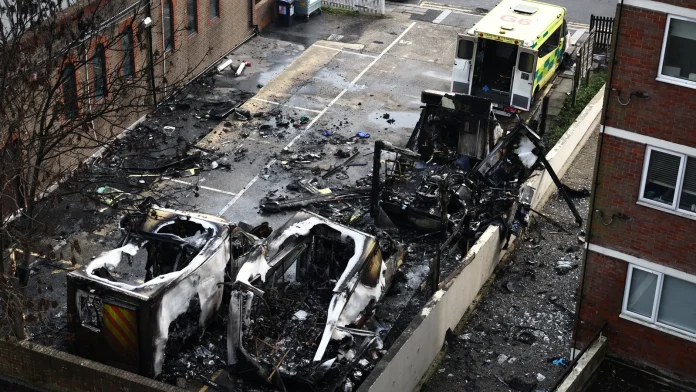
Smoke Over Golders Green: When Ambulances — and Trust — Were Set Alight
Before dawn on a cool London morning, the hush of Golders Green was ruptured by orange tongues of flame licking at the sides of four ambulances. The vehicles belonged to Hatzola, the volunteer Jewish ambulance service whose sirens have threaded through North London’s streets for decades—answering calls in the darkest hours, regardless of faith or background.
By 1:45am the quiet residential road had become cordoned off, windows steamed from the heat, and a charred bouquet of metal and melted plastic lay where lifesaving vehicles had stood the night before. Neighbours were evacuated, roads closed, and the usual late-night hum of this diverse community paused beneath the acrid smell of smoke.
What Happened
Police say CCTV footage captures three people setting fire to the ambulances. Officers also reported hearing explosions consistent with gas canisters stored on board the vehicles. Miraculously, no people were hurt—no volunteers, no passers-by—but the symbolic damage was immediate and raw.
The Metropolitan Police have opened a hate crime investigation, saying the attack is being treated as an anti‑Semitic incident. “We are in the process of examining CCTV and online footage,” said the local superintendent, adding they are looking for three suspects and urging witnesses to come forward. At the time of writing, there have been no arrests.
Voices from the Ground
The shock was felt across a community accustomed to being both visible and visible for the right reasons: charity, care, and mutual aid. “They come when anyone needs them,” said Damon Hoff, president of Machzike Hadath synagogue, which houses the ambulances. “This isn’t only about Jewish people—it’s about people who are there to save lives.”
One Hatzola volunteer I spoke with, who asked to remain anonymous, wiped soot from his jacket and said softly, “We train to run into danger for strangers. Tonight, someone chose to turn that back on us.” His voice trembled between anger and exhaustion.
Outside a nearby kosher bakery, Miriam, a shop owner who’s lived in Golders Green for 22 years, summed it up with weary clarity: “This place is my home. We hear all kinds of stories here—weddings, funerals, babies crying—now we hear sirens in a different way. People are frightened.”
Political and Communal Response
From Downing Street to the streets of Golders Green, words of condemnation came fast. The Prime Minister urged communities to “stand together,” calling the episode a “horrific anti‑Semitic attack.” London’s mayor described it as a “cowardly attack on the Jewish community,” promising that “Londoners will never be cowed by this kind of hatred and intimidation.”
The UK’s Chief Rabbi framed the assault as an attack on shared values, saying Hatzola’s volunteers “protect life, Jewish and non‑Jewish alike,” and that the targeting of such a service is “particularly sickening.” The Archbishop of Canterbury, community leaders, and medical bodies also condemned the assault; the British Medical Association highlighted how deliberate attacks on healthcare services are “reprehensible.”
Why This Cuts So Deep
It’s not just that ambulances were torched. It’s the symbolism of attacking emergency responders—the people who stand as a society’s last, neutral line against chaos. It’s an assault on an institution that, by its very mission, refuses to pick sides.
Hatzola, founded in 1979, operates as a volunteer emergency response and transport service in North London. It has long been a point of civic pride: trained volunteers from within the community who step forward when someone’s life hangs in the balance. To target them is to target a social fabric stitched together by care.
Context: A Rise in Fear
Across Britain and much of Europe, Jewish communities have reported heightened anxiety in recent years. Charities and community groups track thousands of antisemitic incidents annually, noting spikes often linked to geopolitical tensions overseas. That pattern leaves neighbourhoods on edge: when global headlines flare, local streets feel the heat.
“You can’t separate local safety from global politics entirely,” says Dr. Naomi Feldman, an expert in community security. “But it’s crucial to remember that hate crimes are acts of choice by individuals or small groups. They are not inevitable. They are preventable with vigilant policing, community solidarity, and political leadership.”
What Comes Next
Investigators are piecing together a timeline from CCTV and digital leads. Patrols around synagogues and community centres have been increased. Hatzola’s London base—though shaken—remains operational, Shomrim confirmed, as volunteers re-route resources and reassure those who call for help.
Local councillors expressed a mix of shock and sorrow. “My first reaction was horror,” said Peter Zinkin of Barnet Council. “Then profound sadness.” Councillor Dean Cohen called it “a new low” to attack ambulances—vehicles dedicated to saving lives 24/7.
Questions for the Reader
What does it say about a society when those who come to help are themselves targeted? How do communities rebuild trust after an act designed both to destroy property and to intimidate people into silence?
These are not rhetorical questions for Golders Green alone. They echo in neighbourhoods where emergency workers, teachers, and volunteers operate under the shadow of targeted violence. How a city responds—through policing, outreach, and leadership—says as much about its values as any statement from a podium.
Beyond the Flames: A Call to Action
There are concrete steps neighbours and officials can take: bolster CCTV and lighting in vulnerable spots; fund rapid-response patrols that work in partnership with community organisations; expand hate‑crime education in schools and faith institutions; and ensure that victims and volunteers have psychological support.
- Encourage anonymous tip lines and community reporting mechanisms.
- Increase dialogue between law enforcement and community charities like Hatzola.
- Support local initiatives that build cross‑community resilience—shared meals, emergency drills, educational events.
As one long-time resident put it, “We need to show up for each other—not just talk about it.” It’s a modest prescription for something far greater: preserving the basic decency that makes a mosaic city liveable.
Final Thought
Golders Green woke to a scene that would be unsettling in any city: the grotesque tableau of ambulances set ablaze. But beyond the photographs and the police tape, this moment exposes a deeper test, one that asks how communities react to fear: by retreating into joyless isolation, or by stepping forward, together, into the light.
In the weeks ahead—when inquiries move on and the press cycle turns—what will remain is the choice each neighbour, leader, and passer-by must make. Will we let this be a wedge, or will we let it be a reason to stand closer? The answer will be written not in statements alone, but in small, everyday acts: volunteers returning to their posts, shopkeepers opening their doors, and people in a diverse city deciding—again—to care for one another.
Socialists Maintain Control of Major French Cities After Local Elections
Morning after the ballots: France’s cities exhale, divide and prepare
The sun rose over Paris as if nothing had changed — cyclists wove through the boulevards, boulangeries filled with the warm scent of croissants — and yet the city felt different. On the pedaled shoulders of Emmanuel Grégoire, who celebrated his win on two wheels, Paris affirmed a politics of coalition, green roofs and social programmes. Across the Mediterranean, Marseille’s narrow victory for Socialist incumbent Benoît Payan felt like a local triumph against a national tremor: in the southern port city, voters chose familiarity over the anti-immigration message that has been buoyant elsewhere.
These municipal ballots, played out across roughly 35,000 communes that make up France’s administrative map, are intimate by design — about potholes, school timetables and urban gardens. Yet the results ripple far beyond town halls: they are being read like tea leaves for 2027, when the country will elect a president and when the far-right National Rally (Rassemblement National, RN) has increasingly looked like a formidable contender.
Winners, losers, and the stubbornness of place
It was a mixed night for the RN. Jordan Bardella, the party’s leader, struck a tone of triumph in the face of high-profile misses, calling these municipal rounds “the biggest breakthrough in its entire history.” The party did indeed notch important wins: Perpignan returned to RN control in the first round, and the party consolidated gains in smaller cities and towns where it had previously been absent. In Nice, political heavyweight Éric Ciotti — a figure who has migrated toward the RN orbit — secured the mayoralty of France’s fifth-largest city.
But the narrative is not one of unimpeded ascent. The RN failed to take Marseille and Toulon, two prize cities where victory would have translated into powerful symbolic capital. In Marseille, Payan’s reported 54% — according to an Elabe poll for BFM TV — felt, to many locals, less like a mandate than an act of communal refusal.
“We’re a port, a city of neighborhoods,” said Simone, who has run a small café near Old Port for twenty years. “People here care about having a voice at the council table. They don’t want someone who will make us a headline for all the wrong reasons.”
Meanwhile, the Socialist Party had a night to savor. Emmanuel Grégoire’s victory in Paris — holding off a strong challenge from conservative Rachida Dati — keeps the capital in left-wing hands and gives center-left forces a showpiece victory to brandish ahead of national contests.
Small ballots, big implications
It’s easy to dismiss municipal elections as parochial. In one sense, they are: much of the campaigning was about tree-lined boulevards, housing renovations and the maintenance of municipal pools. But they also map the alliances and fault-lines that could decide a presidential race.
“Municipalities are the laboratories of French politics,” observed Claire Montfort, a political scientist at the Institut d’Études Politiques in Lyon. “Here you see who can build coalitions — left with greens, centrists with conservatives — and where the RN’s national rhetoric translates into local power or fails at the doorstep.”
What the RN gains in Perpignan and in some smaller towns is tangible: administrative control, local visibility, the practical enactment of policy that can then be tallied and broadcast as competence. But in larger, more diverse urban centers — where municipal coalitions can consolidate against a single-party surge — the RN’s appeal shows limits. In Marseille and Paris, alliances and tactical withdrawals by rival left and centre-left forces played decisive roles.
Faces in the crowd: snapshots from the cities
In Paris, Grégoire’s campaign leaned into the visible: bollards for safer streets, expanded bike lanes and a promise to make the mayor’s office more accessible. “Paris will be the heart of the resistance,” he said after his victory, invoking unity against what he and supporters call an alarming drift toward far-right governance.
At a tram stop in Marseille’s working-class 3rd arrondissement, Ahmed, a municipal bus driver, shrugged. “We looked at the issues — schools, garbage collection, lighting — and for us, it wasn’t about grand speeches. It was about who takes out the trash and fixes the streetlights,” he said. “Sometimes people forget that.”
In Roubaix, a northern post-industrial town where France Insoumise (LFI) made significant inroads, young organiser Léa described the campaign as a long-haul community project. “People are tired of being told they don’t matter,” she said. “When you put a candidate who actually listens, turnout changes. It’s not just ideology — it is recognition.”
A city mayor’s ripple: Edouard Philippe and Le Havre
On the other side of the political spectrum, Edouard Philippe — the former prime minister and a centre-right figure who once served under Emmanuel Macron — was re-elected mayor of Le Havre. His victory is being watched not for its municipal implications alone but for what it might mean in national leadership contests. Philippe’s ability to win locally gives him a steady platform should he decide to pursue national ambitions in 2027.
“His re-election says something about the centre-right’s resilience,” Montfort added. “It suggests that unity and a moderate, managerial approach still have traction, particularly in cities that prize stability.”
What the results say — and what they don’t
These elections do not, and cannot, deliver a forecast of the presidential vote. Municipal ballots are atomised: nearly every town and village runs its own race; local personalities matter as much as national narratives. But they do sketch trends: the RN’s growing footprint in local government; the ability of left-wing urban coalitions to resist it; the urgent need for the centre-right to reconcile internal divisions and build broader alliances.
Some commentators suggest the RN has run into a “glass ceiling” — a metaphor for the party’s difficulty converting regional momentum into victories in large, multi-ethnic, cosmopolitan cities. RN officials reject that framing, while opponents see the municipal map as proof that broad-based coalitions can blunt the party’s surge.
- Key facts: France has roughly 35,000 communes; Paris has about 2.1 million residents; Marseille roughly 860,000.
- RN won Perpignan and made gains in smaller cities; failed to capture Marseille and Toulon.
- Socialists held Paris and Marseille, providing momentum for left-leaning networks.
Where do we go from here?
As France’s political classes digest these results, voters across Europe will be watching. The continent is watching how local ballots translate into national storylines, and whether political systems can respond to the grievances that feed populism without eroding democratic norms.
Ask yourself: what matters more — the charisma of a national leader, or the daily competence of the person who fixes your pothole? In 2027, French voters will have to reconcile those two scales of politics. This municipal cycle shows they are not willing to hand over entire cities without a fight, but neither are they content to keep doing the same.
In the café in Marseille, Simone wiped a table, smiled and said, “Politics here is messy. It’s loud. But it’s ours. We vote for the people who feed us and clear our streets. Maybe that’s how change will win — quietly, one neighbourhood at a time.”
Whatever the national narratives, France’s towns and cities have issued a reminder: democracy is lived, not just polled. The real measure of political strength will not be how loudly a party argues on TV, but how it governs on the ground.

Greece to bar under-15s from social media starting in 2027
Greece’s bold move: a country tries to reclaim childhood from the screen
On a late spring afternoon in Athens, parents clustered outside a primary school...

Woman nicknamed ‘Ketamine Queen’ to face court over Matthew Perry death
The Quiet of a Hot Tub and the Loud Echo of a Celebrity's Death
It was a foggy October morning in Los Angeles when the...
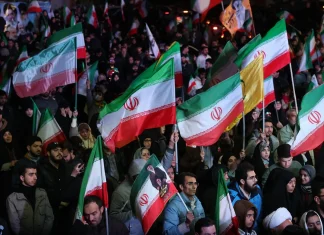
US and Iran Agree Truce: Essential Details You Should Know
Two Weeks to Breathe: A Fragile Truce, a Crowded Strait, and the World Holding Its Breath
Late into the night, a fragile agreement flickered to...
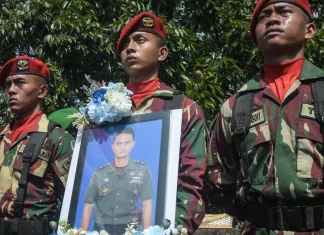
UN Says Peacekeepers Likely Killed in Strikes by Israel, Hezbollah
Under the Olive Trees: When Peacekeepers Become Targets
The sun sinks slow over southern Lebanon, gilding the knobby trunks of centuries-old olive trees and casting...
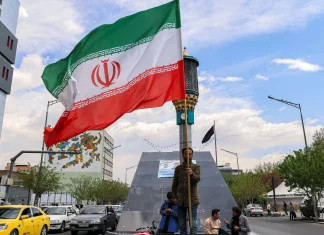
Trump backs down at the eleventh hour, easing national tensions
A Day the World Held Its Breath: How a Single Post Rewrote Normal
It began like a thunderclap in an otherwise ordinary morning: a short,...