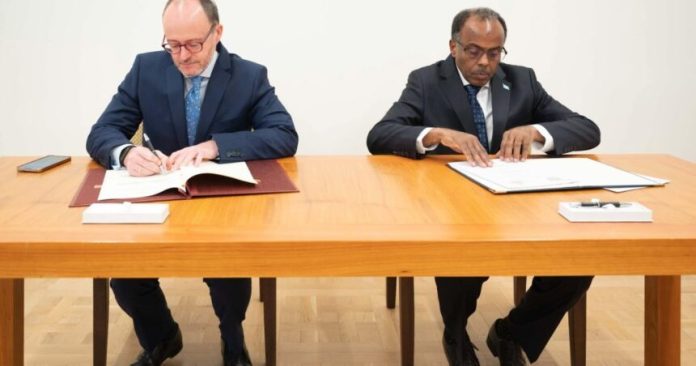
Nov 09(Jowhar)- Magaalada Muqdisho ayaa lagu soo xiray Shirweynaha Iskaashiga Dhaqaalaha Bariga Afrika (EACCON 2025), kaas oo muddo laba maalmood ah (7–8 Oktoobar) ka socday caasimadda dalka, iyadoo ay kasoo qayb galeen madax sare oo heer gobol iyo heer qaran ah, khubaro, ganacsato, iyo wakiillo ka kala socday dalalka xubnaha ka ah Ururka Iskaashiga Dhaqaalaha Bariga Afrika (EAC).
California man arrested in connection with fatal Palisades blaze
A Night of Orange: The Arrest That Reopened a City’s Wound
When the hills above the Pacific bowed to flame in early January, Los Angeles woke to an orange dawn the city had never truly known. Streets became rivers of ash. Smoke crawled into living rooms, stained the sails of sailboats tied in marinas, and turned the sun into a coin the size of a dinner plate. More than 9,300 hectares—about 23,000 acres—were seared. Nearly 6,000 homes, businesses and other structures were lost. Twelve people died. And now, months after the embers cooled, federal agents say they have a man in custody who intentionally started the blaze.
“We have arrested a suspect on federal charges who we allege set the fire deliberately,” Bill Essayli, the acting US attorney for the Central District of California, told reporters as investigators unspooled a case that has riveted an entire region. “The evidence we’ve collected—digital media, witness statements and other investigative leads—supports those charges.”
From an Uber Shift to Headlines
Authorities say Jonathan Rinderknecht, living in Pacific Palisades at the time, was working as an Uber driver the night the fire began. He allegedly dropped off passengers moments before ignition. He was arrested in Florida and is expected to be transferred back to Los Angeles to face federal criminal counts related to destruction of property by means of fire.
Local detectives and the Bureau of Alcohol, Tobacco, Firearms and Explosives (ATF) pieced together a quilt of digital evidence: cellphone videos, 911 calls, location data and, strikingly, AI-generated images that investigators showed at a press briefing—images that, according to prosecutors, the suspect created in the weeks leading up to the blaze depicting a cityscape in flames.
“We’re increasingly seeing how digital tools—both benign and malicious—shape intent and action,” said Dr. Maya Hernandez, a criminologist who studies technology’s role in modern crimes. “That prosecutors are pointing to AI-generated imagery is a sign that courts and investigators will have to grapple with a new evidentiary landscape.”
What investigators say ties him to the fire
Officials say the case rests on a combination of forensic and testimonial pieces: videos on a cellphone that appear to capture the early moments of the fire, 911 audio, geolocation pings, and the AI-generated images. At the press conference, images were displayed showing a burning cityscape that investigators claim the suspect had created in the weeks prior.
“These aren’t mere coincidences. We followed the digital trail,” one federal investigator told reporters. “There’s more to present in court. But we felt it necessary to act when we did to prevent further harm.”
Landscapes of Loss: Where the Fire Raged
The fire leapt across ridgelines in Pacific Palisades, Topanga and Malibu, places where coastal chaparral and eucalyptus groves meet affluent neighborhoods and narrow canyon roads. The Santa Monica Mountains—normally a mosaic of sage and scrub, a refuge for hikers and weekend picnickers—turned into a furnace. Helicopters and air tankers were grounded for days by winds gusting as high as 160 kilometers per hour (about 100 mph), leaving firefighters largely dependent on ground crews and sheer grit.
“I could hear the hills crackle like a paper fire,” said Rosa Alvarez, who lost her home in Topanga. “We grabbed what we could—photos, passports—and we left with the ashes of our life in a black trash bag. My daughter stood on the hill and said, ‘Mama, it looks like the world is burning.’”
Firefighters battled the blaze for about 24 days before it was largely contained. The scale tested not only firefighting capacity but the very infrastructure of an urban region unaccustomed to such conflagrations: reservoirs and hydrants strained, roads became impassible, and hospitals diverted patients. Initial damage estimates tied to the fire ran into the billions; investigators have cited a figure of roughly $150 billion in economic losses, a number that includes property destruction, business interruption and other cascading costs.
Echoes Beyond the Burn Scar
This is not simply the story of a single fire or a single alleged arson. It sits at the crossroads of climate, urban planning, mental health, digital culture, and law enforcement.
California’s fire seasons have lengthened and grown more violent across recent decades. In 2020, summer and fall wildfires in the state burned roughly 4.2 million acres—one of the worst seasons on record. Scientists point to hotter temperatures, earlier snowmelt, and prolonged droughts as factors that intensify fire behavior. At the same time, more people live at the wildland-urban interface—homes pressed up against wild slopes—making every blaze a potential human catastrophe.
“We don’t fight the same fires our grandparents fought,” said Captain Marcus Reed, a veteran of the Los Angeles Fire Department. “The fire runs faster. It leaps farther. And the fuels—both natural and infrastructural—are different. We need to adapt how cities plan, where we build and how we manage the landscape.”
AI, media and the digital trail
Perhaps the most novel element of the investigation is the role of digital creativity. AI-generated images—tools that can produce photorealistic scenes from simple prompts—have become part of the public toolkit. But when such imagery appears to foreshadow violent acts, investigators face new questions about intent, admissibility and the speed with which technology can be weaponized.
“We’re seeing a collision between the digital and the physical,” said Dr. Alphonse Llewellyn, a sociologist who advises civic technology groups. “When someone repeatedly consumes and produces violent imagery, it can feed into their perception of acceptability. Courts will have to consider how to interpret these artifacts.”
Human Costs and Community Resilience
For residents, though, the trial and the evidence will not be the immediate focus. They are rebuilding homes, chasing repair permits, comforting elderly neighbors and replanting burned gardens. In the weeks after the fire, community centers became hubs of food distribution and legal aid. Church basements hosted clinics. Local restaurants served free meals to displaced families.
“We have a potluck tonight,” said Keisha Park, who volunteers with a Pacific Palisades mutual aid group. “People show up with casseroles and coffee, but mostly with stories. The fire took our things, but it didn’t take our memory of this place or our will to help each other.”
As prosecutors prepare for a federal case, the arrest raises questions about deterrence, about how communities can prevent arson and about the emotional and technological drivers that lead to such acts.
What should we ask ourselves?
Is this an isolated act of destructive behavior, or a symptom of larger fractures—social, technological, environmental—that we’re only beginning to understand?
How do cities protect themselves when climate change and human hostility conspire? How should the law respond when the forensic trail runs through algorithms and creative software? And finally: how do communities rebuild trust and infrastructure after a blaze that took so much? These are the conversations Los Angeles now must have out loud.
“Fire is a teacher of a brutal kind,” Captain Reed said quietly. “We can be outraged, we can prosecute, we can adapt—but if we fail to learn, we’ll sit in the same ash twice.”
For people in the Palisades and beyond, the coming months will be a test of justice, resilience and imagination: rebuilding homes and habits, tightening digital safety nets, and rethinking a relationship to a landscape that, for better and worse, is changing beneath our feet.
Trump: Israel and Hamas Reach Agreement on First Phase of Peace Plan

After Two Years of Smoke and Silence, a Tentative Breath of Hope
When the sun slipped behind the flattened skyline of southern Gaza, a hush fell over Al-Mawasi that felt less like relief and more like the cautious quiet before someone exhales and listens for a sound. Families clustered around battery-powered radios; teenagers scrolled illuminated screens with the practiced speed of those who have learned to measure hope in headlines. For many here, hope is an art of restraint.
On social media and in brisk announcements from Cairo and Washington, a startling claim rippled across the world: the first phase of a U.S.-brokered peace plan had been accepted by both Israel and Hamas. The plan, described by the American president as “historic and unprecedented,” reportedly calls for an immediate ceasefire, the release of all hostages held in Gaza, and Israel’s phased withdrawal to an agreed line — the first steps, its proponents say, toward a “durable and everlasting peace.”
“If this holds, we will finally breathe,” a man who had been displaced from northern Gaza told an AFP correspondent, as he sat amid the debris of what was once a family home. “Not for long. Not yet. But a breath.”
What the deal would mean, in practical terms
According to the outline shared by negotiators, the opening phase includes:
- an immediate and mutually verified ceasefire;
- the release of the hostages still inside Gaza — reported to be 47 people after the October 7, 2023 attacks that initially took 251 captive;
- a list of Palestinian prisoners to be freed from Israeli jails in exchange;
- a phased pullback of Israeli forces to pre-agreed lines; and
- measures aimed at laying the groundwork for Hamas’s gradual disarmament.
“We are at the beginning of a painstaking process,” said a Western diplomat close to the talks. “Ceasefires sound simple on paper; they are brutal in their implementation. Verification, confidence-building, humanitarian access — these are the scaffolding that must not be ignored.”
Voices from three capitals and a living room in Gaza
The announcement was punctuated with thank-yous to mediators: Qatar, Egypt and Turkey. The president, posting on his preferred social platform, wrote that both parties had “signed off on the first Phase” and that “ALL of the Hostages will be released very soon.” An aide at the White House described a rushed, dramatic moment earlier in the day — an urgent note handed across a room, the clatter of advisors, a plan moving faster than the usual machinery of diplomacy.
Israel’s prime minister said he would convene his cabinet to consider the agreement and pledged to bring hostages home “with God’s help.”
Hamas, for its part, issued a statement saying it had agreed to a truce that included an Israeli withdrawal and a prisoner exchange, and called on guarantor states to ensure Israel fully implements the ceasefire. The group, and its claim, will be subjected to intense scrutiny; past ceasefires have often unraveled on points of verification and mutual trust.
“We will release the list of those we hold,” a senior Palestinian negotiator said in Cairo, “and we expect guarantees that the people in Gaza will be able to rebuild, return, and live with dignity.”
Numbers that refuse to be abstract
Two years into a war that has reshaped the lives of millions, the human toll is stark. An AFP tally based on official Israeli figures credits the October 7 attacks with the deaths of 1,219 people, mostly civilians. In Gaza, the health ministry in the territory — the UN considers its casualty reports credible — places the death toll at least 67,183 people since the conflict began, a number that does not distinguish combatants from civilians and notes that more than half of the deceased are women and children.
“When you talk about numbers, remember they are people,” said Dr. Samira Al-Harazi, a pediatrician now working in a makeshift clinic outside Khan Younis. “You learn each name, each child’s story. There’s no way to render it sterile.”
Humanitarian agencies warn that much of Gaza lies in ruins, with an unfolding food crisis that the United Nations has described in stark terms. Millions face acute shortages; basic infrastructure — water, power, healthcare — has been decimated. Families of Israeli hostages, meanwhile, have watched each update with a painful blend of hope and skepticism, their living rooms plastered with photos, candles, and calendars that mark every day of absence.
Scenes on the ground
In Al-Mawasi, the smell of frying za’atar bread mingled with cigarette smoke and the diesel tang of generators. Children kicked a waterlogged soccer ball near a collapsed mosque minaret. A woman brewed coffee over a small gas stove and handed me a cup as if offering an age-old rite of dignity: “Sit. Tell me what they are saying.”
Across the border, in a suburb of Tel Aviv, families gathered before television sets and smartphones, scanning for confirmation. “We have lived through false dawns,” said Natan Weiss, whose sister remains listed among the missing. “But if even half of this is true, it’s a window. We must make sure it becomes a door.”
Why this moment matters — and why it might still falter
Diplomacy in the Israel-Gaza context is cyclical, often propelled by international pressure, mediated by regional powers, and vulnerable to spoilers. The participation of parties like Islamic Jihad and the Popular Front for the Liberation of Palestine in the talks underscores the complexity: no single agreement will hold unless it accounts for the patchwork of armed groups, political actors, and everyday civilians who must live with its aftermath.
“Sustaining a ceasefire requires more than signatures,” explained Dr. Leila Haddad, a Middle East analyst. “You need mechanisms for verification, for addressing grievances that predate the latest round, and for rebuilding livelihoods. You need jobs, schools, and the slow work of trust.”
For the United States, which has poured diplomatic energy into the mediation, the stakes are not only humanitarian but geopolitical. A successful first phase could reset regional relations, influence domestic politics, and alter the calculus of actors from Tehran to Brussels. For mediators like Qatar and Egypt, it is a moment to translate back-channel influence into a visible outcome.
Questions that remain
Who will verify the ceasefire? How will prisoner lists be authenticated? What guarantees will be offered to ensure the continued flow of humanitarian aid? And perhaps most critically: what will be the enforceable framework for the longer-term political questions that lie beneath the military ceasefire — governance, borders, and the daily rights of people to move, to work, and to be safe?
These are not theoretical matters. They are the scaffolding of whether a temporary pause becomes a path forward or just another pause between storms.
What you can do — and why you should pay attention
As readers around the world watch this fragile story unfold, there are small but meaningful ways to stay engaged: follow multiple reliable news sources, support humanitarian organizations working on the ground, and hold your representatives to account for policies that affect civilians caught in conflict. We often speak of global crises in the abstract; here, the consequences land in everyday kitchens and schoolrooms.
Will this breath become a sustained inhale? Will children be able to play without hiding? Will hostages finally be reunited with their families? The next hours and days will be decisive.
For now, amid the ash and the fractured rooftops, people in Gaza and Israel share a fragile, universal wish: to see their children sleep through a night without sirens. That wish is at the heart of the negotiations — and it is what must be protected if peace is to be more than a headline and become a life restored.
Badenoch pledges spending cuts if Conservatives form next government
Manchester, ambition and the scent of fresh paint
The conference centre in Manchester felt oddly like a museum of future plans — banners fluttering in a draft of empty seats, coffee urns hissing in the corners, microphones glinting as if waiting for history to speak into them. Outside, the crisp autumn air smelled of street food and diesel; inside, Conservative members shuffled programmes, compared notes and tried to conjure momentum.
When Kemi Badenoch took the lectern to close the proceedings, she offered a vision both austere and liberating: prune the state, reward enterprise, and tear down one of Britain’s long-standing levies on property — stamp duty on primary homes. It was the kind of promise that lands somewhere between a policy tweak and a cultural manifesto.
A bold promise: stamp duty gone
“Stamp duty is a bad tax,” Badenoch declared, looking out across an audience that had been watching polls and defections like weather reports. “We must free up our housing market. A society where nobody can afford to move or buy is a society where social mobility is dead.”
On its face, the policy is simple: abolish stamp duty land tax for people buying their main home. For many buyers — especially first-timers squeezed by deposits and rising rents — that could feel like an immediate win. For the Treasury, it’s a complicated subtraction: stamp duty receipts for the last financial year were estimated at about £13.9 billion, but that figure includes levies on second homes and commercial transactions.
Analysts at the Institute for Fiscal Studies (IFS) put the price tag for abolishing stamp duty on primary residences at roughly £4.5 billion a year. The Conservative leadership, suspicious of optimistic arithmetic, told delegates they had “cautiously” modelled the policy as costing closer to £9 billion. Either way, it’s a sizeable hole to fill in public finances.
How the party says it will pay
In the same speech, Badenoch outlined what she called a “golden rule” for budgeting: only half of any savings from spending cuts would be recycled back into the economy; the other half would be used to tackle the deficit. It was an attempt to portray the policy as fiscally responsible, not campaign fireworks.
She also announced plans to trim university student numbers — a move the Conservatives estimate would free up approximately £3 billion — and said that money would be redirected to double the apprenticeship budget. “If we can reduce red tape and invest in skills, we give young people workable pathways into careers,” she told delegates.
Policy bouquet and the arithmetic of promises
Badenoch’s closing pitch was not limited to one headline. The conference rolled out a suite of pledges: abolish VAT on private schools, unwind recent inheritance tax changes affecting farms, and scrap the carbon tax. Combined with other promises made across the week, the party put the cost at about £21.1 billion — a figure set against a claimed £47 billion in savings identified by the party’s own fiscal team. Numbers tangle into narratives quickly in a conference hall.
- Stamp duty receipts last year: ~£13.9bn
- IFS estimated cost of abolishing stamp duty on main homes: ~£4.5bn
- Conservative cautious estimate of cost: ~£9bn
- Estimated cost of conference pledges: £21.1bn
- Identified savings claimed by party fiscal managers: £47bn
The politics beneath the promises
If you listen to delegates over coffee you hear skepticism and hunger in the same breath. “We need something that people feel in their pockets,” said Sarah, a local councillor from Lancashire. “Stamp duty is a visible tax. If it helps a young family buy their first home, voters will notice. But will it fix rents? Will it stop house prices from shooting back up? That’s the worry.”
Across the corridor, a young estate agent laughed, half in irony. “If you make moving cheaper, you might get more churn. That could open up homes for people stuck in the wrong place. But as a market mechanic it could also push certain prices. The devil is in the details.”
Those details matter because the party’s conference has been shadowed by two storms: the electoral threat from Reform UK and a string of internal controversies. Nigel Farage’s party has been nibbling at the Conservatives’ voter base, and last week twenty councillors defected. Polls published during the conference continued to put the Conservatives behind the main challengers.
“There is a hunger for change that we must satisfy with ideas that work, not just slogans,” Badenoch insisted. She singled out Labour repeatedly, accusing them, James in the crowd joked, of “shaking the same magic money tree” — a rhetorically playful dig, but one aimed straight at the political center-left’s spending promises.
Empty seats and public unease
Images from the conference hall — rows of empty seats stretching beneath the chandeliers — became a visual shorthand for a party struggling for momentum. Delegates shrugged off the optics. “Numbers in the exhibition hall don’t tell the whole story,” Kevin Hollinrake, party chairman, told reporters. “Members are energized. We expect to see this translate in the polls.”
Yet the conference was not only about fiscal math. It carried a social undertow: debates about identity and integration bubbled up when a recording emerged of a senior party figure complaining about the ethnic mix in part of Birmingham. The exchange prompted accusations of tone-deafness and a debate about how the party addresses Britain’s multicultural realities.
“If we want to talk about social mobility, we must talk about community cohesion,” said Dr. Amina Rashid, a sociologist based in Manchester. “Taxes and apprenticeships are vital. But so is listening. People need to feel respected and included, which is a policy and a practice.”
Beyond Britain: what this tells the world
Across Europe and beyond, governments wrestle with the double bind of housing affordability and fiscal prudence. From Amsterdam to Sydney, abolishing or reducing transaction taxes has been tried as a lever to mobilize housing stock — sometimes with mixed outcomes. The British debate is, then, part of a wider conversation about whether tax breaks should be used to prime markets or whether targeted public investment and social housing are better levers for equity.
So here’s a question for you: when policymakers choose between cutting a tax that helps some buyers now and investing in structures that protect renters and future buyers, which do you trust will make the country fairer in twenty years’ time? Do you prefer immediate cash in people’s pockets or a slower, steadier reshaping of the market?
Closing notes — the day after
By the time the lights dimmed on the final day, delegates walked back into Manchester’s cool streets, clutching leaflets, arguing with friends, and planning the next steps. The stamp duty pledge will now ricochet through media cycles, economic analysis, and focus groups. It will be modelled and counter-modelled, cheered and vilified.
Policymaking is, at its best, a conversation between ideas and lived experience. The Conservatives have pitched a new chapter in that conversation: lower barriers to buying, reined-in state spending, and a renewed embrace of profit as a force for good. Whether that chapter convinces the country — or whether voters will demand different remedies to Britain’s housing crisis — is the real story that will unfold beyond the banners and microphones.
EU urged to counter hybrid warfare threats, says bloc chief
When the Sky Feels Like a Battlefield: Europe Confronts a New, Uneasy Warfare
It was a grey morning in Strasbourg — the kind that makes the old stone of the Petite France neighborhood look like a charcoal sketch. Inside the European Parliament, pockets of conversation hummed as usual: MEPs exchanging notes, interpreters adjusting headsets, a barista in the corner calling out orders. Then the tone of the room shifted. Ursula von der Leyen, the President of the European Commission, stood and offered language that made the everyday suddenly heavy with consequence: Europe is facing not random harassment, she said, but “hybrid warfare.”
Those words landed like a weather alert. They describe a conflict that does not wear a uniform or live only on a map — a slow, deliberate pressure campaign combining drones buzzing across borders, disinformation campaigns that stoke suspicion, cyber intrusions that flick the lights of critical infrastructure. They are designed to unsettle citizens, test resolve, and, crucially, to divide.
A campaign of irritation and intimidation
“You wake up to a drone over the barn at 4am and you can’t help but think: who’s watching?” said Marek Kowalski, a farmer from eastern Poland who has seen drones hover along his property line near the border. “It’s not a warzone, but it feels like one — because it keeps testing the limits of what the state will tolerate.”
Officials in Brussels stopped short of accusing any one actor for every single incident, but the finger-pointing has already begun in earnest. Several recent airspace violations — from small UAVs to more sophisticated unmanned systems — have been attributed by European intelligence services and NATO partners to actors aligned with Moscow. Von der Leyen’s speech captured that point without making blanket accusations: the aim, she argued, is to sow division across the Union and to weaken political will to support Ukraine.
Compact, consumer-grade drones are no longer toys. They are cheap, ubiquitous and, when used deliberately, surprisingly effective tools for harassment and surveillance. Analysts say the proliferation of these devices has complicated borders and law enforcement in ways we are only beginning to understand. “We’re seeing a tectonic shift in the nature of conflicts,” said Dr. Lena Moritz, a security policy analyst in Berlin. “Kinetic force is one tool. But disruption — legal, informational, psychological — is now a key weapon.”
Not just soldiers and tanks: a call for a new mindset
Tackling this new hybrid front, von der Leyen insisted, requires measures that go beyond traditional defence. The EU needs a “new mindset,” she said — one that combines unity, deterrence and resilience. That calls for a cross-cutting strategy: airspace control, counter-drone technology, legal frameworks for policing and defense, better public communication, and cyber defenses bolstered at municipal and national levels.
“In practical terms, this means improving detection systems at our borders, sharing intelligence faster between member states, and investing in counter-UAV capabilities that can neutralize threats without endangering civilians,” said an EU security official, speaking on condition of anonymity. “It also means toughening sanctions where needed, but understanding this isn’t only about weapons. It’s about narratives and infrastructure.”
Germany’s recent move to give police the power to shoot down drones — a controversial step that grabbed headlines across Europe — is a concrete example of how states are already shifting legal norms in response to this threat. Civil liberties groups were quick to warn of potential overreach. “We must strike a balance,” said Emilia Duarte, director of a Brussels civil liberties NGO. “Countermeasures that trample on privacy or enable indiscriminate force could erode democratic norms precisely when we need them most.”
Everyday people, shifting realities
Across cafés and market squares from Vilnius to Valencia, conversations reflect the small anxieties that add up to national concern. “You used to worry about pickpockets on Saturday markets,” laughed Antonella, a pastry chef in Strasbourg, “now patrons ask at the door if there’s been any official notice about drones.” Her laugh is rueful; the café’s terrace umbrellas cast familiar shadows, but the public’s sense of normal has shifted.
For border communities, the changes are more than anecdotal. In Lithuania, a small town on the frontier reported disruptions to agricultural radio beacons — simple things that ripple outward: delayed shipments, missed classroom time when schools lockdown for unconfirmed air threats, and an increased dependence on national authorities for daily safety assurances.
And yet, not all responses are fear-driven. Resilience has a creative face. In Latvia, a youth media collective turned a community center into a “digital literacy” hub; volunteers teach residents how to spot manipulated images and false narratives spreading on social apps. “It’s about making people less vulnerable to manipulation,” said the center’s coordinator, Rasa. “You can’t defuse hybrid warfare with weapons alone — you need critical thinking.”
What Europe can — and must — do
If hybrid threats aim to exploit fractious politics and public confusion, then the remedy must be collaborative and civic-minded. Experts outline a few immediate priorities:
- Improve cross-border intelligence-sharing and early-warning systems.
- Invest in scalable counter-drone technologies and clear legal standards for use.
- Strengthen information resilience through media literacy and rapid rebuttal mechanisms for disinformation.
- Engage communities at local level to reduce fear and build trust in institutions.
“This is not just a military problem. It’s municipal, social and psychological,” said Dr. Moritz. “If we only react with tanks, we miss the point entirely.”
So what should citizens expect? For one, more visible coordination among EU capitals and a steadier stream of public messaging aimed at demystifying incidents. And for another, more difficult debates about the trade-offs between security and civil freedoms.
Ask yourself: would you trade some privacy for the feeling of being safer under a screened sky? Or do you worry that measures meant to protect could become permanent powers that shape everyday life? There are no easy answers — only choices with long shadows.
Toward a sturdier horizon
Strasbourg’s cobblestones soak up the rain and the city moves on. The flags outside the Parliament still flutter, and inside, debates will continue — about budgets, sanctions, and how to defend the democratic idea from a campaign that prefers to blur lines rather than cross them outright.
Hybrid warfare asks something from everyone: governments to coordinate better, technologists to create smarter defenses, civil society to guard rights, and citizens to stay informed. It’s a complex mosaic of effort. But the essential truth is simple: if a peaceful sky is part of what binds a community together, then safeguarding that sky demands more than missiles. It demands resilience, clarity, and shared resolve.
Trump demands Chicago mayor be jailed as federal troops arrive

When Soldiers Show Up at the Bus Depot: Chicago, Troops, and the Politics of Occupation
The morning the National Guard buses rolled into the dull gray of Elwood, a town southwest of Chicago, people stopped their errands and stared. For some it was a jolt — an unmistakable reminder that the federal government had crossed a line they had thought inviolate: sending soldiers to patrol American cities during peacetime.
“You don’t expect to see camo and Humvees when you’re picking up your kid from soccer practice,” said Maria Alvarez, a community organizer from the Near West Side, watching the convoy from the parking lot of a neighborhood taqueria. “It felt like watching a war movie with our skyline as the backdrop. It’s unnerving.”
That unease was no accident. The White House’s recent push to deploy National Guard units and federal agents to Democratic-run cities is a visible manifestation of a broader strategy — one aimed at cracking down on irregular migration and the communities perceived to shelter it. In Illinois, roughly 200 Texas National Guard troops were mobilized for an initial 60-day period, according to a Pentagon official who requested anonymity. Earlier authorizations included up to 700 Guardsmen for Chicago, with similar contingents sent to Los Angeles, Washington, Memphis, Portland and other cities.
From campaign pledge to street-level reality
For President Donald Trump, the deployments represent the fulfillment of a vow he made during last year’s campaign: to stem what he described as waves of foreign criminality and to use every federal tool at his disposal. His rhetoric has been blunt — accusing local officials of protecting migrants and even calling, on his social media platform, for the mayor and governor of Chicago to be jailed.
“Chicago’s leadership has failed to protect ICE officers and our communities,” he posted, capturing the furious tenor of a debate that has now moved beyond press releases into the churn of courtrooms and municipal streets.
On the other side, Governor J.B. Pritzker’s response was raw and immediate: “They should stay the hell out of Illinois,” he said, calling any forced deployment an “invasion” if done against state consent. The Illinois attorney general echoed that sentiment in court filings: “The American people should not live under the threat of occupation by the United States military,” she told a judge as her office sought to block the moves.
A nation split on the role of its military
This clash is not happening in a vacuum. A Reuters/Ipsos poll taken in late September found that 58% of Americans believe armed troops should be used only to face external threats — not domestic law enforcement tasks — and a full 83% said the military should remain politically neutral. The president’s approval rating in that survey tracked at roughly 40%, with public concerns mounting over crime and cost-of-living pressures.
Yet opinions were divided: about one in five Republicans told pollsters they want the military to take the president’s side in domestic debates. And some 37% overall said a president should be allowed to deploy troops into a state even over the governor’s objections — a figure that reveals just how contested the boundaries of federal power have become.
On the ground: anxiety, defiance, and everyday life
Walk through Pilsen or Back of the Yards, and the politics of the moment meets everyday rituals. A man selling tamales wore a baseball cap with the Chicago flag; a daycare teacher signed children in and spoke softly about how the federal presence had worried Latinx families arriving for drop-off. “My parents called and cried,” she said. “They lived through dictatorships. This looks like that to them.”
At the Army Reserve Training Center in Elwood, soldiers assembled with the efficiency of routine; to them, it was a mission brief, uniforms and protocols. “We are here to protect federal property and personnel,” a Guardsman said, speaking on condition of anonymity as many which handles sensitive assignments do. “We do our jobs. We’re not here to be part of politics.”
Local officials, however, framed the deployment as a tool of political punishment. Illinois’ lawsuit argues the federal government is using troops to “punish” jurisdictions that disagree with its policies — a charge that raises thorny constitutional questions about states’ rights, executive authority and the very meaning of domestic security.
Courts, commanders and the possibility of the Insurrection Act
The judiciary has begun to test the limits of the administration’s vision. In Oregon, a federal judge temporarily blocked a troop deployment, writing that the president’s rationale was “untethered to the facts,” noting that protests in Portland did not rise to the danger of rebellion and that regular law enforcement could manage demonstrations. That ruling has hardened the administration’s rhetoric: the president publicly mused about using the Insurrection Act, an arcane post-Civil War statute that allows the military to quash insurrections in U.S. territory.
“We have an Insurrection Act for a reason,” he said, arguing he would consider it if local officials or courts got in the way while “people were being killed.”
Legal scholars warn this is a fraught route. “The Insurrection Act is not a blank check,” said Leah Montgomery, a constitutional law professor. “Its use should be narrowly constrained and justified by clear, imminent threats — not as a tool for broad domestic policing or political leverage.”
What does occupation feel like in a democracy?
It’s one thing to debate troop movements from a national news studio; it’s another to see a convoy in front of your child’s school. That visceral reaction—fear, solidarity, outrage—helps explain why this policy resonates so powerfully in communities across the country.
How should a democracy balance the federal government’s duty to protect with the rights of local communities? When does concern about public safety justify extraordinary measures? And what precedent will be set if soldiers come into American cities to enforce immigration policy?
These questions are not abstract. They sit inside court dockets, in the orders governing troops’ mandates, and in the lived experience of people who now have to explain to their children why men in uniform are patrolling a neighborhood that had, until recently, felt comfortably ordinary.
Looking ahead
Whatever legal outcomes await, the cultural and political fallout is immediate. Deploying troops inside the United States is a message as much as a tactic: it signals a willingness to escalate, to redefine boundaries between federal power and local autonomy, and to view civil immigration enforcement through a national-security lens.
For many Americans this is a chilling reminder that the instruments of war can be repurposed for domestic politics. For others, it is a necessary step to confront perceived threats. Where do you stand? And what kind of country do you want on the other side of this debate — one where the military is a last resort, or one where it becomes a routine tool of internal governance?
Back in Elwood, as afternoon shadows lengthened across the training center’s fenced lot, a woman from a nearby town summed it up quietly: “We should be able to disagree without becoming an occupied city. That’s what scares me.”
Dowladda Soomaaliya oo beenisay iney Sweden heshiis kula soo gashay soo celinta dad Soomaali ah
Nov 08(Jowhar)-Dowladda Soomaaliya ayaa diiday warbixin ay faafisay warbaahinta Sweden oo sheegaysay in xafiiska Wasiirka 1aad ee xukumada uu Dowladda Sweden la galay heshiis qarsoodi ah oo Soomaaliya dib loogu soo celinayo dad dambiyo ka soo galay Sweden oo Soomaali ah.
Three scientists receive Nobel Prize in Physics for landmark discovery

A quiet thunder in the lab: how three physicists nudged the world toward a quantum tomorrow
On a gray morning in Stockholm, where the Baltic water glints like brushed steel, the Royal Swedish Academy of Sciences announced what felt like both the end of a long experiment and the opening of a new chapter: John Clarke, Michel Devoret and John Martinis have been awarded the 2025 Nobel Prize in Physics for “the discovery of macroscopic quantum mechanical tunnelling and energy quantisation in an electric circuit.”
It’s an achievement that reads like a blend of thought experiment and hard wiring — the kind of discovery you expect to find in chalk-stained notebooks and late-night lab benches rather than in ordinary life. And yet its implications are already threading into the fabric of our daily future: stronger quantum sensors, more secure communications, and the tantalizing, sometimes terrifying promise of quantum computers.
A scene from the lab
Imagine a corridor lit by fluorescent tubes, the hum of cryogenic refrigerators, and a tangle of coaxial cables glinting like the arteries of a modern cathedral. That’s the landscape of circuit quantum electrodynamics and superconducting qubits — where these laureates spent decades turning abstract quantum quirks into phenomena you can measure in a lab.
“We felt, early on, that the unusual could be coaxed into the ordinary,” says Michel Devoret in a voice that suggests both mischief and method. “That a circuit could behave like a tiny atom, showing discrete energy jumps, was thrilling. But what kept us going was the idea that we could build technologies from those jumps.”
John Clarke, who has made a career of measuring the almost immeasurable, remembers the first time he and students saw signatures of macroscopic tunnelling in their instruments. “It’s like hearing a whisper from the quantum world,” he says. “You know something fundamental is happening, and for a moment you feel like a medium translating between two realities.”
Why this matters: from tunnelling to technologies
The prize citation may sound esoteric — macroscopic quantum tunnelling and energy quantisation in an electric circuit — but underneath it sits a practical engine. When circuits show quantised energy levels and can tunnel between states on a scale large enough to manipulate, they become the building blocks of quantum technologies.
Experts say that these principles are foundational to superconducting qubits, one of the leading architectures in the race to build scalable quantum computers. While a useful quantum computer that outperforms classical machines on broad, useful tasks is not yet here, progress has accelerated: error rates have dropped, coherence times have improved, and companies and national labs are investing billions.
“This isn’t just about bragging rights,” says Dr. Amina Koroma, a quantum information scientist in Geneva. “These experiments turned what were once philosophical curiosities into devices that could measure gravity waves, detect tiny magnetic fields in the brain, and eventually break — or protect — encryption. The societal implications are enormous.”
Numbers that ground the dream
To put the scale in perspective: the Nobel physics prize this year carries a total award of 11 million Swedish crowns (around €1.04m, roughly $1.1m), to be shared among the three winners. Nobel laureates enter a lineage dating back to 1901, with physics names like Einstein, Marie Curie and Niels Bohr — figures who reshaped how humanity understands reality.
Last year’s prize, awarded to John Hopfield and Geoffrey Hinton for breakthroughs in machine learning, served as a reminder of how fundamental research can unexpectedly reshape economies, politics and public life — and how scientists often wrestle with the ethical fallout of their breakthroughs. Quantum technologies are likely to present the same tangled promise and peril.
Voices from the community
In a small café near a Cambridge lab, a graduate student who has been living off instant coffee and 3 a.m. code told me, “This prize is validation. Not just for the three of them, but for the hundred-thousand small choices that the lab community makes. It’s for the students who keep showing up.” Her eyes lit up at the thought of what comes next.
A Swedish Academy official, speaking from Stockholm, framed the award in national and cultural terms. “The Nobel Prize has always been about the curiosity that drives mankind,” she said. “From Alfred Nobel’s will to today, physics holds a special place in that story. It’s fitting that this year’s prize goes to research that sits squarely between the conceptual and the utilitarian.”
Even outside the ivory towers, the news rippled. A small start-up founder in Tel Aviv, whose company develops quantum-safe encryption, responded by texting, “We need a new generation of engineers. This recognition brings attention — and hopefully funding — to the field.” A municipal official in San Francisco mused, “If quantum sensors become affordable, imagine the environmental monitoring we could do.”
Local color: Nobel week and Swedish ritual
Each December 10 in Stockholm, the laureates will step into a ritual that few other professions enjoy: the Nobel ceremony in the blue-hued, torch-lit Stockholm Concert Hall, followed by a banquet in the city hall’s ornate Red Hall. The prize money, the medals, the speeches — they are theater and reckoning at once.
Outside the ceremony halls, the city hums with festive precision: reindeer dishes in restaurant windows, the smell of cinnamon buns (kanelbullar) in the air, and a sense of history bundled with a slightly modern edge. For scientists, the ceremony is both a coronation and a call to responsibility.
Looking outward: the geopolitics and ethics of quantum
There is a global scramble underway. Nations pour resources into quantum research because the technology promises secure communications, superior sensors for navigation and defense, and computational power that could transform materials science and pharmaceuticals. That raises inevitable questions: Who controls these technologies? How do we protect privacy when encryption can be broken? How do we keep an open international scientific community while competing for strategic advantage?
“Scientific recognition is also a political signal,” remarks Professor Luis Herrera, a historian of science. “By honoring work that underpins quantum technologies, the Nobel Committee is spotlighting a field at the crossroads of innovation, security and public life.”
What should we expect next?
For readers watching the horizon, here are a few things to keep in mind:
- Quantum technologies move from the lab to the market slowly but steadily; practical, wide-use quantum computers remain a medium-term prospect.
- Quantum cryptography and quantum sensors are already finding niche, then broader, applications—from secure communication links to medical imaging enhancements.
- Governments and private investors will likely amplify funding; the challenge will be to balance rapid development with ethical frameworks and international cooperation.
So, what do you think? Should breakthroughs like this be raced, regulated, or shared openly? The question is not academic — it will shape whether quantum technologies become a force for shared progress or a new frontier of inequality.
Closing: a prize that celebrates curiosity — and responsibility
There is an old phrase in physics: “Nature is subtle, but not malicious.” The Nobel Prize this year honors three people who taught instruments to ask nature its quietest questions and then listened. As the laureates prepare for December’s ceremony and a world waits for the next wave of quantum-enabled tools, we should carry both wonder and caution.
These discoveries do more than decorate CVs. They invite a society-wide conversation: about the kinds of futures we choose to build, who gets to build them, and how we make sure the next quantum leap serves everyone. If curiosity started this story, responsibility must write the sequel.