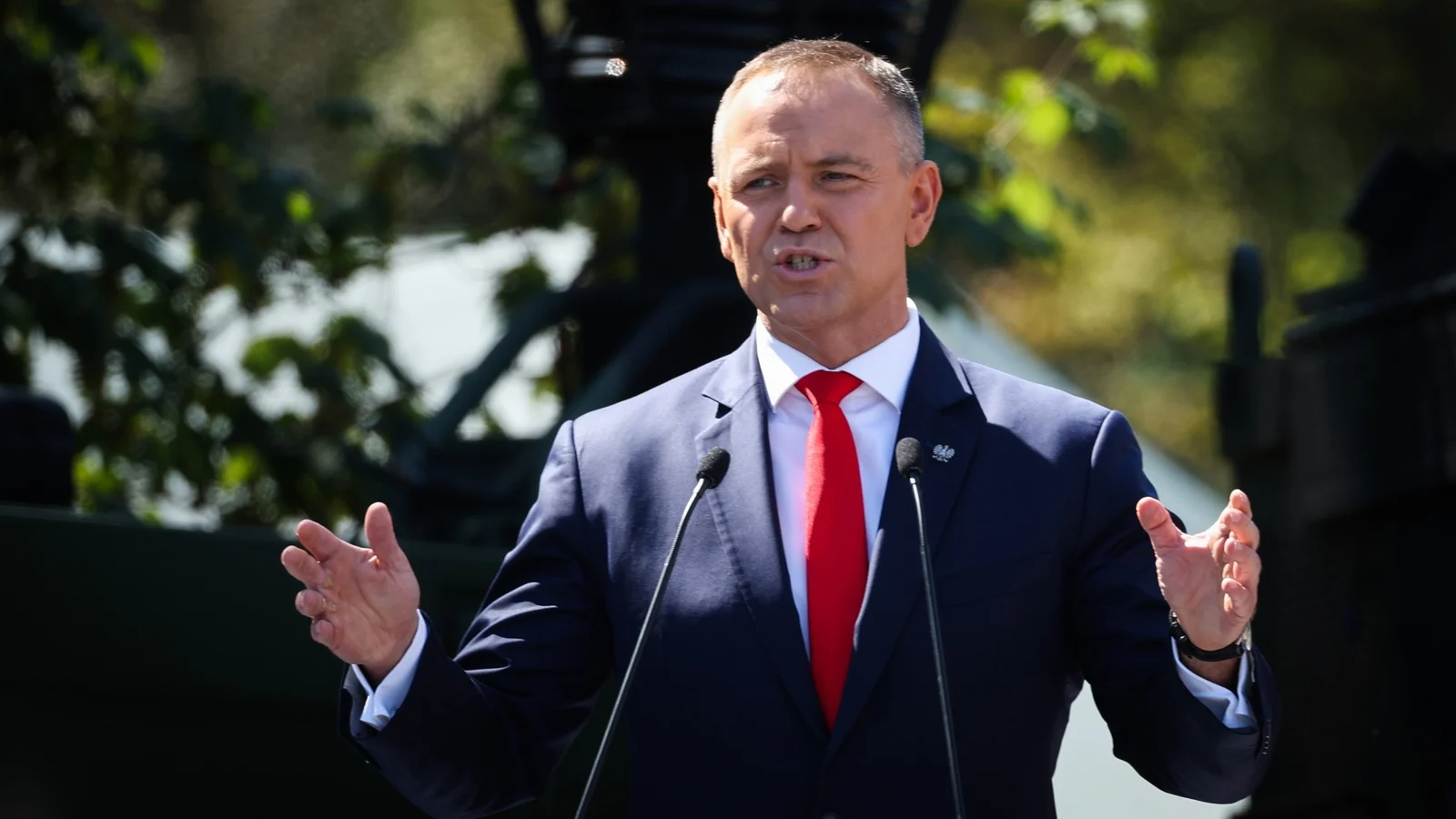
As Poland marked the moment Nazi Germany’s first shots rang out on its soil, President Karol Nawrocki used the solemn anniversary to renew a long-running demand: that Berlin finally address World War II reparations.
The attacks on 1 September 1939 set in motion the conflict that became World War II. Britain and France entered the war two days later, declaring war on Nazi Germany on 3 September.
“I appeal to the German Chancellor, to the German nation, let’s settle the issue of reparations and reparations with historical justice in mind, but also with the future in mind,” Mr Nawrocki said at a pre-dawn ceremony in Westerplatte, a peninsula at the northern edge of Gdańsk.
Mr Nawrocki, a nationalist historian, argued that a “true, firm alliance” with Poland “requires that our allies from Berlin and our neighbours pay us compensation”.
Any money received, he said, would be directed to the Polish armed forces and the Polish arms industry “so that we do not have to take Western loans, so that we get what we deserve”.
Under Poland’s previous nationalist government, in power from 2015 to 2023, Warsaw demanded €1.3 trillion from Germany for the destruction inflicted during nearly six years of occupation by Nazi Germany.
Prime Minister Donald Tusk’s current government has not pressed that specific figure, though it has also not dropped the broader push for some form of reparations from Berlin.
In 2024, foreign minister Radoslaw Sikorski urged Germany to “think in a creative way about finding a form of compensation for these war losses, or of redress”.
German governments have repeatedly said the issue is settled, pointing to Poland’s 1953 renunciation of any further war reparations claims.
Poland rejects that interpretation, contending the renunciation came from the communist authorities in power at the time.
At the ceremony in Westerplatte on Monday morning, Mr Tusk struck a different tone, emphasising cohesion among Western allies and warning that “evil is once again lingering behind our border”—a clear reference to Russia’s invasion Ukraine.
“The coming months, this autumn and this winter ahead of us, may prove crucial not only for the independence of Ukraine, but also for the security of Poland and the entire free world,” Mr Tusk said, adding that NATO “cannot be an alliance on paper”.
Polish leaders return every year on 1 September to Westerplatte, where Polish soldiers mounted a defence after German forces attacked at 4.45am.
Cut off and outgunned, the defenders held their ground for seven days before surrendering.
Later, Mr Tusk also took part in commemorations in Wieluń in central Poland, remembered as the first Polish town bombed by the Luftwaffe at 4.40am on 1 September 1939.
Of Wieluń’s 16,000 residents, estimates suggest more than 1,000 were killed.
Poland was then attacked from the east as well: on 17 September 1939 the Soviet Union invaded under a secret pact with Nazi Germany to divide the country between them.
Poland capitulated on 27 September, and its government fled into exile.
The German invasion ushered in almost six years of brutal occupation.
More than six million Polish citizens—around 20% of the pre-war population—died during the war.
Among them were three million Polish Jews murdered by the Nazis in extermination camps.