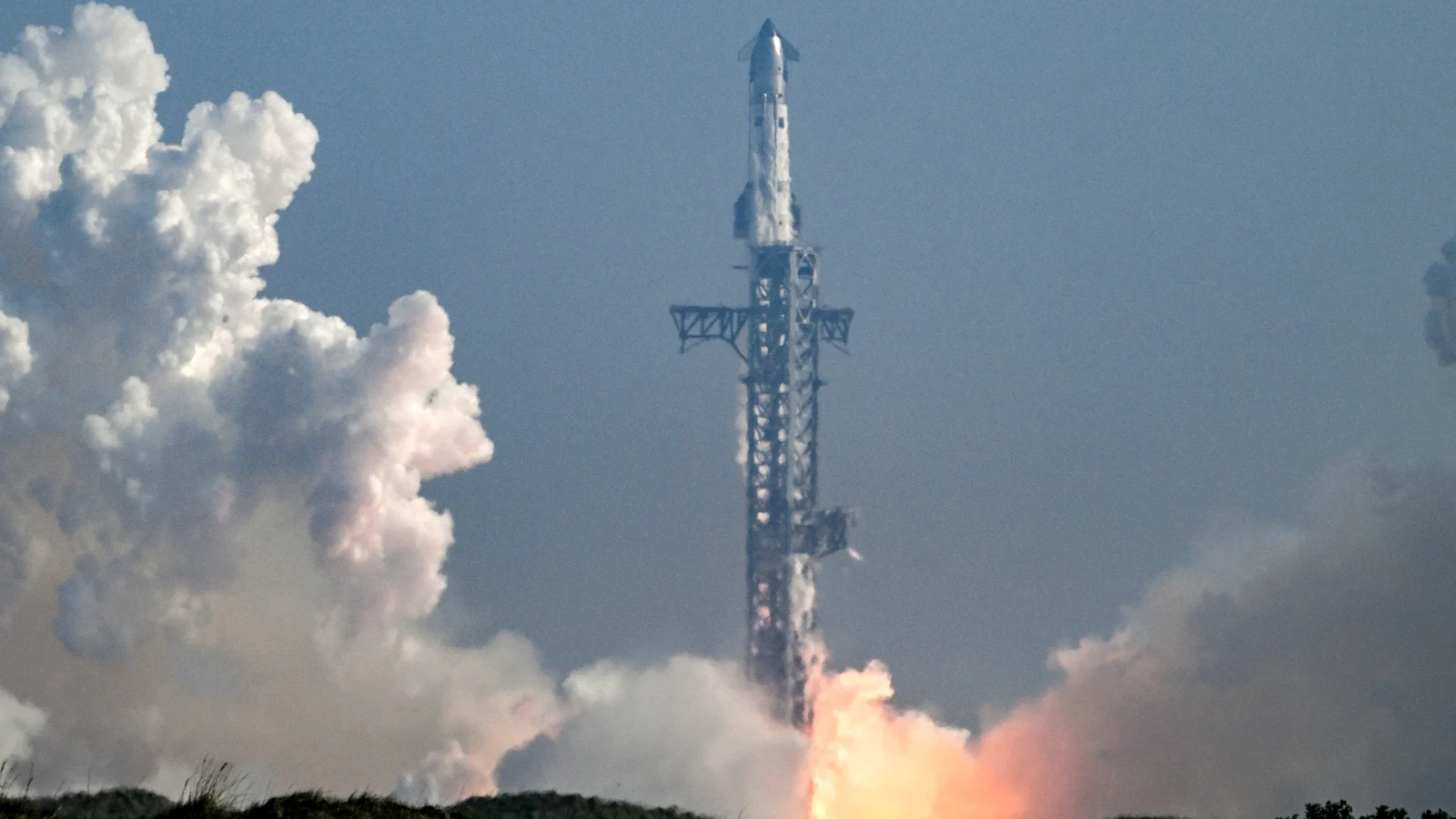
Starship’s Fiery Ocean Waltz: A Night on the Texas Coast and a Giant Rocket’s Biggest Test Yet
The sky above South Padre Island burned like a studio light as the Starship rose into the late afternoon, a silver needle slicing the heat shimmer. People craned their necks along the shoreline, phones held high, some with the same silent hope you feel when watching a child take its first steps. At 5:30pm local time—11:30pm in Ireland—the latest iteration of SpaceX’s behemoth left its launch mount and the air thudded with the sound of a machine determined to defy the familiar rules of gravity.
This was not a quiet experiment. This was spectacle: a 124‑metre stack of steel and ambition, the third-generation Starship and its Super Heavy booster, designed to fling payloads and, someday, people toward the Moon and beyond. It was mission number twelve for Starship, the first flight in seven months. And while the company did not plan to recover every piece, the drama that unfolded was textbook human—flawed, brave, and strangely lyrical.
The flight in plain language: a controlled mess
SpaceX’s livestream commentators kept a steady, professional cadence—until they didn’t. Cheers erupted in their control room when the upper stage performed one of the more cinematic bits of the flight: flipping upright in space and relighting its engines to regain control. That maneuver was crucial, especially given that one engine had failed during an earlier burn and the vehicle was not in a textbook orbit afterward.
“I wouldn’t call it nominal orbital insertion,” company spokesperson Dan Huot said on the feed, a phrase that felt half technical, half admiring. He added, however, that the trajectory remained “within bounds” of what engineers had modelled. And then came the moment the cameras couldn’t quite capture: the splashdown. The upper stage returned to the Indian Ocean in a fiery but controlled descent—a finish SpaceX had planned, signed off on, and celebrated. On X, the company wrote simply: “Splashdown confirmed!”
Not everything landed in the script. After separation, the Super Heavy booster failed to execute its boost-back burn. It fell uncontrolled into the Gulf of Mexico. SpaceX had not intended to recover that booster, but engineers had hoped for a more precise return. “We wanted a precision return,” one engineer watching from the control room told me, rubbing his temples. “Still, you learn as you go.”
Small satellites, big lessons
The third‑gen Starship was carrying 22 mock satellites—little test payloads meant to simulate what the rocket might haul on future commercial missions. Two of those tiny cubesats even attempted to photograph the spacecraft’s heat shield as it passed, an effort to gather engineers’ most intimate forensic data: how does the skin of Starship stand up to real re‑entry heat?
Data like that matters. Spaceflight is not just spectacle; it is a long arithmetic of failures turned into knowledge. “Every failure that looks dramatic from the beach is just another data point for the engineers,” said Dr. Amina Rahman, an aerospace systems specialist I spoke with after the launch. “You don’t get to the Moon by only doing the things that can’t possibly go wrong.”
Voices from the sand and the control room
On South Padre Island, people watched from fishing piers and beach blankets. “I’ve seen launches before, but tonight felt different,” said Maria Gonzalez, who runs a beachfront taco stand. “You could feel everyone holding their breath together.” A charter boat captain, his face still flaking with salt spray, told me: “You know when a big wave hits the bow and the whole boat shudders? The air did that tonight.”
In the control room, reaction toggled between celebration and meticulous note‑taking. SpaceX employees on the live stream cheered when engineers confirmed key checkboxes had been met; later on X, Elon Musk praised the team: “Epic,” he wrote. “You scored a goal for humanity.” It’s a flattering line—and one that captures the way SpaceX has fused athletic metaphors with rocket science.
What worked, what didn’t—and why it matters
Put simply: the flight demonstrated important redesigns and novel behaviours. The upper stage’s flip-and-relight, the deployment of mock satellites, and the integrity of the heat shield photos were wins. The engine malfunction and the booster’s uncontrolled re‑entry were reminders of how savage the environment of spaceflight remains.
“The upgraded version of Starship did most of what SpaceX hoped it would do during the launch,” Clayton Swope, an aerospace expert at the Center for Strategic and International Studies, said in commentary shared with media. “But there is a long way to go and many more test flights before Starship is ready for the next Artemis mission.”
Those “next steps” are enormous in consequence. SpaceX is contracted by NASA to produce a modified Starship as a lunar landing system. NASA has scheduled a 2027 test of an in‑orbit rendezvous that would be a rehearsal for landing humans on the Moon—an essential part of the Artemis programme. Meanwhile, other nations are pushing their own timelines. China, for example, has publicised ambitions to mount crewed lunar missions in the 2030s, setting up a new era of competitive exploration.
Money, regulators, and a public fascinated by risk
The timing of the test is hardly accidental. SpaceX filed with US financial regulators earlier this week to go public—an initial public offering that analysts expect could be among the largest in history if it moves forward. The company is girding both for the scrutiny that comes with an IPO and for the technical scrutiny that comes with landing humans back on the Moon.
All of that raises questions: how do we balance transparency and secrecy in a private company with public mission goals? How do investors weigh the science of risk alongside the romance of possibility? And what does it mean when a private enterprise becomes a central actor in national space policy?
Why we should pay attention
Beyond contracts and IPO filings, Starship’s progress is a test of a broader idea: that space travel can be industrialised, commercialised, and scaled. If successful, Starship could change the cost structure of access to orbit and open new markets for satellites, interplanetary cargo, and, eventually, people. That matters for climate monitoring, telecommunications, national security, and perhaps most poetically, our collective imagination.
But progress is not linear. It staggers and rebounds. It learns more from smoke and fire than from applause. “We’ll celebrate the wins and we’ll catalogue the losses with equal attention,” a senior SpaceX flight director said after the splashdown. “That’s how you turn a risky business into routine capability.”
Looking forward: what’s next?
SpaceX now has more data and a clearer map for the next flight. NASA, investors, competitors, and curious beachgoers will be watching. More tests will come; engineers will iterate. The booster that fell into the Gulf won’t be returned, but the lessons it taught will be.
So I’ll end with a question for you, the reader: when you look up and see a trail of smoke beaming into the horizon, what do you feel—pride, unease, fascination? And can a handful of engineers and a giant rocket alter not just what we can do, but how we imagine our future? Tonight’s splashdown suggests the answer is yes—but it will take many more nights like this to know for sure.