Back to the Light: Thaksin’s Parole and the Rhythm of a Nation
It was a humid Bangkok morning that felt like the first hot breath of a long, unfinished story. The gates of Klong Prem prison opened and a man who has been at the center of Thailand’s political storms for a quarter-century stepped out into a world that had been reshaped while he was away.
Thaksin Shinawatra, 76, emerged with his hair closely cropped and a loose white shirt, smiling and proffering embraces — most poignantly to his daughter and political protégé, Paetongtarn Shinawatra. Around them rose a chorus of voices in red: “We love Thaksin,” they chanted, the color worn like a banner of memory and loyalty.
“I was relieved,” he told waiting reporters, raising his hands in a gesture both simple and heavy with history. “I went to hibernate. I can’t remember anything now.”
A familiar face in unfamiliar times
For many Thais, that single human moment — a relieved, smiling man hugging family members under the glare of cameras — was enough to plug a hole of longing. For others, it reopened old wounds. Thaksin’s return to public life is not merely the release of an individual; it’s the reintroduction of a political force who remade Thai politics through a blend of populist programs, business savvy and raw ambition.
He dominated the scene from 2001 to 2006 as prime minister, pioneering policies like low-cost healthcare initiatives and village funds that touched millions of ordinary citizens. He was as much a philanthropist to some as a polarizing oligarch to others. Fifteen years in exile ended in 2023 when he returned to Thailand to face an eight-year sentence for convictions including conflicts of interest and abuse of power. But his return has unfolded with dramatic twists: a royal commutation cutting his sentence, a prolonged hospital stay, a Supreme Court ruling that found his hospitalization unnecessarily prolonged and ordered time to be served in prison — and now, parole.
The human chorus: voices from outside the gate
Among the crowd was Rommanee Nakano, 76, who held a small flag and waited through the heat. “He should never have been jailed,” she said, the lines on her face deepening as she spoke. “Whatever he did, he did it for the people. He just wanted the people to be well-fed and have enough to live on.”
Nearby, a young motorbike taxi driver named Anan wiped sweat from his brow with a T-shirt printed in red. “He meant jobs for my parents,” Anan said. “We voted for the promises.” He paused, then added, “But now everything is so messy. Who knows what comes next?”
A vendor frying satay on a street corner, whose stall has fed union workers and civil servants for decades, shrugged and said, “It’s not about one man. It’s about a way of life. People want to know whether their children will have work.”
Politics, prisons, and the pulse of change
The political landscape Thaksin returns to is not the one he left. His once-dominant Pheu Thai Party suffered its worst election performance on record earlier this year, slipping into a junior role in a coalition led by figures who were once his allies. Paetongtarn, who had been his visible heir in many ways, was removed from the premiership amid a wave of legal and political maneuvers that left the Shinawatra clan’s grip visibly weakened.
“He could help revive Pheu Thai,” said Titipol Phakdeewanich, a political scientist at Ubon Ratchathani University. “But he must move carefully. His instincts are to be out front, but in Thailand today, being too conspicuous attracts legal reprisals and political counterattacks.”
Titipol’s caution is not idle. The Shinawatra family has seen six leaders toppled by courts or coups over the years — an almost cyclical pattern that underscores how Thailand’s institutions, from the judiciary to the military, have repeatedly reshuffled the deck. The question now is whether Thaksin’s reappearance will be a pivot point toward political consolidation or another act in a prolonged, destabilizing drama.
Legal tangles and the question of mercy
Thaksin’s journey from conviction to commutation to hospital and then back toward incarceration exposed something else: the interplay between law, health claims and royal prerogative in Thailand. His sentence was reportedly commuted to a year by the king, and he spent months in a hospital’s VIP ward, citing heart trouble. The Supreme Court later determined that the hospital stay and minor surgeries were drawn-out maneuvers and ordered that he still had to serve the time.
As part of his parole conditions, he is required to wear an electronic ankle monitor until his sentence finishes this September — a visual reminder that freedom here is circumscribed, monitored, conditional.
Local color: ritual, food and the scent of hope
Outside the prison, the scene was steeped in everyday Bangkok life: motorbike taxis weaving between parked cars, a vendor selling som tam with chilies hitting your nose like a small promise, incense smoke from a makeshift shrine curling upward as if trying to stitch the morning together. The red shirts — a political sign, a uniform of affection — fluttered in the hot air like flags of memory.
“He’s part of our daily talk,” said Naruemon, a teacher who teaches history in a public school. “We discuss him when we eat, when we ride the bus. He’s more than politics to many people. He’s the reason families got loans, or a small clinic opened in a village. That’s tangible.”
What the world should watch
For observers beyond Thailand’s borders, Thaksin’s return is a prism through which to watch several global currents: the resilience of populist movements; the tension between legal institutions and popular mandates; and the ways in which exile and return shape modern political narratives. From Latin America to Eastern Europe to Southeast Asia, the same questions recur: What happens when a charismatic leader with deep legacies comes back after punishment or exile? Does their comeback heal or further polarize?
“Thailand is not alone in facing these dilemmas,” said Dr. Mali Charoensri, a fictive political analyst I spoke with after the release. “Leaders who built networks of loyalty often remain influential even when formally removed. The challenge for democracies is to accommodate popular movements without permitting polarization to calcify into institutional breakdown.”
Looking ahead
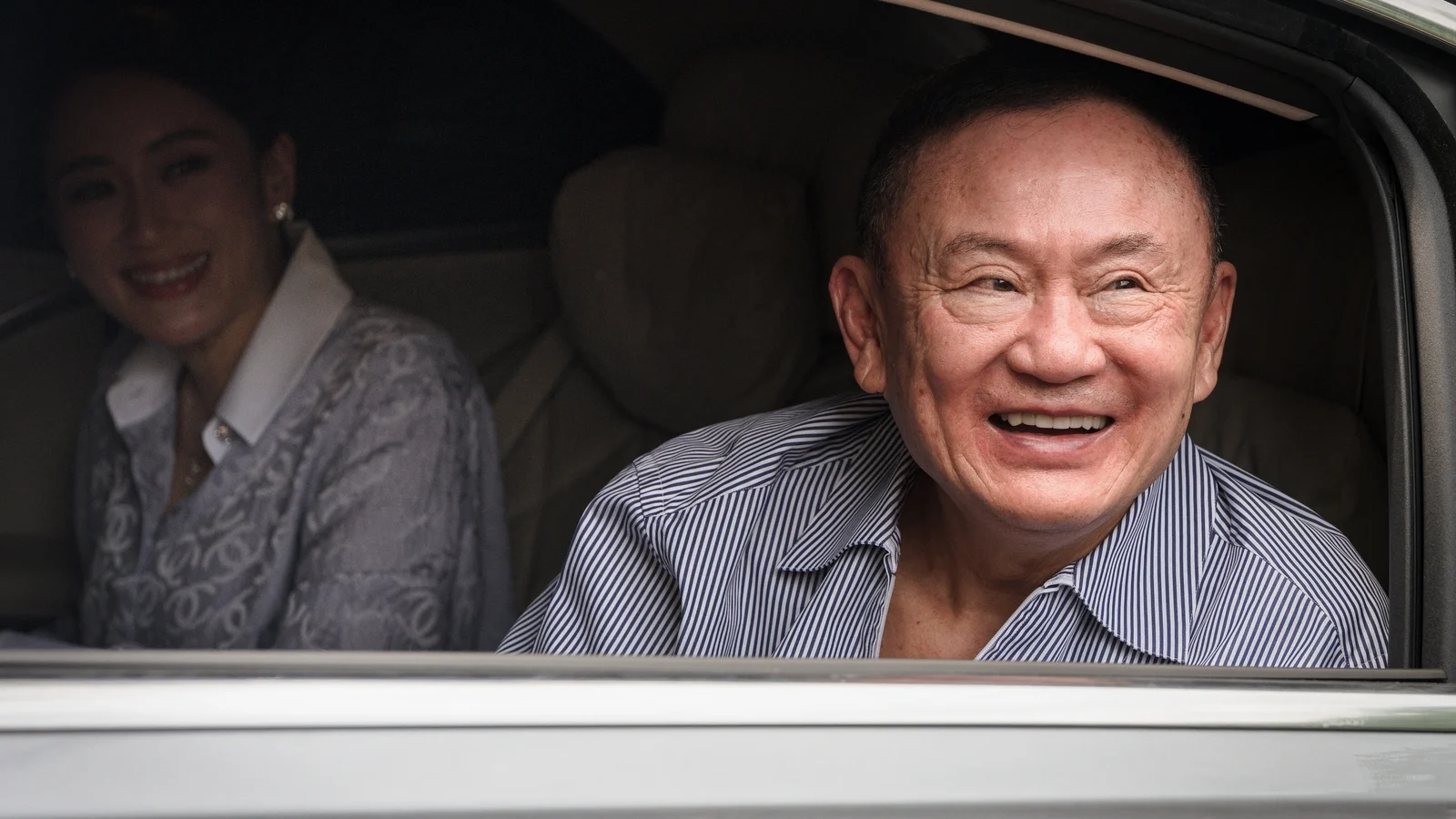
As the sun climbed, the crowds thinned and life in Bangkok reset into its familiar beat: street vendors sweeping, commuter trains groaning, office towers reflecting sunlight. Thaksin got into a car and drove away with family members at his side, an ankle monitor catching the light like a small, persistent star.
What does his release mean for everyday Thais? For the Pheu Thai party? For the long tug-of-war between courts, kings, soldiers and voters? The answers will not come in a day. They will be written in hospital wards and courtrooms, in election booths and in kitchen conversations where parents fret about money and hope.
So I ask you: when a political giant returns, whose story are we really witnessing — the man’s, the party’s, the people’s, or the country’s? And which of those stories will prevail in the years to come?
For now, Bangkok exhales. The man who shaped an era has stepped back into the light, watched by a nation that still cannot agree on what to do with its past. The next chapters will tell whether his presence becomes a balm, a catalyst or another chapter in a book Thailand has been writing for decades.