Washington is warning it can swiftly return to fighting with Iran, even as President Donald Trump insists any peace deal must meet his non-negotiable demands — chief among them, that Tehran never develop a nuclear weapon.
The White House has suggested Mr Trump is nearing a decision on an initial agreement after weeks of uneven, fragile negotiations. Iran, however, has rejected the notion that a final accord is in place to end the Middle East conflict that has shaken the global economy.
US officials have said a deal is essentially awaiting Mr Trump’s approval. Yet the president emerged from a two-hour session in the White House Situation Room in Washington yesterday without making a final call.
From Singapore, where he is attending a major Asia defence summit, Pentagon chief Pete Hegseth underscored the administration’s warning today, saying the United States could restart the war if it chose to.
“Our ability to recommence if necessary is [that] we are more than capable, our stockpiles are more than suited for that, both there and around the globe because of how we balance exquisite and more plentiful munitions,” he said.
His remarks mirrored a message from the US Central Comand (CENTCOM), which wrote on X that American forces “remain present and vigilant across the region”.
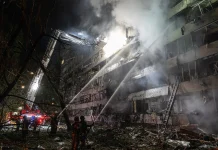
The diplomatic track — mediated by Pakistan — was jolted this week after US strikes hit the southern Iranian port of Bandar Abbas, drawing retaliatory fire from Iran and raising fresh doubts about whether the talks can hold.
Even so, negotiations have continued, including a parallel effort aimed at halting the fighting in Lebanon. Iran has said any formal end to the war must include Lebanon, where Israeli Prime Minister Benjamin Netanyahu announced further advances even as military delegations from both countries met at the Pentagon in Washington.
In a social media post announcing the Situation Room meeting, Mr Trump spelled out what he wants: Iran’s commitment to never pursue nuclear weapons and the reopening of the blockaded Strait of Hormuz, a critical maritime route.
“President Trump will only make a deal that is good for America and satisfies his red lines,” a White House official said after the meeting.
“Iran can never possess a nuclear weapon,” the official added.
Iranian foreign ministry spokesman Esmaeil Baqaei rejected the framing of Mr Trump’s demands, telling state media the Islamic republic “said goodbye to the language of ‘must’ 47 years ago”.
He said messages were still being exchanged, but stressed that “no final agreement has been reached yet”.
In a phone call with the Emir of Qatar, Iranian President Masoud Pezeshkian said Iran was prepared to reach a “dignified framework” to end the war, according to state news agency IRNA.
Mr Trump’s post described a series of steps he said Tehran would take, including removing mines from the Strait of Hormuz and ending the closure of the waterway with “no tolls,” while the United States would lift what he called its parallel blockade of Iranian ports.
He also said the two countries would coordinate to remove and destroy Iran’s enriched uranium, adding that “no money will be exchanged, until further notice”.
Iran’s Fars news agency, however, cited sources who said Tehran was seeking “the immediate release of $12bn in frozen Iranian assets” before proceeding to the next stage of talks.
Those sources also disputed key elements of Mr Trump’s account, saying there was no agreement on a toll-free reopening of Hormuz — “no such clause appears in the text of the agreement,” they said — and calling his assertion about destroying Iran’s nuclear material “is fundamentally baseless”.
Fighting in Lebanon
On Lebanon, the war’s other main front, the battles have not eased.
Mr Netanyahu said yesterday that Israeli forces had pushed beyond a river about 30kms (20 miles) north of the Lebanon-Israel frontier.
Hezbollah, for its part, said it had carried out attacks on northern Israel and targeted Israeli troops attempting to advance near the medieval Beaufort fortress, also known as Qalaat al-Chakif. The site served as an Israeli base during its two-decade occupation of southern Lebanon, which ended in 2000.
A ceasefire between Israel and Hezbollah was meant to begin on 17 April, but it has not held, with each side accusing the other of breaching the truce.
Lebanon entered the conflict in early March after Tehran-backed Hezbollah fired rockets at Israel following the killing of Iran’s supreme leader in US-Israeli attacks, prompting Israeli strikes and a ground invasion.
Israel and Lebanon began direct talks in April, and a fourth round is expected next week in Washington.