A surprise breakthrough at the Palace of Versailles has set in motion an effort to halt the Middle East war, after US President Donald Trump and Iran’s President Masoud Pezeshkian signed a deal under which Tehran will dilute its enriched uranium in exchange for sweeping economic relief.
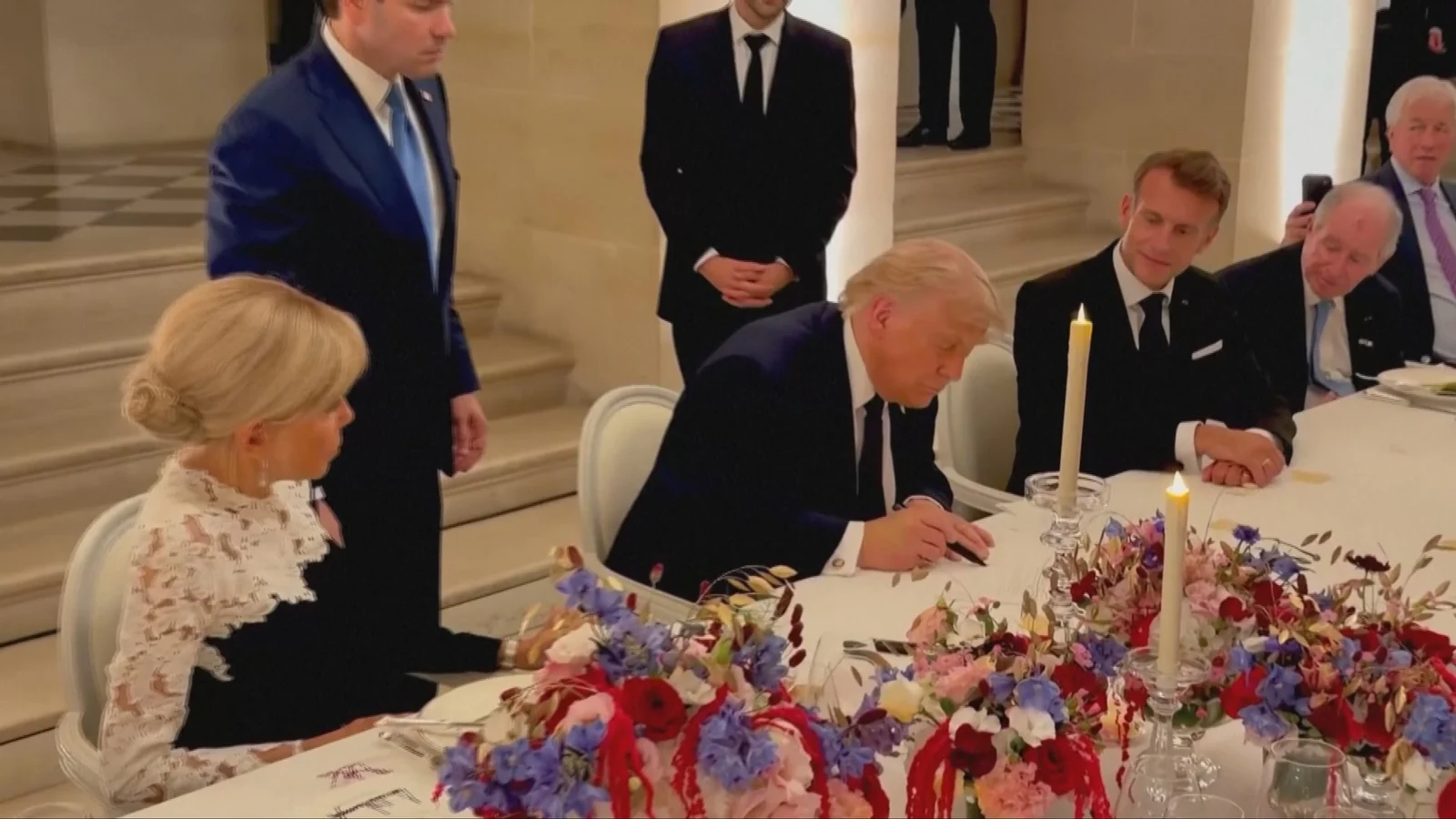
Mr Trump signed the memorandum of understanding during a candlelit dinner at Versailles after a G7 summit, as host French President Emmanuel Macron and other guests applauded, according to a video posted by a Trump aide.
“Just signed it,” Mr Trump told reporters as he emerged from the palace.
Iranian Foreign Ministry spokesman Esmaeil Baqaei, quoted by the state news agency IRNA, said the document “was finalised with the signatures of the presidents”.
Prime Minister Shehbaz Sharif of Pakistan, which mediated the agreement, said on X that it “shall enter into force with immediate effect”.
The agreement is intended to close the chapter on the war launched 28 February by the United States and Israel, which triggered Iranian retaliation in the form of missile and drone salvos across the region and effectively shut down the Strait of Hormuz, a vital artery for the global economy.
Watch: ‘This was not easy’, Trump says while signing Iran MOU at Versailles
The US had responded by blocking shipping to and from Iranian ports.
“As a first step, Islamic Republic of Iran will instantly reopen the Strait of Hormuz and the United States of America will immediately lift the naval blockade,” Mr Sharif wrote.
Under the text, Washington also commits to immediately waive oil sanctions that have crippled Iran’s economy.
And once a final agreement is reached on the Islamic republic’s nuclear programme, the United States will also facilitate the release of a $300 billion reconstruction fund supported by regional nations, the deal says.
The signing had initially been expected to be carried out by Iran’s chief negotiator and parliament speaker, Mohammad Bagher Ghalibaf, and US Vice President JD Vance.
Iran later said an in-person ceremony was no longer necessary.
However, Mr Sharif said an official ceremony will take place tomorrow in Switzerland and that technical talks will commence.
Donald Trump was given a tour of Versailles by the French president
‘Great victory’
Even as the document was inked, Iranian officials framed it as evidence of US weakness rather than compromise.
“People will see it and judge,” Mr Ghalibaf said on state television late yesterday, after the text was released by both sides.
Underscoring the wider stakes, China said its top diplomat had impressed on Tehran that it was “key” for all sides to “genuinely implement” their commitments.
Mr Trump’s move to end the war a conflict in which 13 US service members were killed and vast quantities of US ammunition stockpiles were consumed has rattled some of his own allies at home.
The agreement is described as a temporary arrangement designed to create space for detailed negotiations on the more complicated question of long-term limits on Iran’s nuclear power ambitions, which Washington has long suspected conceal a clandestine bomb-making programme.
More: What is in the 14-point draft of the US-Iran deal?
Mr Trump said earlier that he was prepared to “bomb the hell” out of Iran if they violated the agreement.
Republican Senator Bill Cassidy sharply criticised the deal.
“Iran’s nuclear ambitions were not curbed, and they have learned that threatening the Strait of Hormuz works,” he said. “Sanctions will be lifted, and the bombing has stopped. This is the worst foreign policy blunder in decades.”
The head of the pro-Tehran Lebanese Shia movement Hezbollah, Naim Qassem, called the agreement a “great victory” for Iran.
He thanked Tehran for insisting that the truce cover Lebanon, which was pulled into the conflict when Hezbollah fired rockets at Israel on March 2 in support of Iran.
Negotiations to begin
A two-month negotiating window now opens, with the long-awaited reopening of the Strait of Hormuz set as the immediate first step.
Under the terms of the deal released by US officials, Iran will dilute its enriched uranium stockpiles, potentially through “down-blending on site under the supervision of the IAEA” the UN nuclear watchdog.
Such a move would unlock more extensive economic support for Iran.
However, a US official said Washington would not be required to contribute financially.
Oil prices have fallen in recent days on hopes of a durable Middle East peace arrangement, but reversed yesterday.
Prices briefly jumped 5% as uncertainty spread about the signing, before stabilising later in the day.
Lebanese front
Israeli Merkava tanks driving along a road past destroyed buildings in southern Lebanon
Although violence in Lebanon eased after the deal was announced, Israeli strikes on the south have killed at least five people since then, according to state media, which also reported Israeli raids in south Lebanon.
Israel’s army said five soldiers were wounded yesterday, one of them severely, “as a result of an explosive drone impact in southern Lebanon”, marking the first such announcement since the US-Iran deal.
The Israeli military also said its air force intercepted “several rockets” launched toward soldiers operating in south Lebanon, without reporting casualties.