A slope shaped like a heart: an alpine town holds its breath
The morning sun laid a sugar-icing of fresh snow over the Crans-Montana plateau, and for a few trembling hours the usual chatter of skiers and the hum of chairlifts were replaced by silence—an almost reverent hush that felt like a physical thing.
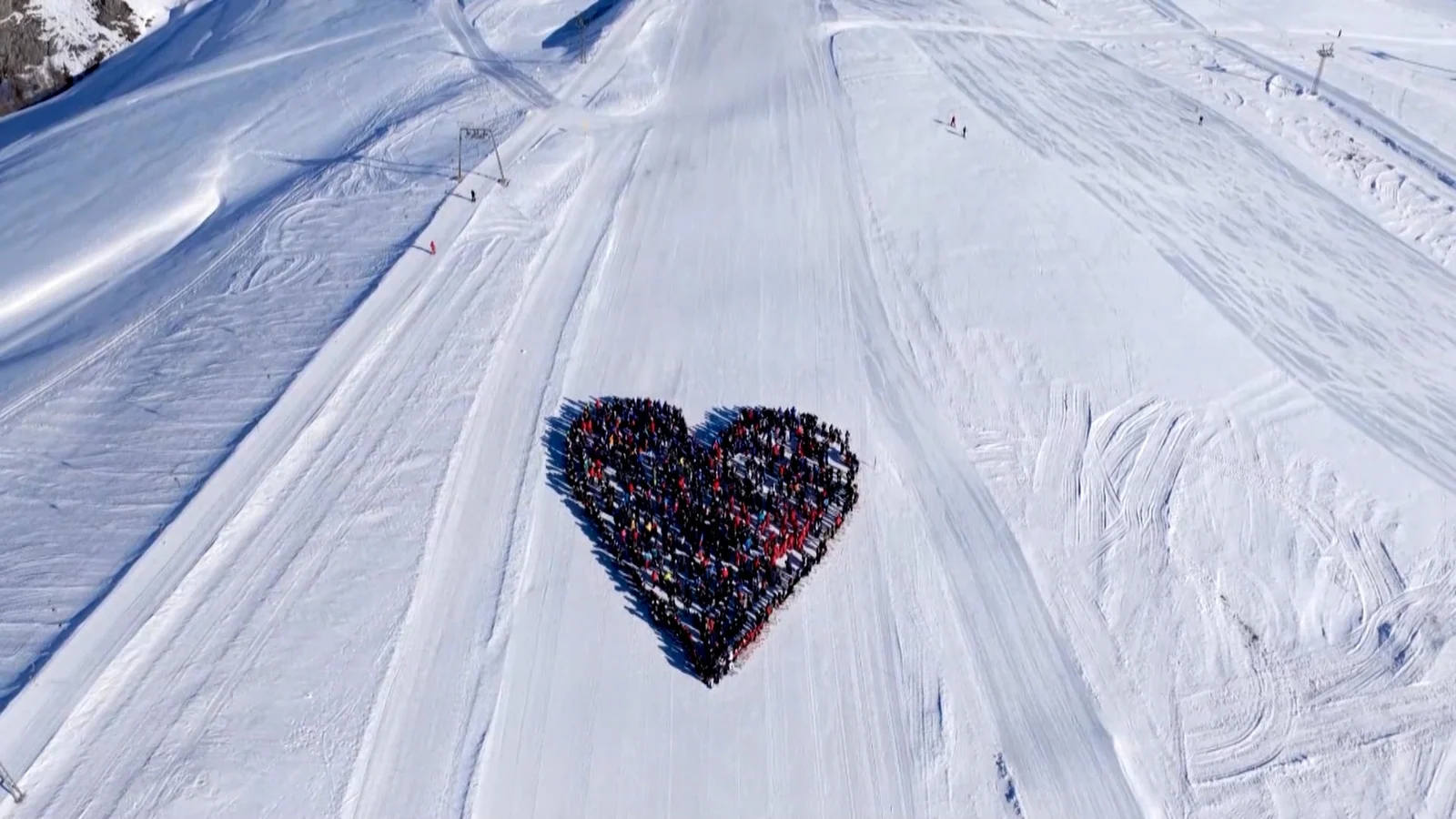
Below the ridgeline, on a broad, gentle run that normally hosts children in bright snowsuits and confident holiday skiers, a group moved with careful choreography. They were not carving new tracks or racing for a view; they were forming a symbol. From above, their skis and poles traced a bright, painstaking heart against the white. It was a human mosaic: friends, seasonaires, instructors, visitors—each one a small gesture of solidarity for the 40 people whose lives ended in a blaze that ripped through the Le Constellation bar in the small hours of New Year’s Eve.
“We wanted something that shows we are together,” said Marie Dupont, a local ski instructor who helped organize the formation. “There are names behind those numbers. We wanted those names to feel loved.”
Inside the night: how a celebration turned tragic
People come to Crans-Montana for powder and peaks, for the hush of pine forests and nights that shimmer with Alpine lights. On the last night of the year, Le Constellation—like many mountain bars—was full of holiday energy: champagne bottles, music, laughter, the loosened restraint that comes with a collective countdown to a new year.
Authorities say investigators have pointed to a likely ignition source: sparklers attached to or affixed to champagne bottles, raised close to a low ceiling, where embers caught a combustible surface. It is a small, terrible sequence of events that has been the undoing of 40 lives and left 119 others injured—many severely.
“We had no idea it could happen so fast,” a survivor, who asked not to be named, told me. “The ceiling was low. It was packed. One moment people were singing, the next it was smoke and shouting. I ran, but I saw friends who didn’t make it.”
Swiss emergency services say the earliest reporting showed rapid fire spread inside the bar’s enclosed space. Local firefighters and mountain rescue teams were on scene within minutes, and patients were rushed to hospitals across the canton. Officials later confirmed all 40 victims were identified on Sunday, a grim milestone for families waiting for news.
What investigators are saying
Investigators have been methodical, combing through CCTV, eyewitness accounts, and the remains of the venue. “Initial findings suggest that indoor pyrotechnics—sparkler-style devices used on bottles—played a central role,” a spokesperson for the Valais cantonal police told reporters. “We are treating this as a major incident and examining every aspect, including product source and how it was used.”
Many countries and venues have strict rules about indoor pyrotechnics; many consumer sparklers are intended for outdoor use and can pose significant fire risks in confined spaces. Fire-safety experts stress that even a small ember near flammable materials can become catastrophic when a crowded room leaves people little room to escape.
“This is a heartbreaking reminder that celebrations need safety built into them,” said Dr. Anya Fischer, a fire-safety specialist who studies mass gathering incidents. “A seemingly festive device becomes deadly in the wrong context: low ceiling, packed room, limited exits. Regulations exist for a reason.”
The human cost and a community’s response
Numbers tell part of the story: 40 dead, 119 injured. But behind each statistic is a life—teenagers planning university, workers who saved for seasons in the Alps, a band of friends who had met on holiday years earlier. Many of those who died were young, which has made the grief in Crans-Montana and beyond feel almost unbearable.
“There are families who came for one night and will never return,” said Mayor Lucien Favre in a brief statement. “Our thoughts are with the victims and with those providing care and support. We stand together in this difficult time.”
Local volunteers have organized donation drives, counseling centers, and vigils. The Crans-Montana tourism office released a video of the heart formation on its social channels with a short message: “In deep solidarity, Crans-Montana and the entire ski community mourn together.” That clip—simple, quiet, human—has been watched and shared well beyond the canton, a reminder that some moments break past municipal borders.
“We had guests who pulled over on the pass to lay flowers,” said Jean-Claude, a hotel concierge who has worked in the resort for twenty years. “It’s not just the town. It’s visitors, alpinists, the whole winter community.”
Questions for tomorrow: safety, tourism, and how we commemorate
After the initial shock, difficult conversations begin. How do small tourist towns protect the celebratory moments that are part of their economy and culture? What regulation and training should be required for venues that host large crowds? And how do communities rebuild the trust that is shaken when a place of joy becomes a site of loss?
There are policy questions and moral ones. Many jurisdictions have tightened rules on indoor pyrotechnics after tragic incidents elsewhere; some venues now require professional display companies, flame-retardant materials, and certified safety officers on the premises. Yet enforcement can be uneven, especially during peak holiday nights when venues operate at capacity and oversight is stretched thin.
“We will need a national review of how these devices are sold and used,” said Senator Mireille Basset, who has called for parliamentary hearings after the tragedy. “This should not be about assigning blame—it must be about preventing another family from waking to such grief.”
How the world watches
Crans-Montana is a small place with global connections: holidaymakers from across Europe and beyond, luxury chalets, world-class slopes. The images of a heart-shaped formation, of candles and skis arranged like a vigil, will travel. They will be engraved alongside stories of policy and mourning in the public imagination.
And they will prompt other communities—coastal towns lit with fireworks, urban clubs, festival organizers—to ask themselves: what precautions do we take when we turn up the music and the lights and invite strangers to share the night?
Remembering, and moving forward
There are flowers at the base of the slope and names whispered in alpine cafés. There are practical needs—medical care, counseling, housing for those who cannot face hotel lobbies where they once danced. There are also rituals, small and large, that begin to stitch a community back together: a choir on the town square, shared meals, a memorial plaque that will someday sit on a bench where skiers rest and look at the mountains.
When I left Crans-Montana, a group of teenagers were writing names in the snow with their skis. They moved slowly, reverent strokes, and then they photographed it, perhaps to remember or to carry the memory elsewhere. “We will not forget,” one of them said simply. “We owe them that.”
How do you honor people lost in a flash of smoke and light? Perhaps by asking again and again whether our celebrations are worth the risks we take—and by making sure the answer is safety first, joy second. For a town on the edge of the world’s winter playgrounds, the work of remembrance and reform begins now.